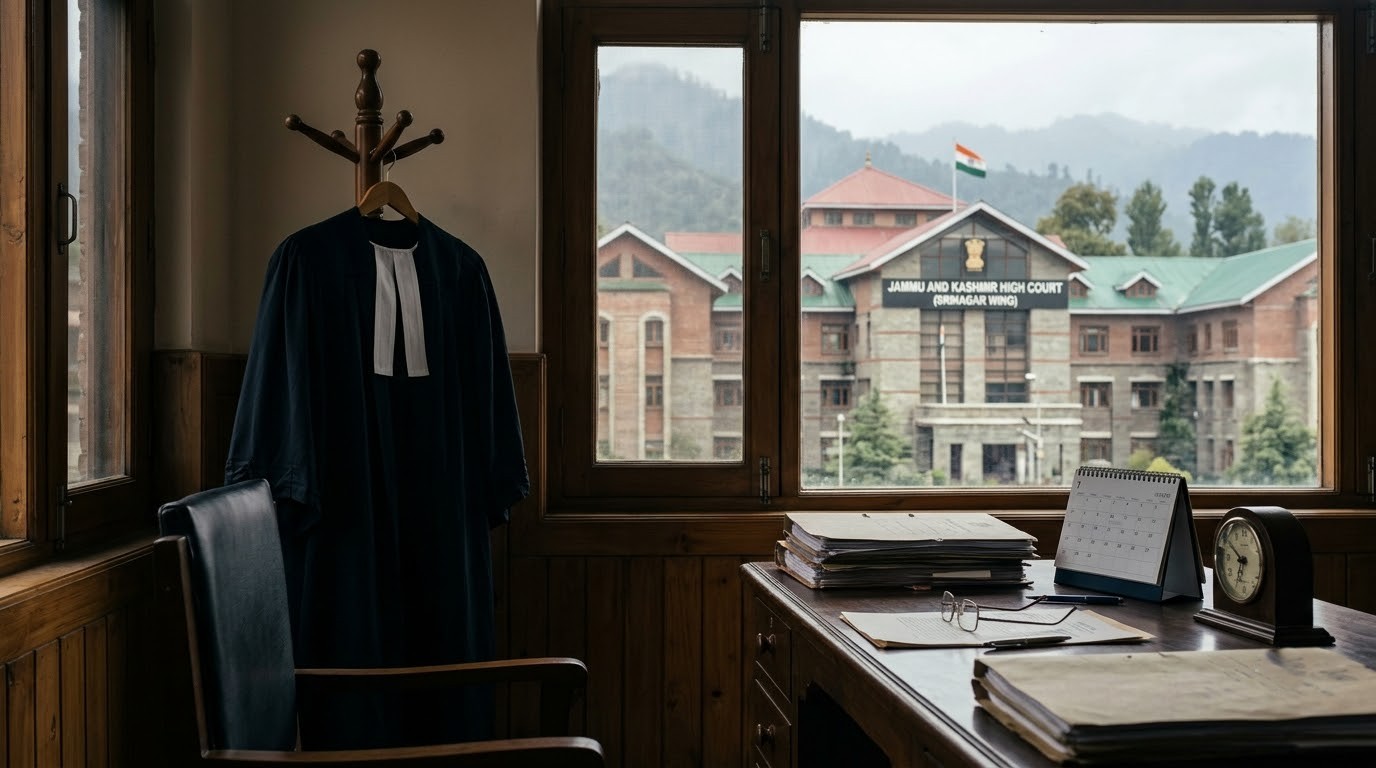
Advocates' Strike Not An Exceptional Ground To Extend 120-Day Deadline For Filing Written Statement: J&K&L High Court
The High Court of Jammu and Kashmir and Ladakh has categorically held that the suspension of work or a strike by advocates does not constitute a valid ground for extending the statutory time limit for filing a written statement. A Single Bench comprising Justice Sanjay Dhar emphasized that such professional abstention from work cannot be classified as an exceptionally hard circumstance that would render it impossible for a litigant to submit their defense within the prescribed timeframe. The ruling came during the adjudication of a petition assailing a trial court order that had refused to condone a delay beyond the statutory limit.
Does an advocates' strike excuse delay under Order VIII Rule 1 CPC?
No, an advocates' strike does not excuse a delay beyond the statutory period. The High Court clarified that work suspension by lawyers fails to qualify as an exceptionally hard circumstance, and courts can only extend the 120-day limit sparingly and cautiously in rare situations where filing is completely impossible.
The legal controversy arose from a civil suit for a permanent prohibitory injunction filed by the respondent, Dali Rani, before the Court of Munsiff at Udhampur. Petitioner number one received summons on August 29, 2019, and her counsel filed a vakalatnama the very next day. However, the formal written statement was placed on the judicial record only on January 20, 2020. This submission breached the outer limit of 120 days mandated by the proviso to Order VIII Rule 1 of the Code of Civil Procedure, as applicable within the Union Territory of Jammu and Kashmir.
To justify the delay, the defendants moved an application before the trial court seeking an extension of time. They contended that the first petitioner was an elderly woman of approximately 70 years who underwent cataract surgery in November 2019. Furthermore, they argued that following the demise of a close relative, she was compelled to travel to New Delhi, where she remained for around fifteen days, rendering her practically bedridden. Alongside these medical and personal grounds, the petitioners also pleaded that advocates had abstained from judicial work for nearly one and a half months, which severely hampered their ability to file the written statement on time. Medical records accompanied the application to substantiate the physical ailments.
The Munsiff at Udhampur, however, rejected the plea, concluding that the grounds advanced by the defendants failed to disclose any exceptional hardship that warranted an extension beyond the statutory cap. Aggrieved by the trial court's refusal, the defendants approached the High Court through a petition, asserting that the provisions governing the timeline were merely directory and that sufficient cause had been established.
Parameter | Trial Court Assessment | High Court Ruling |
|---|---|---|
Applicable Provision | Order VIII Rule 1 CPC | Order VIII Rule 1 CPC |
Statutory Deadline | 120 Days | 120 Days (Strict Adherence) |
Advocates' Strike | Insufficient Ground | Not an Exceptionally Hard Circumstance |
Operative Outcome | Application Rejected | Petition Dismissed |
While evaluating the rival submissions, the High Court examined the binding precedent laid down by a Division Bench in the case of Anoop Dutta versus Union Territory of Jammu and Kashmir. The Division Bench had previously upheld the constitutional validity of the amended provisions of Order V and Order VIII of the Code of Civil Procedure as applicable to the region. It had explicitly ruled that the statutory period of 120 days must be strictly observed under normal circumstances, and any violation results in the forfeiture of the defendant's right to file a written statement.
The High Court reiterated that the Division Bench had carved out a very narrow exception confined solely to exceptionally hard cases where the defendant suffers from an absolute incapacity to file the pleading due to factors entirely beyond personal control. The bench underscored that discretionary extensions must be exercised sparingly and cautiously after recording cogent reasons and imposing costs. In the present case, the court observed that the cumulative effect of the medical grounds, travel, and the advocates' strike did not meet this stringent threshold. Consequently, the High Court upheld the order of the Munsiff at Udhampur and dismissed the petition filed by the defendants for lack of merit.