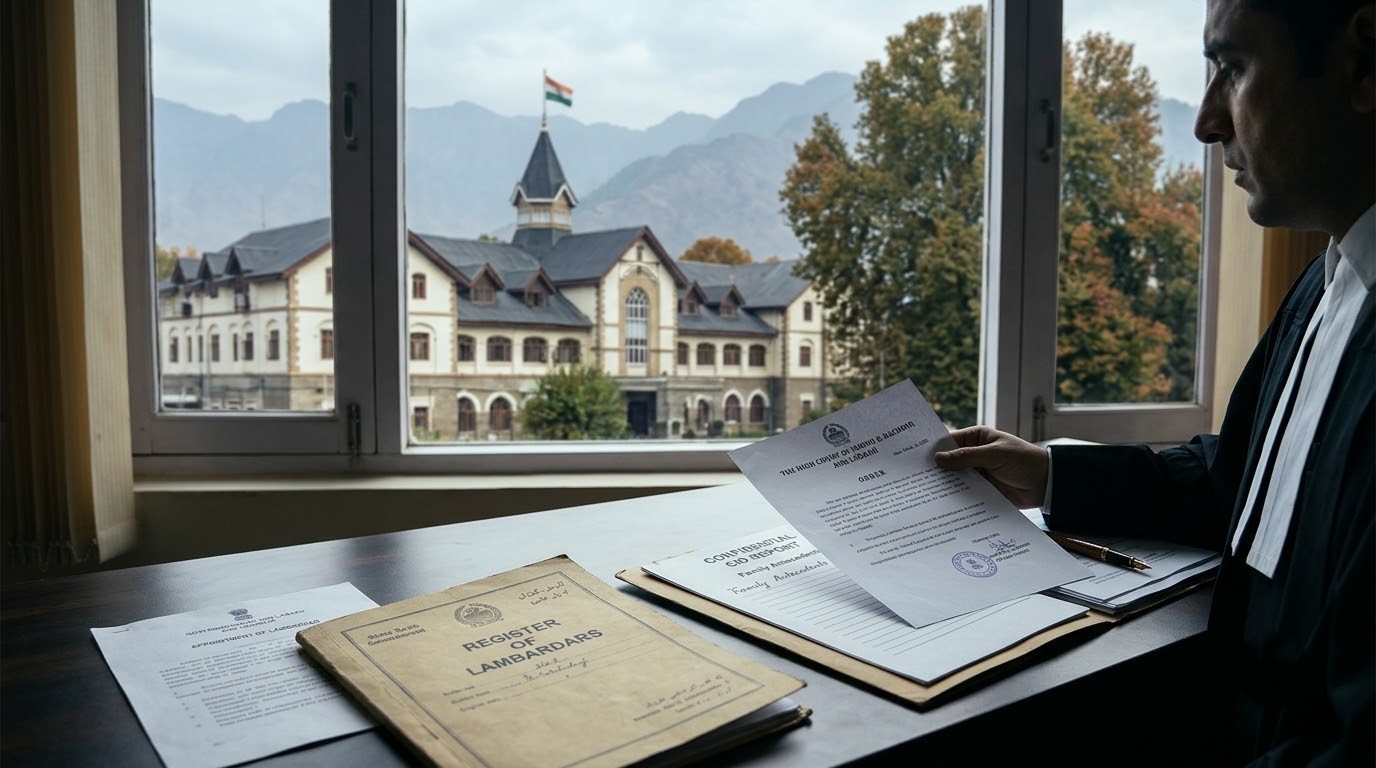
Can a candidate be disqualified from public appointment based on the criminal or militant background of extended family members?
The Jammu and Kashmir and Ladakh High Court has ruled that a candidate cannot be denied consideration for the post of Lambardar merely due to the alleged militant or anti-national antecedents of their relatives, provided no unlawful conduct is directly imputed to the individual applicant.
The High Court delivered this ruling while adjudicating a writ petition filed by Zahoor Ahmad Bhat, who challenged the appointment of a rival candidate as the temporary Lambardar of Village Sangam in Srinagar. The previous incumbent had resigned, leaving the office vacant, which led the local administration to evaluate potential candidates for the position under the governing statutory framework.
During the selection process, the candidature of the petitioner was sidelined following an adverse intelligence verification report submitted by the Criminal Investigation Department. The intelligence agency flagged that the applicant's maternal uncles possessed past connections to militancy dating back to the early nineteen-nineties and faced criminal proceedings under statutory arms legislation. Based solely on these familial ties, the security report asserted that the petitioner belonged to a household associated with secessionist elements.
Aspect | Intelligence Report Claims | Court Holding |
|---|---|---|
Basis of Disqualification | Maternal uncles linked to past militancy and arms cases. | None; individual applicant must be assessed on personal conduct. |
Attribution of Wrongdoing | Linked to family background without personal illegal acts. | No illegal activity was ever attributed to the petitioner. |
Validity of Rejection | Used to justify exclusion from selection. | Invalid and legally impermissible for rejecting candidature. |
Justice Rajnesh Oswal, presiding as a Single Bench, examined the pleadings and the official records presented by the contesting parties. The bench noted that the intelligence verification documents failed to point toward any personal wrongdoing, illegal action, or active involvement in subversive activities by the petitioner. The court emphasized that penalizing or disqualifying a citizen on account of the background of extended relatives violates fundamental fairness and cannot lawfully serve as the ground for rejecting a candidature.
The bench concluded that the reliance placed by the authorities on the adverse intelligence dossier was legally unsustainable. Consequently, the High Court allowed the writ petition, setting aside the administrative order that had appointed the respondent as the temporary Lambardar of Village Sangam. Furthermore, the court directed the official respondents to conduct a regular election process for the position within a period of three months. The bench explicitly clarified that the disputed intelligence report must not obstruct or prevent the petitioner from participating freely in the upcoming election proceedings.