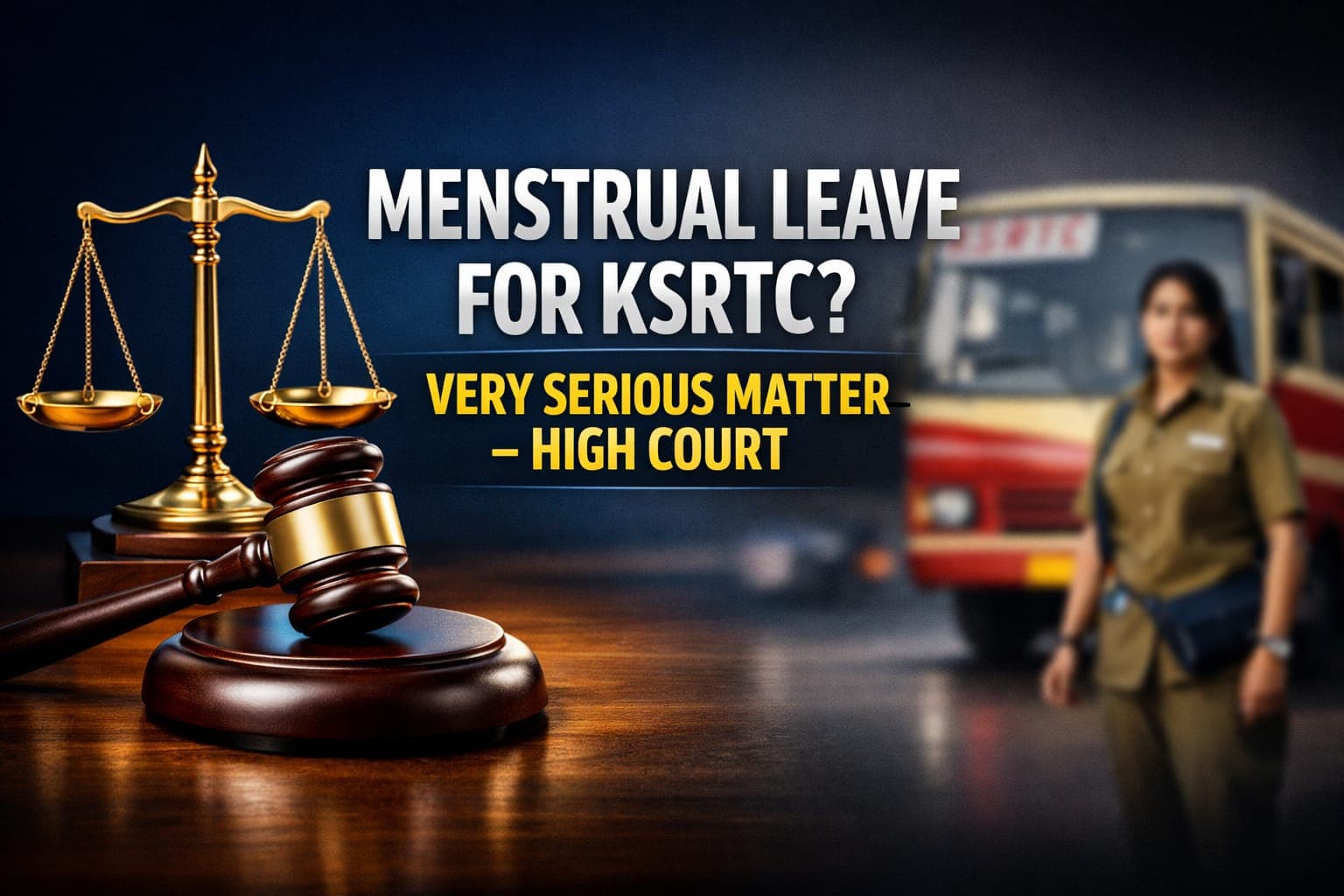
In a significant move towards recognizing the unique health challenges faced by women in the transport sector, the Kerala High Court has termed the demand for paid menstrual leave for Kerala State Road Transport Corporation (KSRTC) conductors as a "very serious matter."
Justice N. Nagaresh, presiding over the case, has directed the State Government to clarify its stance on whether a dedicated policy can be implemented for these women workers, who often endure grueling work schedules under difficult physical conditions.
The matter reached the High Court through a petition filed by Asha S.S. and several other women conductors working for the KSRTC. The petitioners highlighted the extreme physical and mental strain associated with their job. Unlike desk-bound roles, conductors are required to be on their feet for extended hours, navigating through moving buses, managing crowds, and handling cash—all while dealing with the biological realities of menstruation.
The petitioners moved the court seeking a direction to the State Government and KSRTC to consider their representation for at least two days of paid menstrual leave every month.
During the hearing, the counsel representing the women conductors, Adv. Anil Kumar M. Sivaraman, painted a stark picture of the working conditions in the state-run transport body. He pointed out that KSRTC currently follows a "double duty" system.
Under this system, conductors are often required to work between 14 to 16 hours in a single day. For a woman experiencing menstrual cramps, back pain, or other symptoms associated with her period, standing and moving in a bumpy bus for nearly 16 hours is not just difficult—it is a health hazard.
"The nature of the job is physically demanding. Expecting women to perform these duties without any reprieve during their menstrual cycle is a violation of their basic right to health and dignity," the counsel argued.
On the other hand, the KSRTC took a rigid stand. The Standing Counsel for the Corporation argued that they cannot unilaterally introduce a menstrual leave policy. The corporation pointed out that the Kerala Service Rules (KSR), which govern the employment conditions of state employees, currently do not contain any provision for menstrual leave.
The KSRTC’s counter-affidavit suggested that since this is a matter of "policy," the decision rests entirely with the State Government. Essentially, the corporation argued that until the government changes the law or the service rules, their hands are tied.
Justice Nagaresh was not quick to dismiss the petitioners' plea based on technicalities. Recognizing the gravity of the situation, the judge turned to the Government Pleader and remarked, "Can you consider? Very serious matter."
The court noted that while the Service Rules might be silent, the welfare of employees and the specific physiological needs of women cannot be ignored in a modern workspace. The judge further noted the petitioners' submission that similar progressive policies have already been implemented in other Indian states like Bihar, Odisha, and Karnataka.
The demand for menstrual leave is gaining momentum across India. While Bihar has had a two-day monthly menstrual leave policy since 1992, other states and private organizations have recently started following suit.
- Bihar: First to implement (2 days per month).
- Odisha: Recently announced one day of paid leave.
- Karnataka: Discussions are ongoing for similar implementation in various sectors.
- Educational Institutions: Recently, the Cochin University of Science and Technology (CUSAT) and other universities in Kerala also introduced menstrual leave for students, setting a precedent within the state.
The Kerala High Court has directed the Government Pleader to get specific instructions from the State Government regarding the feasibility of this policy. The Court wants to know if the government is willing to consider the representation made by these women workers as a special case, given the intensity of their labor.
The case has been posted for further hearing in two weeks.
This case is more than just a dispute over a few days of leave; it is about the "Right to Dignity" at the workplace. For years, women in the blue-collar workforce, such as conductors and police officers, have had to "tough it out" because workplace rules were originally designed for men.
If the Kerala High Court eventually rules in favor of the petitioners, it could open the doors for millions of other women in physically demanding jobs across India to demand similar rights. It would mark a shift from treating menstruation as a "taboo" to recognizing it as a legitimate health condition that requires workplace accommodation.
As the state of Kerala often prides itself on being a leader in social and literacy indicators, all eyes are now on the government's response. Will the "Kerala Model" evolve to include the reproductive rights and health of its woman workforce? The answer will likely come in the next fortnight.
Case Details:
- Case No: WP(C) 44089/2025
- Case Title: Asha S.S. and Ors. v. State of Kerala and Ors.
- Bench: Justice N. Nagaresh
- Advocates for Petitioners: Adv. Anil Kumar M. Sivaraman, Lakshmisree P.S.
- Advocate for Respondents: Adv. Deepu Thankan (KSRTC)