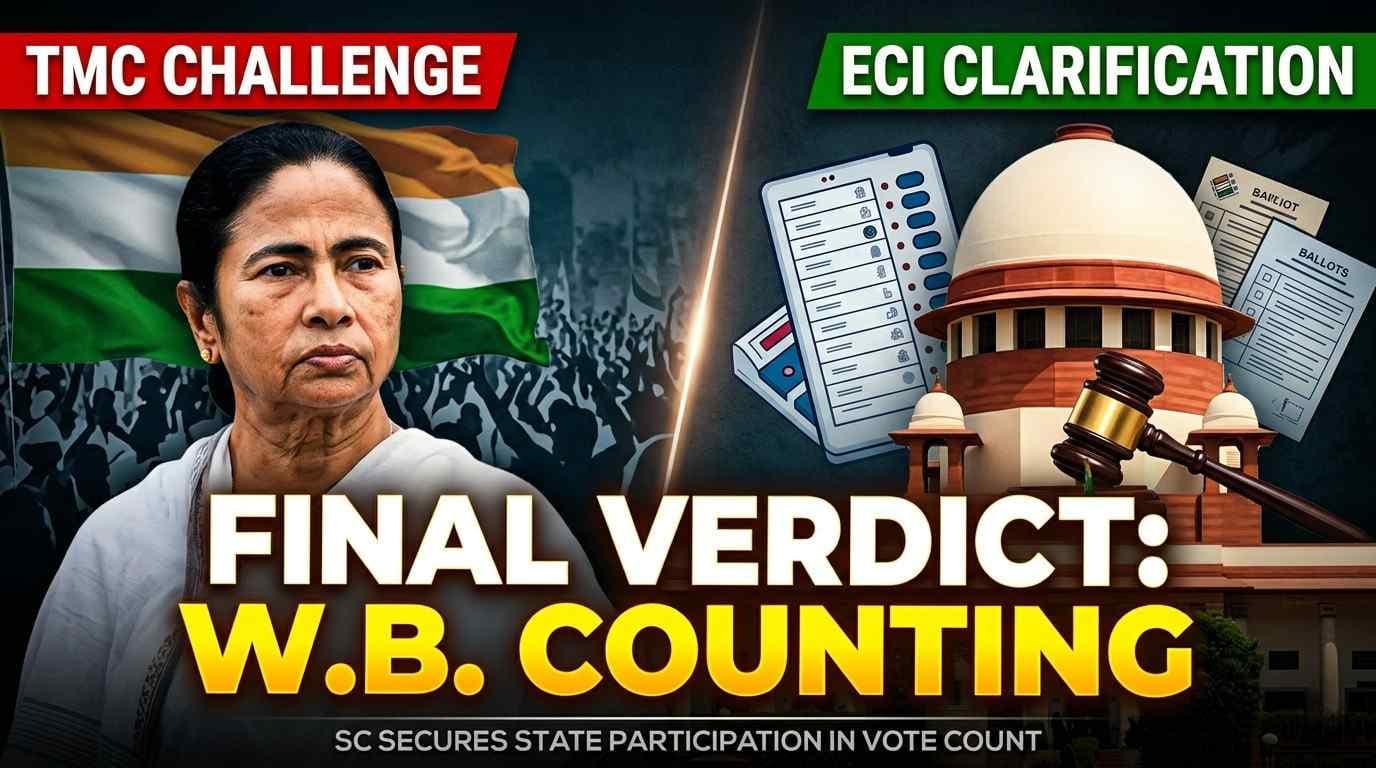
In a decisive move to ensure transparency during the final stages of the West Bengal Assembly elections, the Election Commission of India (ECI) has clarified before the Supreme Court that State Government nominees will be integrated into the vote-counting process. This statement came during a special hearing on a petition filed by the Trinamool Congress (TMC), which had expressed concerns over the potential exclusion of state personnel. The clarification essentially provides a balanced resolution to the brewing conflict between the state administration and the central electoral body.
The legal challenge reached the apex court after the TMC voiced strong opposition to a directive that appeared to prioritize Central Government and PSU employees for the roles of counting supervisors and assistants. The party argued that such a move, coming just days before the results, created a perception of bias and disrupted the "level playing field." However, the ECI’s assurance that the state’s administrative machinery will not be entirely bypassed has significantly lowered the legal temperature surrounding the issue.
During the proceedings, the Supreme Court bench, led by Justice PS Narasimha and Justice Joymalya Bagchi, emphasized the importance of institutional trust. The bench noted that government employees, whether from the state or the center, are expected to function as neutral agents of the Election Commission once they are drafted for poll duty. By recording the ECI’s commitment to include state nominees, the Court ensured that the administrative framework for the counting day remains inclusive and follows established constitutional norms.
The ECI explained that its decision-making process was guided by the need to maintain absolute objectivity in a high-stakes electoral environment. While the Commission often utilizes central staff for specialized roles like micro-observation, it maintained that this does not equate to a total lack of confidence in the state bureaucracy. The presence of state nominees at the counting tables is intended to serve as a bridge, ensuring that the process is observed by officials from both tiers of government.
The Supreme Court’s intervention also highlighted the various existing layers of oversight that govern the counting of ballots. Beyond the officials themselves, every counting table is monitored by agents from all contesting political parties and is under constant CCTV surveillance. The Court pointed out that these multi-layered safeguards are designed to prevent any single individual from influencing the outcome, thereby safeguarding the sanctity of the democratic mandate.
This clarification is expected to streamline the logistics for the upcoming counting day on May 4. For the legal and political observers in West Bengal, the Supreme Court’s role in this matter reinforces the judiciary’s function as a stabilizing force. By avoiding a total stay on the ECI’s arrangements while securing a commitment for state participation, the Court has allowed the administrative process to proceed without further delay or uncertainty.
The ruling also addresses the broader federal concerns raised by the TMC. The inclusion of state nominees acknowledges the role of the state executive in the electoral process, even when under the temporary supervision of the Election Commission. This collaborative approach is vital for the smooth functioning of democracy, especially in regions where political competition is intense and the administrative stakes are exceptionally high.
As the state moves toward the final declaration of results, the focus remains on the seamless execution of the ECI's counting plan. The Supreme Court has effectively signaled that while the ECI has the discretion to manage personnel, that discretion must be exercised in a way that promotes public confidence. With the legal hurdles now largely cleared, the emphasis returns to the transparency of the count and the eventual transition to the newly elected government.