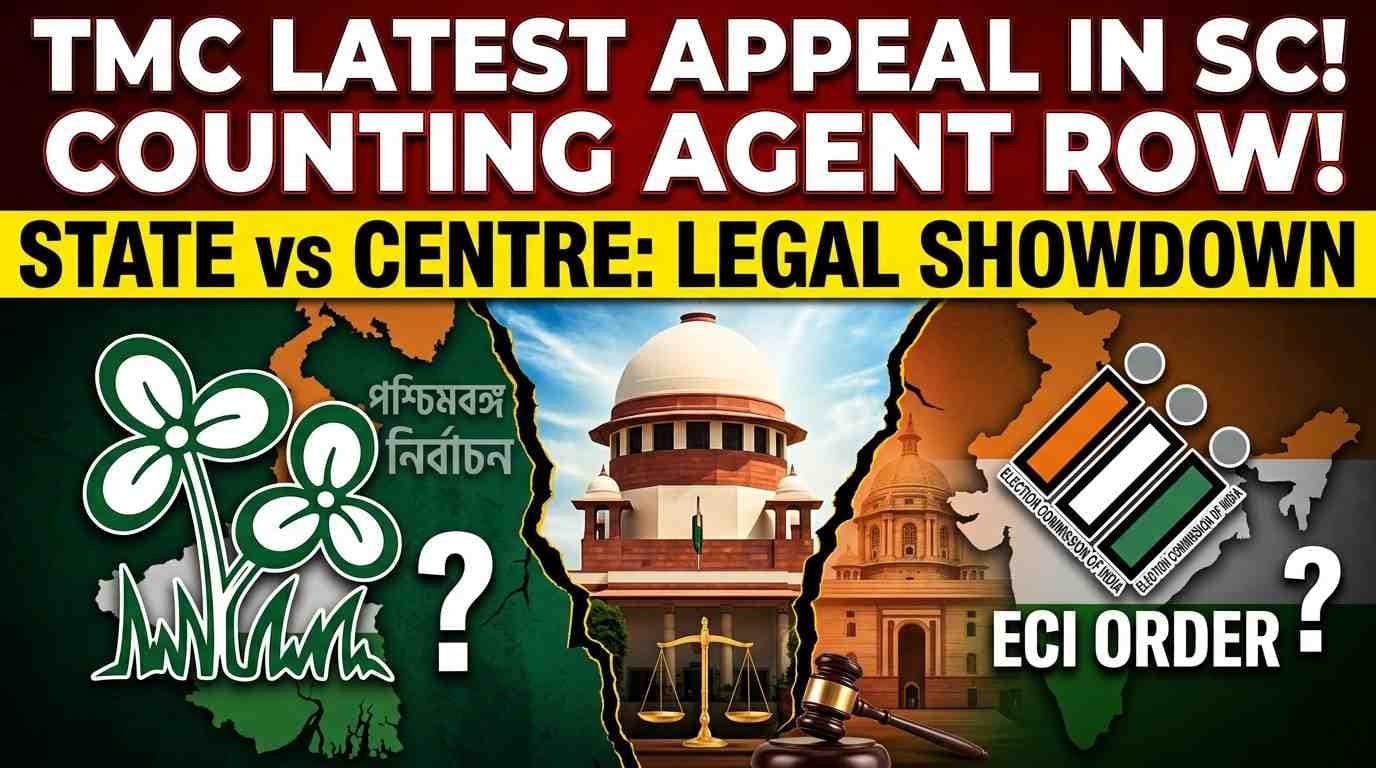
The political and legal landscape of West Bengal has reached a fever pitch as the All India Trinamool Congress (AITC) approached the Supreme Court of India in a last-minute legal battle. The party challenged a decision by the Election Commission of India (ECI) to appoint only Central Government and Central Public Sector Undertaking (PSU) employees as counting supervisors and assistants for the 2026 Assembly elections. This move by the TMC follows a setback at the Calcutta High Court, which recently dismissed their plea, maintaining that the ECI has the prerogative to decide the deployment of personnel.
At the heart of the TMC’s grievance is the exclusion of State Government employees from critical roles in the counting process. The party argued that the directive issued by the Additional Chief Electoral Officer of West Bengal deviates significantly from the ECI’s own handbook. According to the petition, while "micro-observers" are traditionally drawn from central services to ensure neutrality, extending this requirement to all counting supervisors and assistants is a move unique to West Bengal and lacks a clear legal mandate.
The Trinamool Congress has raised serious apprehensions regarding the neutrality and fairness of the counting process scheduled for May 4. The party contended that since Central Government employees are under the administrative control of the Union Government—which is led by a rival political party—there is a high susceptibility to influence. By excluding state personnel, the TMC alleges that the "level playing field" essential for a democratic election is being compromised, creating a bias that could impact the transparency of the final tally.
In the previous round of litigation, the Calcutta High Court rejected these claims, stating that mere apprehension of bias is not enough to warrant judicial interference. The High Court observed that the ECI’s handbook allows for the appointment of staff from either central or state services at the discretion of the authorities. It also pointed to existing safeguards, such as CCTV surveillance and the presence of counting agents from all political parties, as sufficient measures to ensure the integrity of the vote count.
However, the TMC’s appeal to the Supreme Court emphasizes that the scale of this exclusion is unprecedented. The party argues that the Additional CEO of West Bengal lacked the jurisdiction to pass such a significant order, as such powers should ideally be exercised by the full bench of the Election Commission. This jurisdictional argument forms a core part of their plea, suggesting that the administrative machinery exceeded its brief in a manner that specifically targets the West Bengal electoral process.
The Supreme Court, recognizing the urgency of the matter given the proximity of the counting date, scheduled a special hearing. The bench, led by Justice Surya Kant, is expected to examine whether the ECI’s decision violates the principles of federalism and equal participation. This case is not just about personnel management; it touches upon the deeper constitutional question of how independent bodies like the ECI should balance state and central resources during high-stakes regional elections.
Observers note that this legal move is symbolic of the deep-seated mistrust between the state administration and central agencies in West Bengal. For the TMC, the reliance on central staff is seen as an affront to the state’s bureaucracy, while for the ECI, it is often framed as a measure to ensure an objective environment free from local political pressure. The Supreme Court's intervention will be crucial in defining the boundaries of the ECI's discretionary powers under Article 324 of the Constitution.
As the nation awaits the results of the West Bengal polls, the outcome of this legal challenge will set a vital precedent for future elections. Whether the Supreme Court directs the inclusion of state employees or upholds the ECI's current arrangement, the ruling will profoundly impact the public's perception of the fairness of the 2026 mandate. In a democracy, the process of counting votes must not only be fair but must also be seen to be fair by all stakeholders involved.