Historical Context Of The Conflict
The root of the current tension lies in the classification of specific land tracts known as Professional Grazing Reserves (PGR) and Village Grazing Reserves (VGR). Historically, these lands were set aside during British colonial rule to provide fodder for livestock and sustain the livelihoods of local villagers. In Karbi Anglong, these reserves total over 7,000 acres.
Over several decades, these grazing lands have seen significant settlement by non-tribal communities, including Hindi-speaking settlers from Bihar and Uttar Pradesh, as well as Bengali and Nepali speakers. Indigenous Karbi organizations view these settlements as illegal encroachments on lands that should be preserved for the tribal community. The situation intensified in February 2024 when a group representing the Bihari Nonia community petitioned the President of India for the legalization of their settlements, sparking widespread fears among the Karbi people of being marginalized in their own homeland.
Recent Updates And The December 2025 Unrest
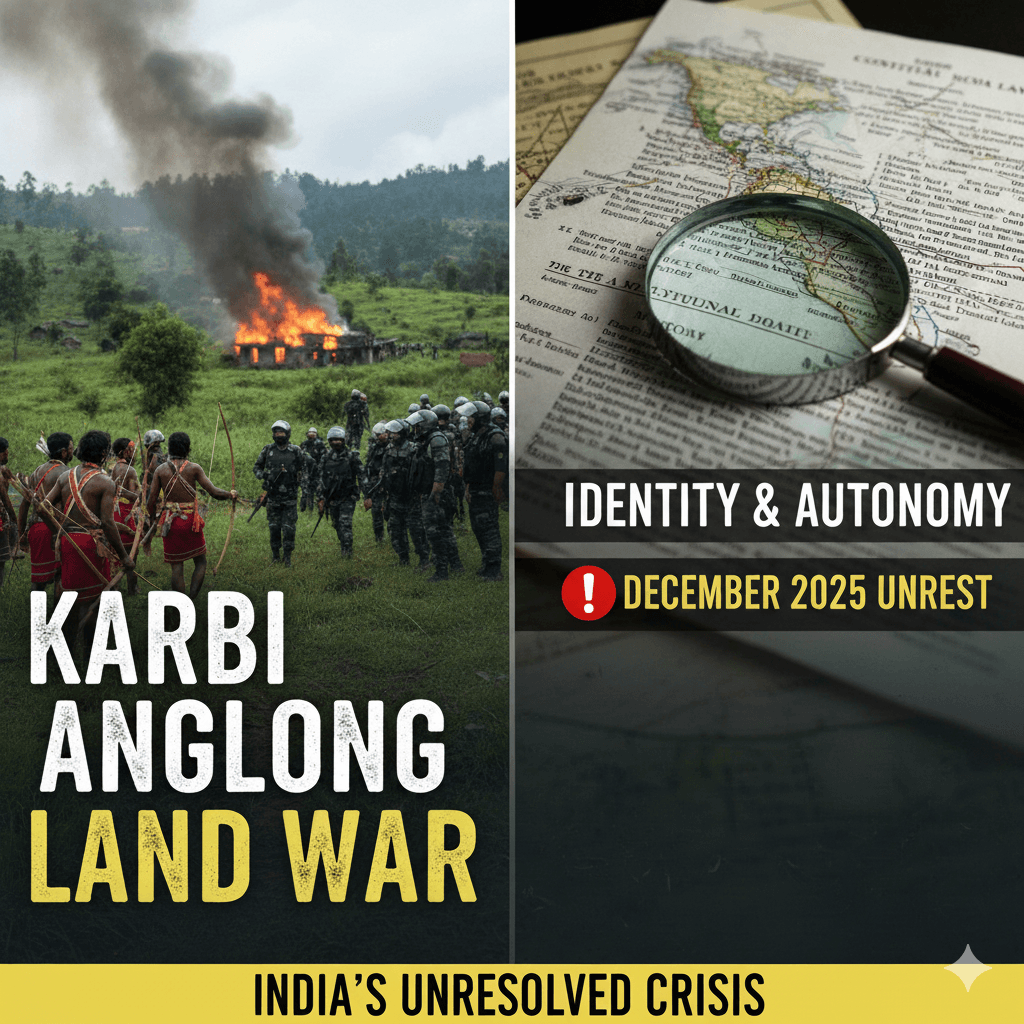
The latest wave of violence was triggered by a fifteen-day hunger strike initiated by Karbi student and civil society groups in the Kheroni area. The protesters demanded the immediate eviction of settlers from the PGR and VGR lands. On December 22, the local administration moved the hunger strikers from the protest site to a hospital in Guwahati due to their failing health. However, rumors quickly spread that the activists had been arrested.
This misinformation led to a massive outbreak of violence on December 23. Mobs attacked security forces with bows, arrows, and stones, and set fire to several buildings, including the ancestral home of the Karbi Anglong Autonomous Council (KAAC) Chief Executive Member. The resulting clashes led to the deaths of at least two individuals—one tribal youth in police firing and a non-tribal resident in a house fire—and injured over 170 security personnel. In response, the government suspended mobile internet services and deployed massive forces, including the Army and CRPF, to maintain order.
Constitutional View And Legal Deadlock
The governance of Karbi Anglong is guided by the Sixth Schedule of the Indian Constitution. This provision grants the KAAC autonomous power to protect the land, language, and culture of indigenous tribes. Under this schedule, land in tribal areas generally cannot be transferred to non-tribals.
Despite these protections, the government has faced a legal deadlock. When the KAAC issued eviction notices earlier in 2024, the settlers moved the Gauhati High Court, which issued a stay order on the evictions. The court requested the KAAC to prove that the disputed lands were indeed officially declared as grazing reserves. However, the council failed to file the necessary legal affidavit for nearly two years, leading to the administrative paralysis that fueled the protesters' frustration.
Government Initiatives And The Tripartite Meeting
In an effort to restore peace, Chief Minister Himanta Biswa Sarma chaired a high-level tripartite meeting on December 26, 2025, involving the KAAC and various Karbi organizations. Several immediate and long-term initiatives were agreed upon:
First, the KAAC has been directed to file its long-delayed affidavit in the Gauhati High Court by January 5, 2026. The State Government and the council will then jointly request the court to vacate the stay orders to allow for legal evictions.
Second, the government announced that all state and council offices currently located within grazing reserves will be relocated. To prevent future encroachment, approximately 8,000 bighas of vacant grazing land will be fenced off and turned into forest areas through an intensive afforestation drive.
Third, the KAAC decided to immediately cancel trade licenses for commercial establishments operating illegally on the grazing lands. The government also pledged to withdraw police cases against the protesters and provided compensation, including ten lakh rupees and a government job, to the family of the deceased tribal youth.
Conclusion
The crisis in Karbi Anglong is a complex intersection of historical land use, constitutional law, and ethnic identity. While the recent tripartite meeting has provided a roadmap for de-escalation, the ultimate resolution depends on the upcoming legal proceedings in the Gauhati High Court. For the indigenous Karbi community, the struggle is about preserving the spirit of the Sixth Schedule. For the settlers, it is a matter of decades-old residency and human rights. Achieving a lasting peace will require the government to balance these competing claims while ensuring that constitutional safeguards for tribal lands are effectively upheld.
The government has scheduled a follow-up meeting for mid-January 2026 to review the progress of these measures.