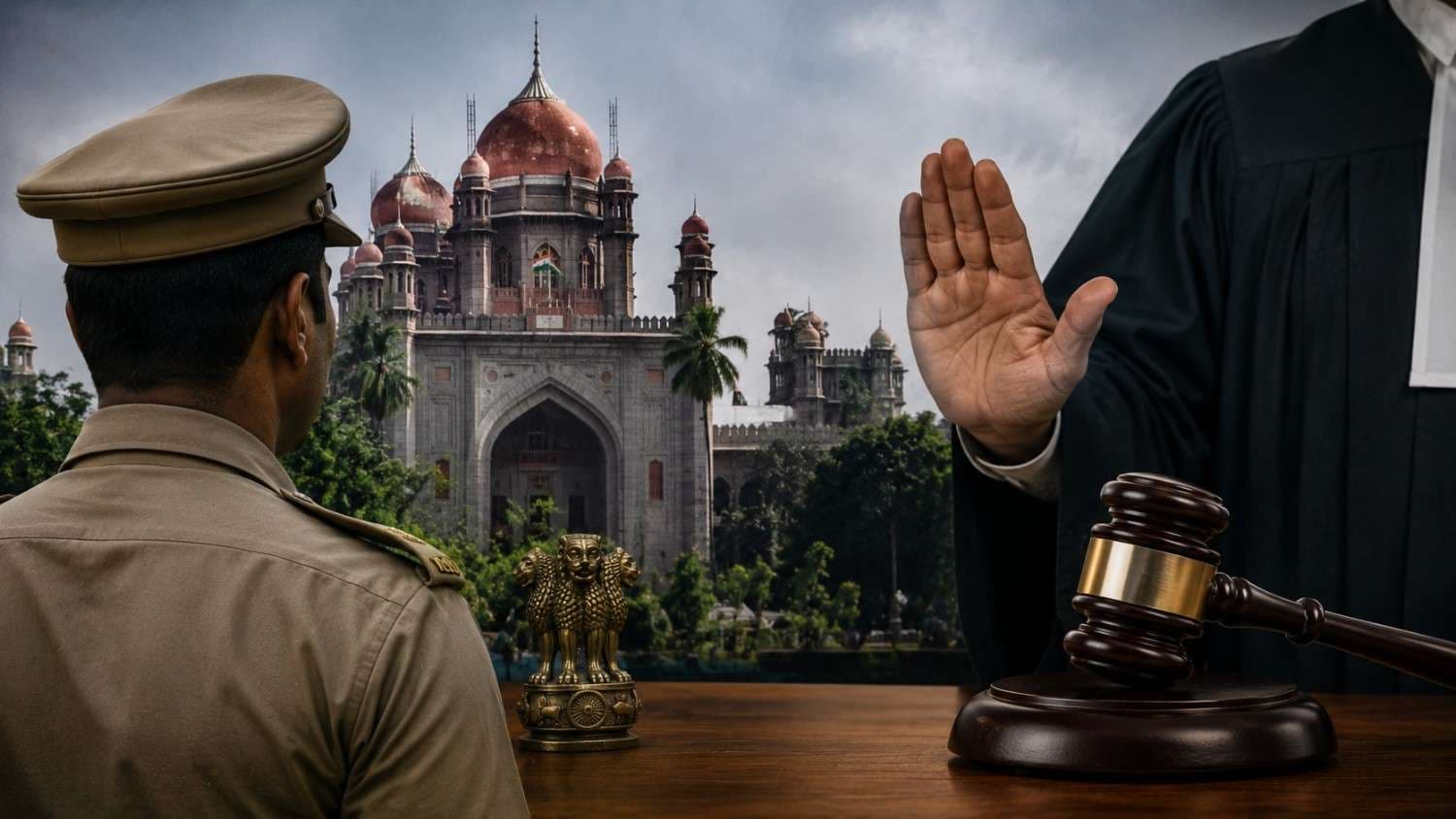
The Telangana High Court has set aside the order of compulsory retirement passed against a judicial officer for misconduct involving police personnel, directing his reinstatement without back wages or consequential benefits. The Division Bench comprising Justice P. Sam Koshy and Justice Narsing Rao Nandikonda observed that the standards of dignity, restraint and propriety expected of a judicial officer extend beyond the courtroom and govern their conduct at all times.
The petitioner, who joined the Andhra Pradesh Judicial Service as a Junior Civil Judge and was posted as II Additional Junior Civil Judge at Gurazala in Guntur District, was stopped by police personnel at the Pondugula Bridge check-post on March 18, 2014, while they were enforcing the Model Code of Conduct. It was alleged that he reacted angrily, addressed the officers disrespectfully, threatened a constable and directed the officials to appear before his Court. The officials were allegedly made to stand in a corner of the courtroom for more than two hours and threatened with proceedings under the Scheduled Castes and Scheduled Tribes (Prevention of Atrocities) Act.
Four additional charges were framed concerning an earlier incident at the Tummalacheruvu Toll Plaza and the petitioner’s alleged absence from Court without informing superior authorities. The Inquiry Officer held the two charges relating to the police personnel as proved but exonerated the petitioner on the remaining four charges. The disciplinary authority disagreed with the Inquiry Officer’s findings on Charges 3 to 6, reversed the exoneration, and after considering the petitioner’s objections, recommended compulsory retirement. The penalty was imposed on January 4, 2018.
The respondents maintained that the departmental inquiry was conducted in accordance with applicable service rules and that the petitioner’s conduct amounted to grave misconduct under Rule 3 of the Andhra Pradesh Civil Services (Conduct) Rules, 1964. The issues before the Court were whether the disciplinary authority’s findings on Charges 3 to 6 could be sustained and whether compulsory retirement was proportionate to the misconduct established under Charges 1 and 2.
The High Court found that neither the impugned proceedings nor the material before it disclosed any cogent reason for reversing the Inquiry Officer’s findings on Charges 3 to 6. No independent or additional material supporting the disciplinary authority’s conclusion was identified. The Court held that in the absence of any additional material or cogent reasons warranting a different conclusion, the disciplinary authority could not have merely substituted its own opinion for that of the Inquiry Officer.
Accordingly, the findings that Charges 3 to 6 stood proved were set aside and the Inquiry Officer’s findings exonerating the petitioner on those charges were restored. However, the Court sustained the two charges relating to the petitioner’s rude and discourteous conduct towards police personnel and their treatment in Court.
While upholding the finding of misconduct under Charges 1 and 2, the Telangana High Court held that the penalty of compulsory retirement was “unduly harsh and shockingly disproportionate” to the gravity of the proven misconduct. The Court directed the reinstatement of the petitioner in service but clarified that no back wages or consequential benefits would be granted for the period of retirement.
The Bench emphasized that a Judicial Officer occupies a position of high public trust and is expected to maintain the highest standards of dignity, restraint and propriety not only while discharging judicial functions on the Bench but also in conduct outside the Court. It observed that the office of a Judicial Officer does not cease with Court hours and that the standards of conduct expected of a member of the judicial service extend beyond the courtroom and govern conduct at all times. The Court stated that a Judicial Officer is, in that sense, a Judicial Officer throughout and not merely during Court working hours.