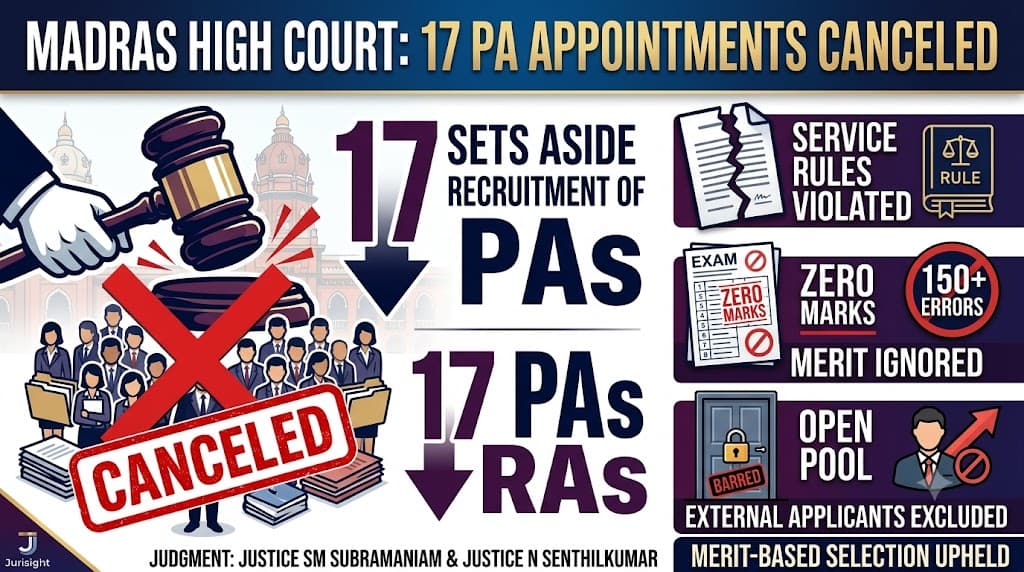
The Madras High Court, acting on a suo motu writ petition, set aside the recruitment of seventeen Personal Assistants to its judges. The bench comprising Justice SM Subramaniam and Justice N Senthilkumar concluded that the entire selection procedure was tainted with arbitrariness and lacked any merit‑based considerations.
The court observed that the service rules governing the post of Personal Assistant to Judges required candidates to have passed the Government Technical Examination in Shorthand and Typewriting in English Higher Grade. However, the issuing circular permitted individuals possessing only Junior or Intermediate Grade qualifications to apply, on the condition that they would acquire the requisite higher grade within two years of appointment. The bench noted that this provision was inconsistent with the existing service rules and amounted to an unjustified relaxation of eligibility criteria.
Justice SM Subramaniam and Justice N Senthilkumar emphasized that the object of any recruitment process must be pedestal ed on merit. By restricting participation to in‑service candidates only, the process effectively barred eligible candidates from the open pool from competing, despite Rule 14A of the Madras High Court Service Rules, 2015 expressly providing for direct recruitment when a sufficient number of qualified in‑service candidates are not available. The court remarked that allowing only in‑service candidates to sit for the selection created a cloaked embargo on external applicants and sent an incorrect message to the public about the sanctity of merit‑based selection.
The bench further pointed out that the selected candidates included individuals who had obtained zero marks in the transcription test. The evaluation sheet revealed that the number of mistakes committed by these candidates far exceeded the permissible limit of 150 errors prescribed for the Senior Grade post. The court described this as a serious discrepancy and a violation of the prescribed standards, stating that the selection was antithetical to the concept of merit.
In its reasoning, the court held that relaxing the rules to accommodate ineligible in‑service candidates, and then granting them additional relaxation to cure their ineligibility, was unnecessary and contrary to established principles of service jurisprudence. Such a practice, the bench noted, resulted in unequal treatment, giving an undue advantage to a particular class of employees while excluding others who satisfied the eligibility criteria.
The court concluded that the selection process suffered from fundamental flaws, including the disregard of merit, the improper relaxation of statutory requirements, and the exclusion of open‑pool candidates. Consequently, the appointments of the seventeen Personal Assistants were set aside. The judgment serves as a reminder that recruitment to judicial posts must adhere strictly to the prescribed rules and maintain the integrity of merit‑based selection.