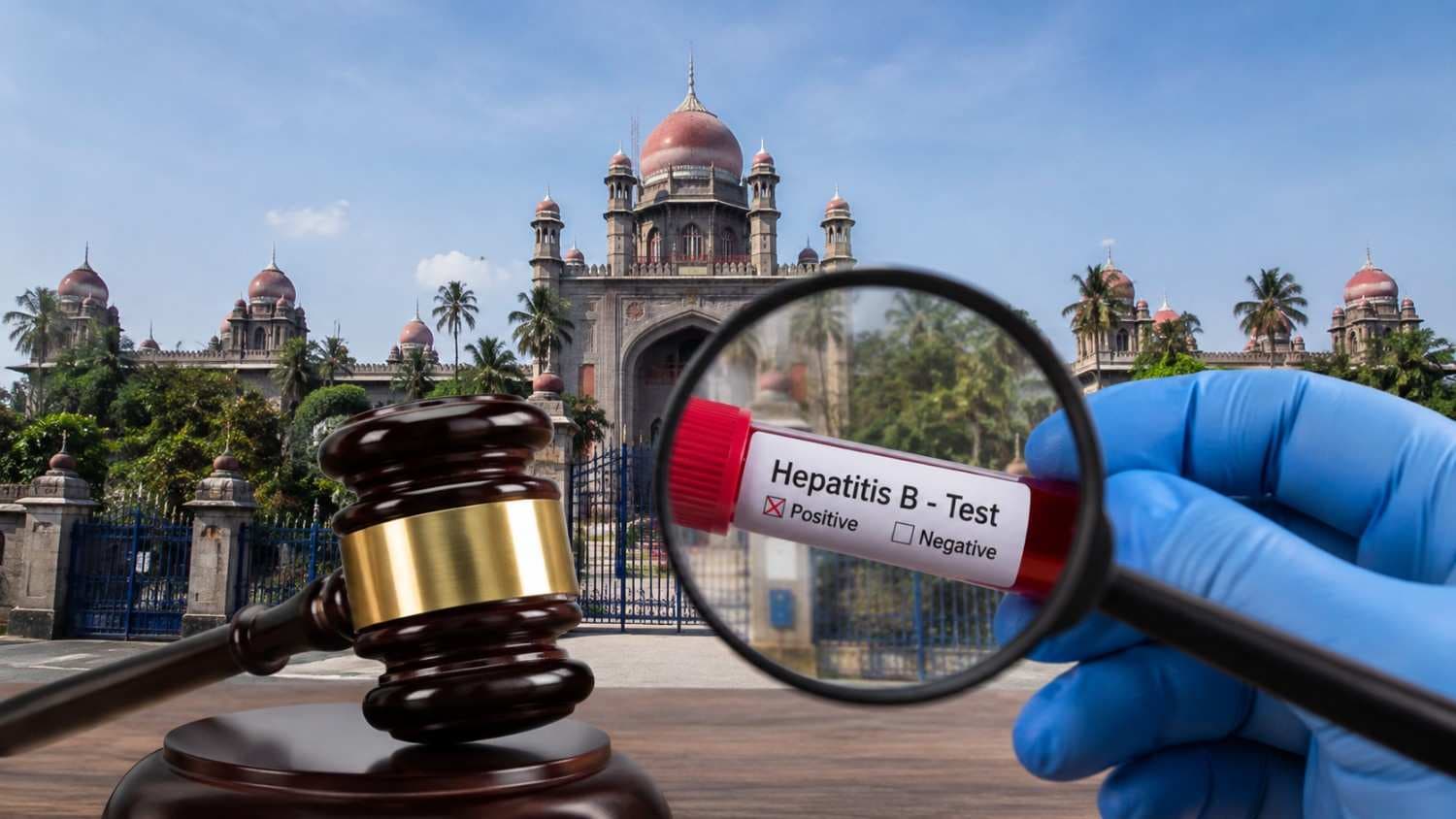
The Telangana High Court has quashed the FIR and subsequent charge sheet filed against four employees of Vijaya Diagnostic Centre for allegedly issuing a false positive Hepatitis B surface antigen (HBsAg) report to a woman prior to her hernia surgery. The court held that the allegations, even if accepted in full, do not disclose an offence punishable under Section 336 of the Indian Penal Code (IPC), which pertains to acts endangering life or personal safety of others.
The complainant had undergone a rapid screening test for HBsAg at the diagnostic centre on June 10, 2022, which returned a reactive result. Based on this report, she experienced severe mental trauma, depression, and suicidal thoughts, and alleged that it increased the anticipated cost of her surgery. Subsequent tests conducted at Yashoda Hospital and a repeat test at the diagnostic centre using the Chemiluminescent Microparticle Immunoassay (CMIA) method returned non-reactive results. The retained blood sample also tested non-reactive via CMIA.
During investigation, the accused staff explained that the initial test was a rapid screening procedure known to be susceptible to false-positive results and that confirmatory testing is required before issuing a final report. They stated that the complainant had declined to provide a fresh blood sample for further testing. The Investigating Officer obtained an opinion from the Superintendent of Gandhi Hospital, which advised that a reactive rapid HBsAg test must be confirmed through methods such as CMIA, CLIA, or ELISA, preferably using a repeat blood sample, before a final conclusion is drawn. Relying on this opinion, the police concluded that the staff had acted negligently by issuing the reactive report without awaiting confirmatory testing and filed a charge sheet under Section 336 IPC.
The petitioners approached the High Court seeking quashing of the criminal proceedings, arguing that the allegations, even if true, do not meet the ingredients of Section 336 IPC. They contended that the report carried a disclaimer stating that the rapid screening test should not be treated as the sole criterion for diagnosis and that confirmatory testing was necessary. They also relied on scientific literature to establish that false-positive results are a known limitation of rapid HBsAg tests.
The State opposed the plea, asserting that the false report caused unnecessary panic, severe mental and financial trauma to the complainant, and that the question of negligence and individual roles of the accused should be determined at trial.
Quashing the proceedings, Justice N. Tukaramji observed that Section 336 IPC does not criminalise every instance of professional negligence. The court emphasized that criminal liability under this provision arises only where the negligence is of such a gross and reckless degree that it endangers human life. Mere inadvertence, an error of judgment, or a lapse in the exercise of due care cannot, by themselves, constitute an offence under this section.
The court held that even assuming there was a lapse in issuing the initial reactive report without awaiting confirmatory testing, such conduct, at its highest, may give rise to a cause of action in civil law or under consumer protection jurisprudence for deficiency in medical services. However, it falls far short of satisfying the stringent threshold required for criminal liability under Section 336 IPC.
The judgment reaffirms the distinction between civil and criminal negligence, stating that the latter is qualitatively different and must involve a culpable disregard for human safety. The court concluded that penal liability cannot be invoked to punish every instance of professional error, and that the remedy for such lapses lies in civil or consumer forums, not criminal courts.