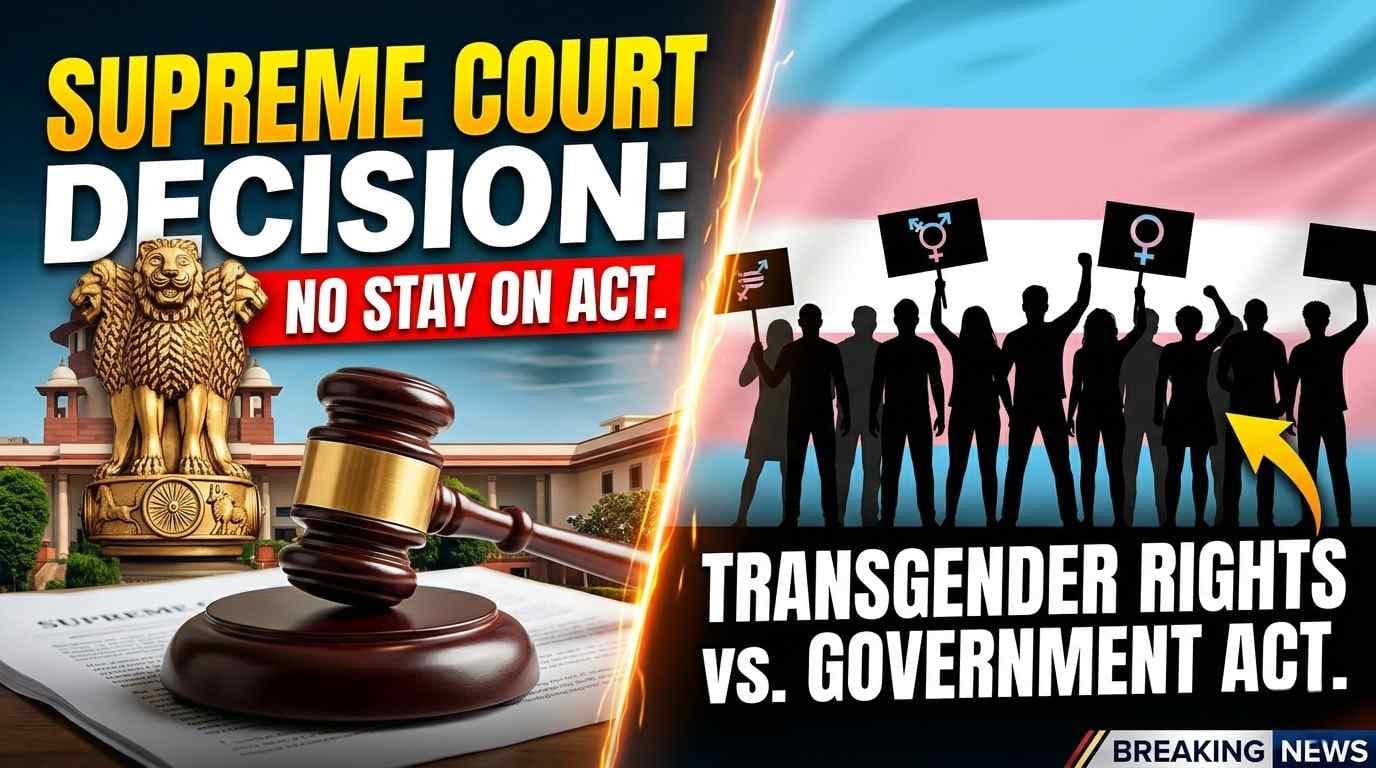
The Supreme Court of India has formally declined to grant an interim stay on the operation of the Transgender Persons (Protection of Rights) Act. While the court has agreed to examine the constitutional validity of several provisions of the Act, it maintained that a central legislation cannot be stayed at the preliminary stage without a detailed hearing. The petitions, filed by several activists and members of the transgender community, argue that the Act in its current form falls short of the landmark standards set by the court itself in the 2014 NALSA v. Union of India judgment.
The primary point of contention in the legal challenge involves the "certification" process required for a person to be legally recognized as transgender. Under the current Act, individuals must apply for a Certificate of Identity from the District Magistrate. Petitioners argue that this requirement violates the fundamental right to self-perceived gender identity—a core tenet of the NALSA ruling—and subjects members of the community to unnecessary administrative scrutiny and potential "gatekeeping" by state officials.
During the hearing, the counsel for the petitioners emphasized that the Act essentially criminalizes certain traditional forms of community living, such as the "Hijra" and "Aravani" systems, by labeling them under broad anti-trafficking clauses. They argued that by not providing a clear distinction between voluntary community structures and forced labor, the Act risks further marginalizing an already vulnerable population. The Supreme Court's decision to hear these arguments highlights the evolving nature of civil rights litigation in India.
The Union Government, defending the legislation, maintained that the Act was designed to provide a comprehensive framework for the social, economic, and educational empowerment of transgender persons. The government argued that the certification process is a necessary administrative step to prevent the misuse of welfare schemes and to ensure that benefits reach the intended recipients. They contended that the Act, rather than infringing on rights, actually formalizes the state's obligation to protect the community.
Another significant issue raised in the PILs is the disparity in sentencing for crimes against transgender persons compared to cisgender women. The petitioners pointed out that the Act prescribes a maximum of two years' imprisonment for sexual abuse against a transgender person, whereas similar offenses under the Indian Penal Code carry much harsher penalties. This discrepancy, they argue, violates Article 14 of the Constitution, which guarantees equality before the law and equal protection of the laws.
While the Supreme Court refused to stay the Act, the bench observed that the issues raised are "serious and deserve a detailed examination." The Court has issued a notice to the Union of India to file a comprehensive response addressing each of the concerns raised by the petitioners. This indicates that while the law remains in force for now, its provisions are under strict judicial scrutiny and may be subject to significant modifications in the future.
For the transgender community, the ongoing litigation is a quest for "substantive equality" rather than mere "formal recognition." The debate in the apex court will likely define the boundaries of how the state can regulate identity and the extent to which self-identification can be exercised without state intervention. The outcome will be a crucial milestone in the journey toward full citizenship and dignity for transgender persons in India.
In conclusion, the Supreme Court’s balanced approach—refusing an immediate stay while agreeing to a deep constitutional dive—ensures that the administrative benefits of the Act continue to flow while the legal gaps are addressed. As the case progresses, it will serve as a vital reminder that laws aimed at protection must not inadvertently become tools of restriction. The legal community and human rights advocates across the globe continue to watch this case as a test of India’s commitment to the NALSA principles.