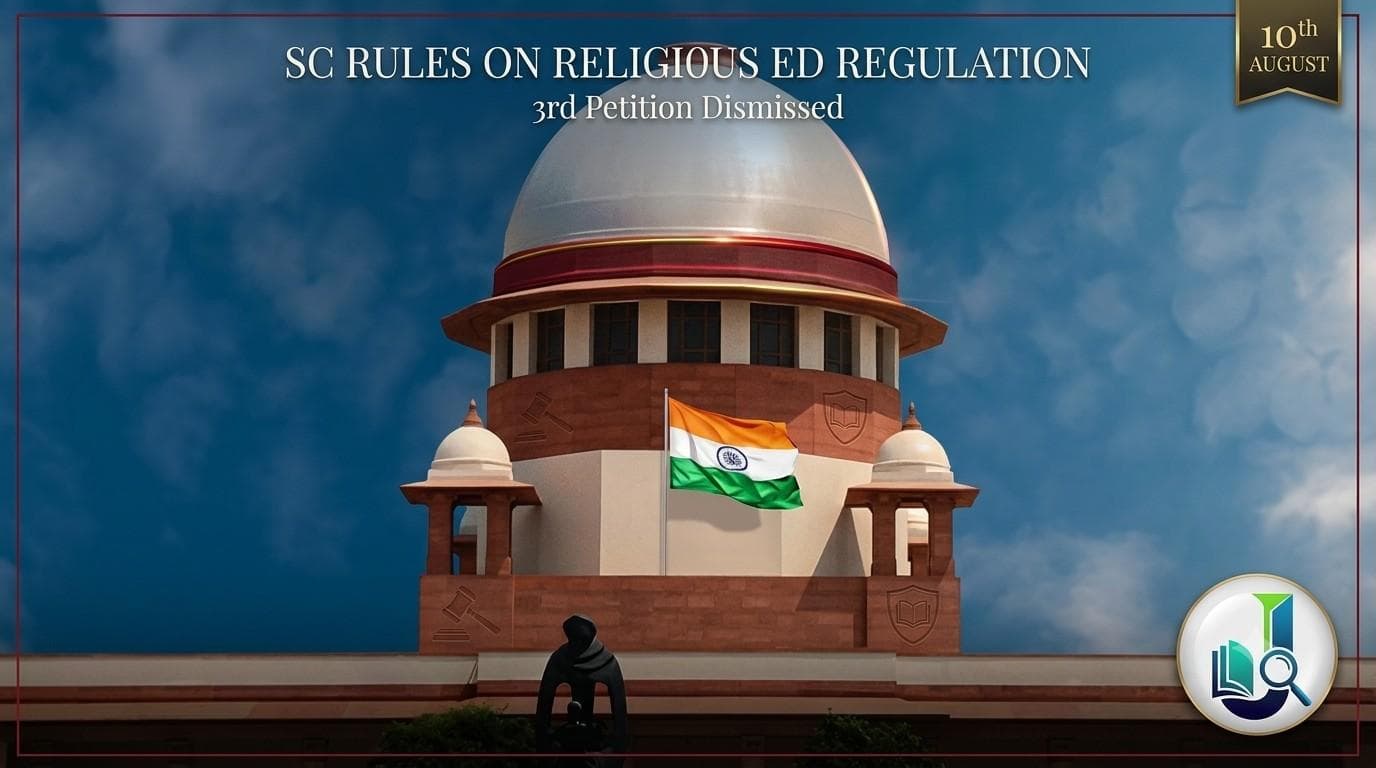
The debate surrounding the state monitoring and regulation of religious education for young children reached another crucial milestone in the country's highest court. In a recent session, the Supreme Court firmly refused to entertain a fresh petition that sought government registration, recognition, and oversight for all institutions imparting religious or secular education to children below 14 years of age.
The petition argued that thousands of unregistered institutions across various districts operate without formal government supervision. It claimed that the lack of oversight raises significant concerns about child welfare, safety, and the quality of basic education. The petitioner cautioned that unregulated environments could leave young children vulnerable to radical ideas, emphasizing that the state has a constitutional obligation under Article 21A to ensure structured learning environments for every child.
In addition to oversight demands, the plea raised complex constitutional questions regarding the interpretation of minority rights. It argued that constitutional protections under Article 30 should apply strictly to secular and professional educational institutions run by minorities, rather than those established primarily to deliver religious instruction. According to the argument, institutions dedicated solely to religious teachings ought to fall under different constitutional provisions governing religious affairs.
However, the Supreme Court bench focused heavily on procedural discipline and judicial efficiency. The judges highlighted that this was the third consecutive petition brought forward by the same individual on the exact same matter. The court pointed out that earlier petitions on the topic had already been disposed of, with directions given to the relevant government authorities to review the petitioner's official representation.
When the petitioner argued that government authorities had failed to respond to his representation within the expected timeframe, the bench offered direct advice rather than accepting a new case. The judges noted that filing repeated petitions on an issue already addressed in court orders risks weakening an otherwise valid cause. Instead of starting fresh litigation, the proper legal step would be to seek enforcement of the existing court direction.
"Don't spoil a good case—you have got an order, enforce it," the court observed during the proceedings. The bench made it clear that while the core issue of protecting children's educational welfare might hold merit, the judicial process cannot be bypassed through repetitive filings. The court explained that if the executive authority ignores a judicial direction, the petitioner holds the right to file for contempt or seek enforcement, rather than asking for the same relief repeatedly.
Recognizing the court's firm stance, the petitioner ultimately chose to withdraw the petition to pursue appropriate legal remedies elsewhere. The decision underscores the judiciary's strict approach to procedural discipline, signaling that even well-intentioned public interest litigation must adhere to established legal pathways and prior court directives.
This outcome leaves the broader conversation on regulating religious instruction in a transitional phase. While the fundamental questions surrounding constitutional mandates, child safety, and state oversight remain unresolved in this specific filing, the spotlight now shifts to how administrative bodies respond to earlier representations regarding educational standards across all institutions.