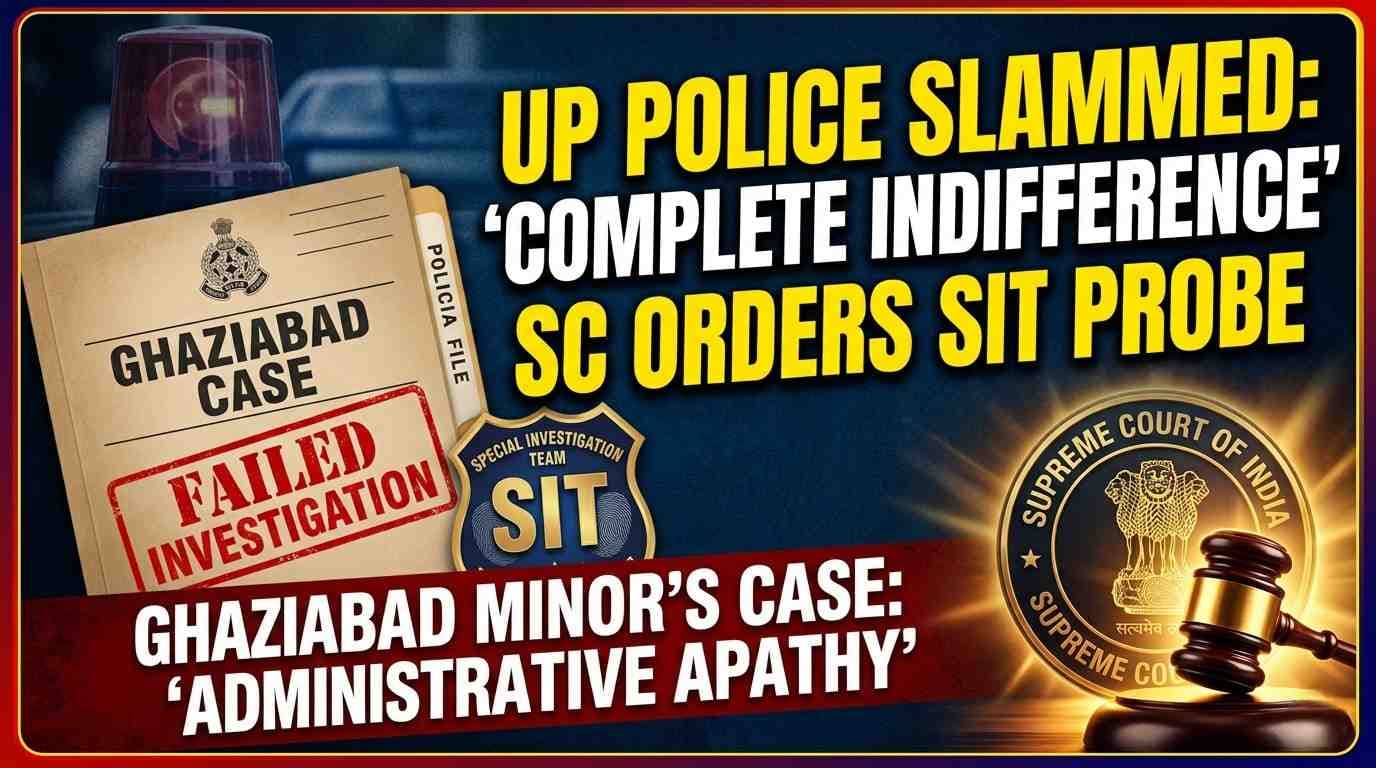
The Supreme Court of India has expressed deep dismay over the "complete indifference" shown by the Uttar Pradesh Police in investigating the horrific rape and murder of a minor child in Ghaziabad. A bench comprising Justices Vikram Nath and Ahsanuddin Amanullah noted that the initial investigation was marred by significant lapses, including a failure to collect crucial forensic evidence and a delay in recording witness statements. Highlighting the gravity of the crime, the Court observed that such administrative apathy not only denies justice to the victim's family but also severely undermines public confidence in the criminal justice system.
As a direct consequence of these systemic failures, the apex court has ordered the immediate constitution of a Special Investigation Team (SIT) to take over the case. This new team is to be headed by a high-ranking officer of the rank of Inspector General (IG) to ensure a high level of expertise and accountability. The Court emphasized that the SIT must conduct a de novo (fresh) investigation into the gaps left by the local police, particularly focusing on the forensic trail and the potential involvement of suspects who may have been overlooked during the initial, lackluster probe.
The Court’s intervention was prompted by a petition from the victim's parents, who alleged that local authorities were shielding certain influential individuals. The bench remarked that the timeline of the investigation suggested a "casual approach" by the investigating officers, where even basic protocols for a POCSO and murder case were not followed. By stripping the local Ghaziabad police of their investigative powers in this matter, the Supreme Court has signaled that it will not tolerate professional negligence in cases involving the most vulnerable members of society.
Furthermore, the Supreme Court has directed the Director General of Police (DGP) of Uttar Pradesh to monitor the SIT’s progress personally and submit periodic status reports to the Court. The bench made it clear that any further delay or lack of coordination among state agencies would be viewed with extreme seriousness. This directive serves as a stern warning to the state’s law enforcement apparatus that the highest court is now supervising the pursuit of justice for the deceased child, ensuring that the investigation is both transparent and exhaustive.
The ruling also touched upon the broader issue of police accountability in the state, questioning why disciplinary actions had not already been initiated against the officers responsible for the original investigation's failures. The Court suggested that "indifference" in such a sensitive case is often a sign of deeper institutional rot or external pressure. To rectify this, the SIT has been given a strict mandate to explore every possible angle, including the possibility of a cover-up at the local station level, to bring the true perpetrators to book.
Ultimately, this order reinforces the Supreme Court's role as the final guardian of fundamental rights and the rule of law. By ordering an SIT probe, the Court has provided a glimmer of hope to the grieving family while setting a precedent for judicial oversight in cases of executive failure. The legal community has welcomed the move, seeing it as a necessary step to ensure that the investigation into the Ghaziabad tragedy is finally conducted with the urgency, sensitivity, and professional rigor that a crime of this magnitude demands.