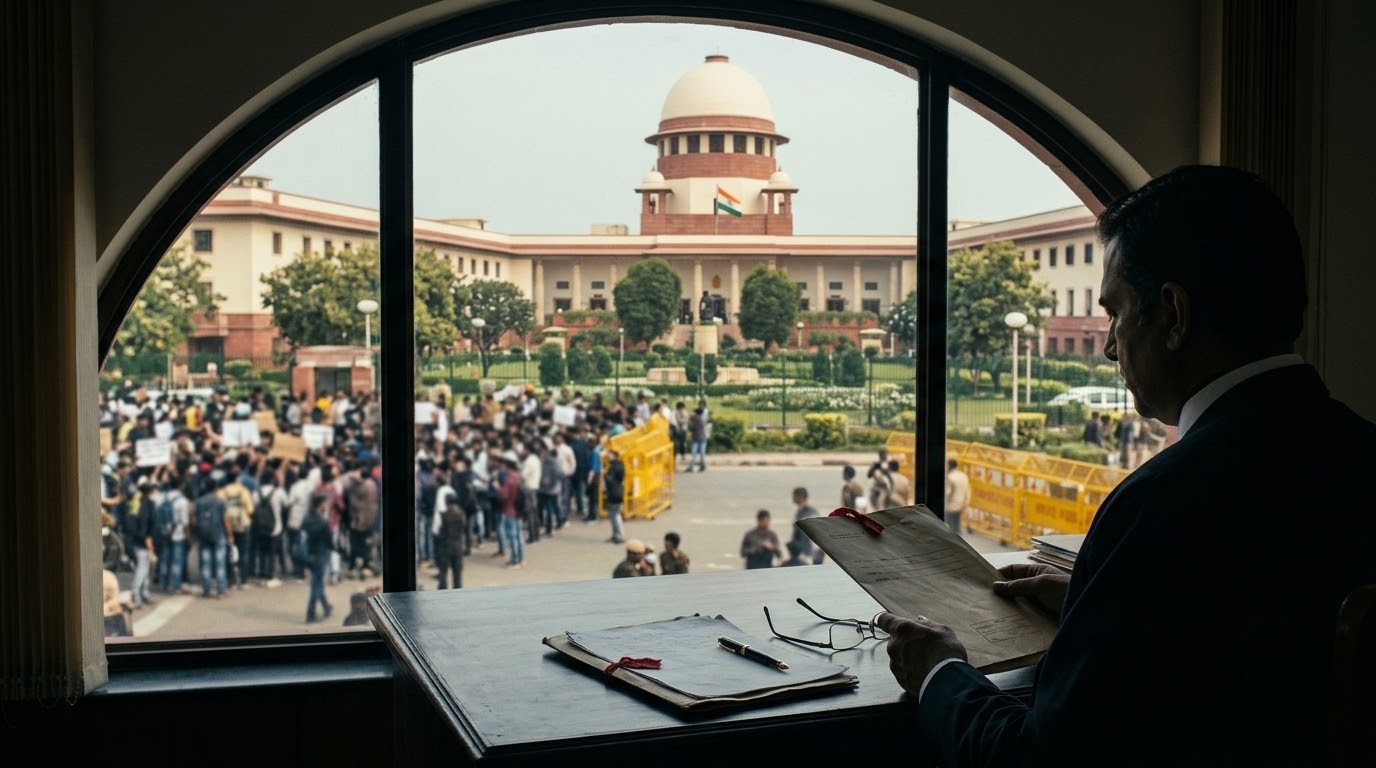
The Supreme Court on November 5, 2026, observed that the High Powered Enquiry Committee (HPEC) constituted to investigate allegations of police brutality during the NEET paper leak protests in July had received very few complaints. The Bench, comprising Chief Justice of India Surya Kant and Justice Bagchi, took note of the Action Taken Report submitted by the Committee on October 31 while hearing petitions filed by Shailendra Mani Tripathi and others against the Union of India.
Why Did The Supreme Court Direct The HPEC To Submit A Report Within One Month?
The Court directed the HPEC to submit its first fact-finding report within one month after noting the paucity of complaints received. The Bench clarified that all material submitted by the parties, including video clips and documents filed on behalf of victims, must be examined and considered by the Committee. The order emphasized that the inquiry should not wait indefinitely and prioritised two specific issues alongside other referred matters.
Composition And Mandate Of The High Powered Enquiry Committee
The HPEC is headed by Justice (Retd.) R. Subhash Reddy, former Judge of the Supreme Court. Its members include Justice Ravi Shankar Jha, former Chief Justice of the Punjab and Haryana High Court; Mrs. Justice Shalinder Kaur, former Judge of the Delhi High Court; Rishi Kumar Shukla, former Director of the Central Bureau of Investigation; and Dr. L.R. Bishnoi, retired Director General of Police, Meghalaya. The Court constituted the Committee to assist it with the highest standards of fairness, transparency, and a dispassionate approach.
Scope Of Inquiry Prioritised By The Bench
The Court recommended that the HPEC address specific issues on a priority basis. These include alleged incidents of targeted violence, harassment, and molestation of female protestors, as well as grievous harm and injury allegedly caused to protestors by police and security personnel. The Committee is also tasked with investigating the chain of command resulting in such excesses, identifying those responsible, and determining whether there were breaches of existing laws, rules, or norms in the exercise of force. Additionally, the HPEC must examine the grant of interim compensation to those injured on either side, including police personnel and protestors.
Court Refuses Reconstitution Of HPEC
In September, the same Bench had refused to alter the constitution of the HPEC. The CJI-led Bench expressed strong reservations against the request for reconstitution, stating that the prayer proceeded on conjecture and preconceived notions articulated even before the Committee had embarked upon its enquiry. The Court reiterated that the HPEC was not created to espouse the cause of any party but to assist the Court independently.
Government Assurances And Status Of FIRs
During the proceedings, Solicitor General Tushar Mehta informed the Bench that the Centre remained committed to three assurances given after a meeting with protest leaders. These assurances included not pursuing FIRs filed against protestors between July 20 and 25, refraining from filing future FIRs against them, and providing compensation to the families of students who died by suicide. The Court had recently permitted State governments to withdraw FIRs registered against protestors involved in the demonstrations.
Delhi Police Data On Criminal Antecedents
The Solicitor General further submitted that regarding persons with criminal antecedents who may have caused destruction of public property, 2,873 individuals with serious criminal records as per the NCRB database were prima facie reported to be at the protest site. The SG stated that fresh FIRs would be registered against these individuals for specific offences unrelated to their participation in the protest.
Priority Issue | HPEC Mandate |
|---|---|
Alleged Violence Against Women Protestors | Examine targeted violence, harassment, and molestation |
Police Excesses And Chain Of Command | Assess grievous harm, identify responsible officers, check legal breaches |
Interim Compensation | Evaluate claims for injured protestors and police personnel |
The Court clarified that the enquiry undertaken by the HPEC shall not be a one-time exercise. The Committee is required to undertake a continuous and periodic assessment of the issues enumerated and submit interim findings periodically to enable the Court to take appropriate measures and issue necessary directions. The matter remains pending for the submission of the HPEC's first fact-finding report within the stipulated one-month timeline.