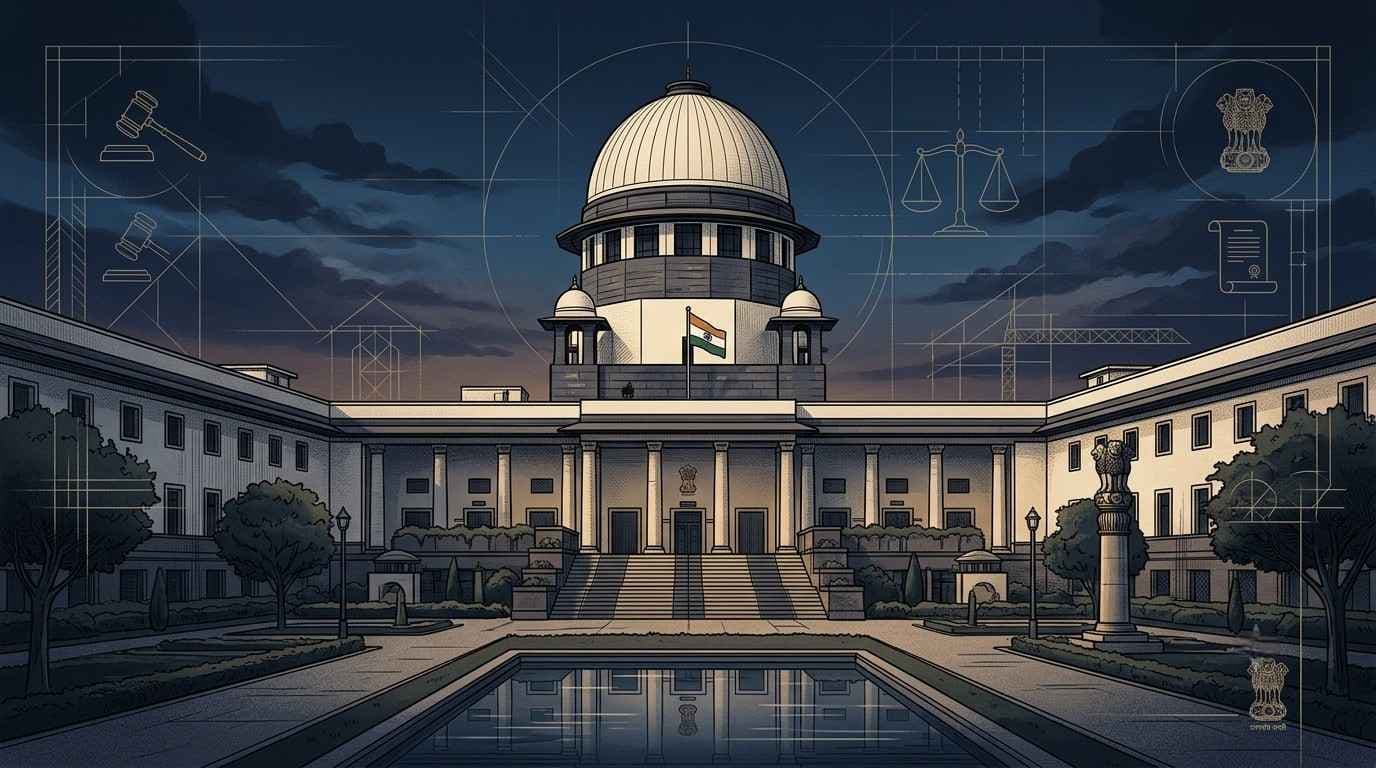
Supreme Court to Clarify 'Industry' Scope Under ID Act
A nine-judge Constitution Bench of the Supreme Court is scheduled to pronounce its judgment tomorrow, August 20, 2026, concerning the re-evaluation of the definition of 'industry' as articulated in the seminal 1978 ruling, *Bangalore Water Supply and Sewerage Board v. A. Rajappa*. The bench, comprising Chief Justice of India Surya Kant, Justices BV Nagarathna, PS Narasimha, Dipankar Datta, Ujjal Bhuyan, Satish Chandra Sharma, Joymalya Bagchi, Alok Aradhe, and Vipul M Pancholi, had reserved its judgment on March 19 after hearing arguments on the limited question of whether the *Bangalore Water Supply* decision was correctly decided.
Background of the 'Industry' Definition
The 1978 judgment, authored by Justice V.R. Krishna Iyer, provided a broad interpretation of the term 'industry' within the framework of the Industrial Disputes Act, 1947. In that ruling, a seven-judge bench had determined that any systematic activity, organised through cooperation between an employer and an employee for the production or distribution of goods and services, could fall within the definition of 'industry'. This interpretation applied even if the organisation was not primarily engaged in profit-making activities.
The *Bangalore Water Supply* case established a 'triple test' for identifying an 'industry', which included:
The presence of an organised and systematic activity.
Cooperation between employer and employee, where the direct and substantial element was deemed significant.
The activity's purpose being the production and/or distribution of goods and services intended to satisfy human wants and wishes. The Court clarified that this encompassed material things or services for 'celestial bliss' but excluded purely spiritual or religious pursuits.
Genesis of the Reference to a Larger Bench
The current reconsideration originates from an appeal filed in 2002. Subsequently, in 2005, a five-judge bench led by Justice N. Santosh Hegde, in the case of *State of Uttar Pradesh v. Jai Bir Singh*, referred the *Bangalore Water Supply* matter to a larger bench for re-examination. The complexity and far-reaching implications of the definition led a seven-judge bench in 2017 to further refer the issue to a nine-judge bench, acknowledging that the original *Bangalore Water Supply* judgment itself was rendered by a seven-judge bench.
Key Issues Framed for Consideration
During the proceedings, a three-judge bench led by the Chief Justice of India, in an order passed on February 16, identified several pivotal issues for the Constitution Bench's deliberation. These issues broadly encompass:
Whether the test laid down in paragraphs 140 to 144 of Justice V.R. Krishna Iyer's opinion in *Bangalore Water Supply and Sewerage Board's case* correctly defines an undertaking or enterprise as an 'industry'. The bench also considered the legal impact of the Industrial Disputes (Amendment) Act, 1982 (which reportedly did not come into force), and the Industrial Relations Code, 2020 (effective from November 21, 2025), on the interpretation of 'industry' under the principal Act.
Whether social welfare activities and schemes, or other enterprises undertaken by government departments or their instrumentalities, can be construed as 'industrial activities' for the purposes of Section 2(j) of the Industrial Disputes Act.
The scope of 'sovereign function' in the context of State activities, and whether such activities fall outside the purview of Section 2(j) of the Industrial Disputes Act.
The impending judgment in *STATE OF U.P. Vs JAI BIR SINGH* (C.A. No. 897/2002) is anticipated to provide definitive clarity on these critical questions, potentially reshaping the landscape of industrial relations and the applicability of labour laws to various sectors, including governmental and welfare organisations.