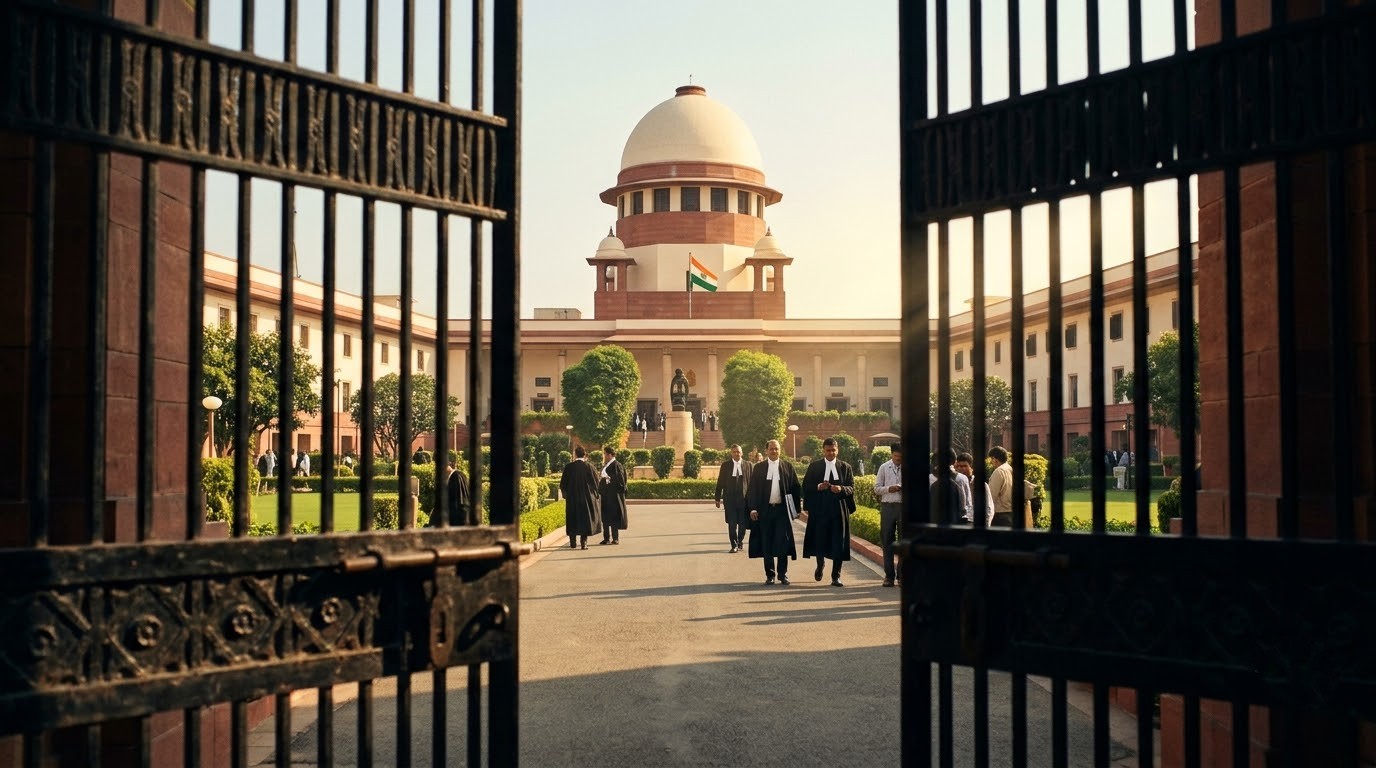
On September 21, 2026, a Bench of the Supreme Court comprising Justice Ujjal Bhuyan and Justice Atul S. Chandurkar delivered a landmark ruling in Jaskaran Jeet Singh Deol v. State of Punjab, reinforcing the constitutional mandate under Article 22(1). The Court declared that an arrest executed without communicating the grounds of arrest in writing to the accused is unconstitutional, subject only to limited exceptional circumstances recognised by the Court.
What is the legal consequence if an arrest violates Article 22(1) for non-communication of grounds?
The arrest is rendered illegal and unconstitutional. The investigating agency cannot re-arrest the released person on its own authority; it must furnish the grounds of arrest and approach the jurisdictional magistrate for custody, explaining the need for re-arrest and the initial failure to supply grounds, with the application endorsed by the investigating officer's immediate superior.
The judgment arose from a plea filed by Shiromani Akali Dal-affiliated leader Jaskaran Jeet Singh Deol concerning a case of sexual assault on a minor. The Bench ruled that once an accused is released because the arrest violated Article 22(1), the power to re-arrest cannot remain solely with the authority that committed the constitutional violation. Consequently, the Court mandated a structured procedure for any subsequent arrest.
Procedural Safeguards for Re-arrest
The Court laid down stringent conditions that the investigating agency must satisfy before seeking custody of a person released due to an Article 22(1) violation. The agency must file an application before the jurisdictional magistrate. This application must explicitly state the grounds of arrest, the necessity for re-arrest, and the reasons why the grounds were not communicated during the initial arrest. Crucially, the application requires an endorsement from the investigating officer's immediate superior officer.
The jurisdictional magistrate is then required to decide on the application, ideally within a week. This magisterial scrutiny acts as a judicial check on executive power, ensuring that the decision to deprive a person of liberty again is not unilateral but subject to independent oversight.
Administrative Accountability for Constitutional Lapses
Beyond safeguarding the liberty of the arrested individual, the ruling established administrative procedures to deter future violations. The superior police officer receiving a request for re-arrest is directed to assign further investigation to a different officer. Simultaneously, a departmental inquiry must be ordered against the official responsible for the initial constitutional lapse. If the inquiry finds the officer at fault, departmental action must follow, and an adverse entry must be recorded in the officer's service record. This mechanism shifts the consequence of non-compliance from the accused to the errant official.
Evolution of Article 22(1) Jurisprudence
The judgment consolidates a developing line of precedent on the communication of arrest grounds. In Pankaj Bansal v. Union of India (2023), the Supreme Court emphasised that Article 22(1) provides a substantive constitutional and procedural safeguard, mandating communication of grounds as a matter of course and without exception, even under special statutes like the Prevention of Money Laundering Act.
In Vihaan Kumar v. State of Haryana (2025), the Court reiterated that grounds must be communicated in a language understood by the accused. It held that once an accused asserts a violation, the burden shifts to the investigating officer to demonstrate strict compliance, leading to the quashing of detention for non-compliance. Subsequently, Mihir Rajesh Shah v. State of Maharashtra (2025) extended the obligation to convey written grounds of arrest uniformly across all statutes, irrespective of whether the arrest is made under special legislation or general penal law.
The current ruling removes residual ambiguity regarding the applicability of Article 22(1) to special statutes and erects a formidable deterrent against executive overreach by combining mandatory departmental inquiries with time-bound magisterial scrutiny. The decision affirms that the constitutional guarantee under Article 22(1) is not a mere formality but a substantive right, the breach of which triggers rigorous judicial and administrative consequences.
Case | Year | Key Holding |
|---|---|---|
Pankaj Bansal v. Union of India | 2023 | Article 22(1) is a substantive safeguard; grounds must be communicated without exception, including under special statutes (PMLA). |
Vihaan Kumar v. State of Haryana | 2025 | Grounds must be in a language understood by the accused; burden shifts to IO to prove compliance; detention quashed for violation. |
Mihir Rajesh Shah v. State of Maharashtra | 2025 | Obligation to provide written grounds applies uniformly across all statutes, special or general. |
Jaskaran Jeet Singh Deol v. State of Punjab | 2026 | Arrest without written grounds is unconstitutional; re-arrest requires magisterial approval with superior officer endorsement; mandatory departmental inquiry for erring officer. |
The Supreme Court's decision in Deol thus marks a definitive step in operationalising the constitutional guarantee against arbitrary arrest, ensuring that procedural compliance is enforced through both judicial oversight and internal disciplinary mechanisms.