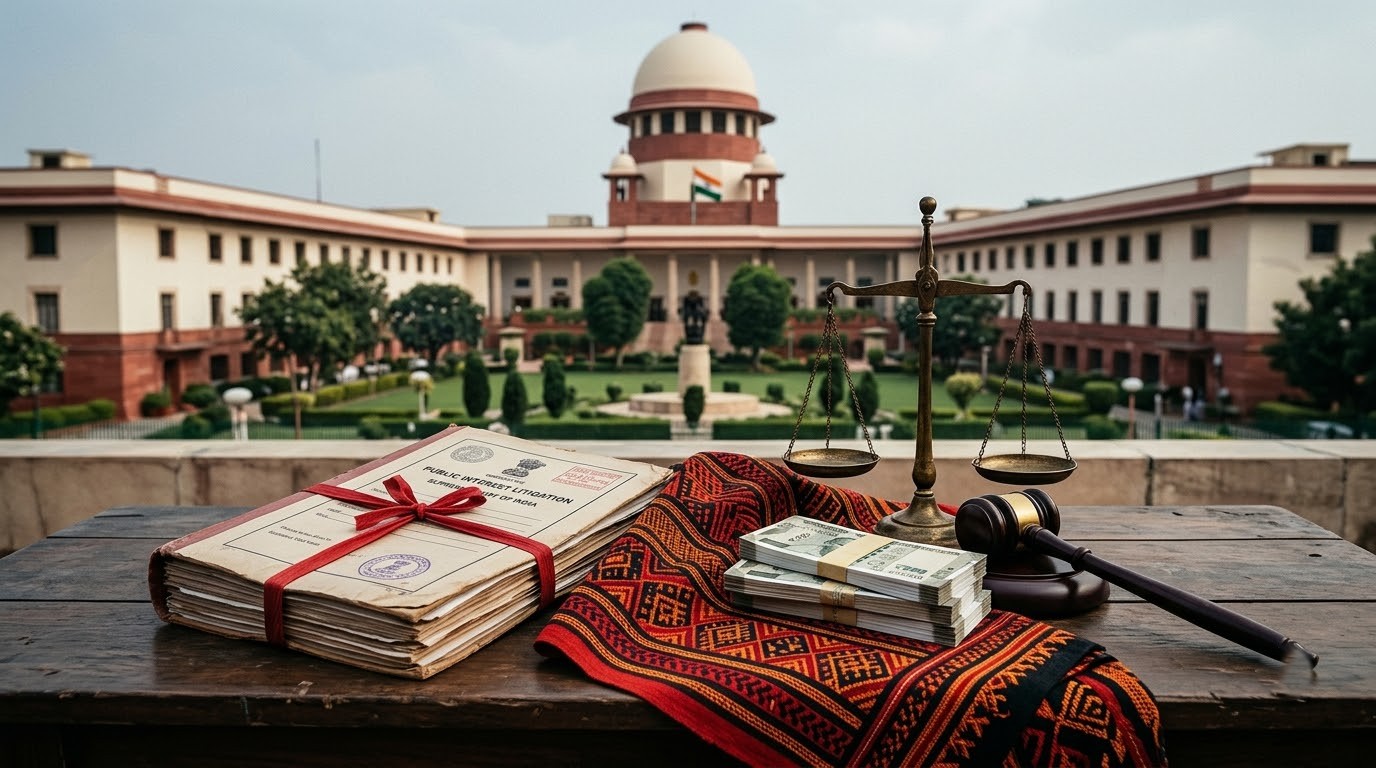
The Supreme Court has formally intervened in a legal challenge concerning the constitutional validity of a provision within a regional tribal enactment in Tripura. A bench comprising Chief Justice Surya Kant, Justice Joymalya Bagchi, and Justice V. Mohana considered a public interest litigation directed against Section 143 of the Jamatia Customary Laws Act, 2017. The petitioner contended that the said provision allows sexual offences, including rape, to be settled through private mediation and monetary fines of up to one lakh rupees. Finding merit in the preliminary submissions, the bench issued notice and tagged the matter alongside a pending writ petition, listing the consolidated proceedings for further hearing.
What is the core legal and constitutional question raised before the Supreme Court regarding tribal customary laws?
The primary legal question centers on legislative competence and whether a regional district council under the Sixth Schedule of the Constitution possesses the authority to enact penal provisions that override central criminal legislation governing heinous offences. The petitioner argued that the legislative powers of autonomous district councils are strictly confined to civil matters, personal laws, and petty local offences, thereby lacking the competence to formulate parallel penal frameworks for grave crimes.
The petition further asserted that heinous crimes such as rape constitute serious offences against society at large rather than private disputes between individuals. Citing statutory frameworks under the Code of Criminal Procedure, 1973, and the Bharatiya Nagarik Suraksha Sanhita, 2023, the petitioner highlighted that sexual offences are classified as strictly non-compoundable. Consequently, any local enactment permitting the compounding of such crimes stands in direct conflict with national criminal jurisprudence.
Legal Parameter | National Criminal Framework | Tripura Tribal Customary Law (Challenged) |
|---|---|---|
Nature of Offence | Offence against society (in rem) | Treated as compoundable via fine |
Compounding Status | Strictly non-compoundable | Permits settlement up to Rs 1,00,000 |
Legislative Source | Parliamentary enactments (CrPC / BNSS) | District Council Enactment (Sixth Schedule) |
The petition also drew upon established precedents of the Supreme Court, including the rulings in Gian Singh v. State of Punjab and State of Madhya Pradesh v. Madanlal. These judgments categorically established that heinous crimes involving mental depravity cannot be quashed or settled through a compromise, as such offences exert a severe impact on the collective conscience of society. The petitioner argued that the impugned provision effectively places a price tag on a woman's dignity and creates an arbitrary classification that denies tribal women the full protection of central criminal legislation, thereby violating Articles 14 and 15 of the Constitution.
By issuing notice, the Supreme Court has set the stage for a detailed constitutional examination of the limits of legislative power under the Sixth Schedule vis-a-vis fundamental rights and national criminal law. The matter will be taken up by the bench for substantive arguments.