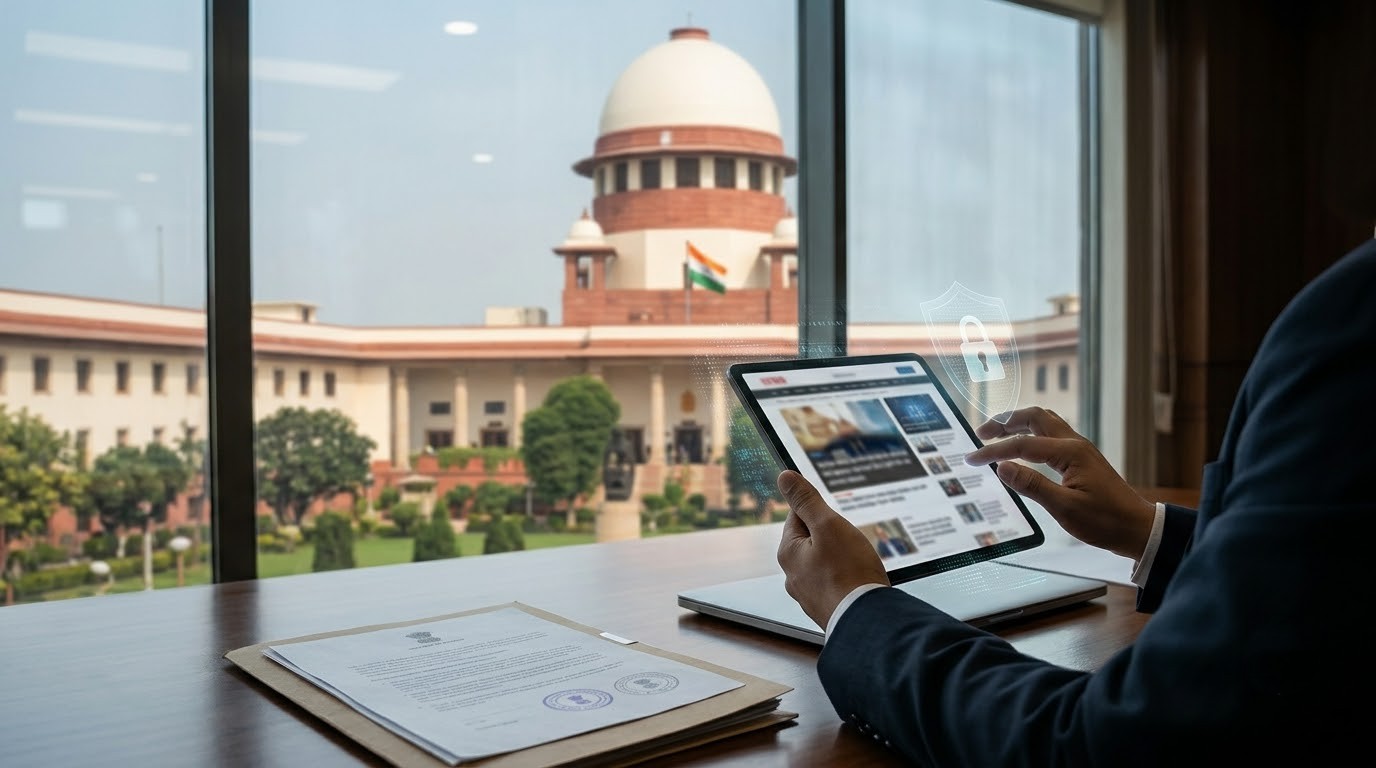
The Supreme Court on Monday issued notice on a petition filed by the Digital News Publishers Association (DNPA) and journalist Yukta Mugdal challenging the constitutional validity of key provisions of the Digital Personal Data Protection Act, 2023 (DPDP Act), and the Digital Personal Data Protection Rules, 2025. The Bench, comprising Chief Justice of India Surya Kant, Justice Joymalya Bagchi, and Justice V. Mohana, ordered the matter to be returnable on November 17.
What provisions of the DPDP Act and Rules have been challenged by digital news publishers?
The petition seeks a declaration under Article 13(2) that Sections 7, 17(2), 18, 19, 27, 29, 36, 37, and 44(3) of the DPDP Act, 2023, read with the Gazette Notification dated November 13, 2025, are ultra vires the Constitution. It also challenges the DPDP Rules, 2025, as inconsistent with Articles 14, 19(1)(a), 19(1)(g), and 21. Additionally, the plea contests the substituted clause (j) of Section 8(1) of the Right to Information Act, 2005, introduced via Section 44(3) of the DPDP Act, arguing it is unconstitutional.
Pre-censorship and newsroom viability concerns
Senior Advocate Madhavi Goradia Divan, appearing for the petitioners, submitted that this is the first comprehensive challenge by institutional legacy media. She argued that the legislation was never intended to apply to journalism and threatens to impose a regime of pre-censorship, potentially shutting down newsrooms. Divan highlighted that if news organisations are left to the mercy of data principals for consent, the fundamental concept of news—particularly live reporting—would be destroyed. She emphasised that legacy media is already thoroughly regulated across print, broadcast, and Information Technology rules.
Chief Justice asks media to propose balance
Chief Justice Surya Kant observed that the petitioners, as domain experts, are best placed to suggest to the Union government and the Court how misuse can be prevented while balancing the rights of innocent citizens against press freedoms. The Chief Justice stated that a balance must be struck between the two, leaving it to the media to guide and suggest mechanisms ensuring no misuse occurs. The Court refrained from passing any interim order at this stage.
Context of parallel challenges
This petition joins a clutch of existing challenges to the DPDP Act. The Supreme Court has previously issued notice in pleas filed by The Reporters' Collective and journalist Nitin Sethi, as well as by the National Campaign for People's Right to Information (NCPRI) challenging amendments to the RTI Act. Another petition by journalist Geeta Seshu and others challenges specific sections regarding data processing, consent, and the powers of the Data Protection Board.
Petitioner | Key Focus of Challenge |
|---|---|
Digital News Publishers Association & Yukta Mugdal | Pre-censorship, newsroom viability, RTI amendment (Sections 7, 17(2), 18, 19, 27, 29, 36, 37, 44(3); DPDP Rules 2025) |
The Reporters' Collective & Nitin Sethi | Constitutional validity of DPDP Act, 2023 (Articles 14, 19, 21) |
NCPRI | Amendments to RTI Act via DPDP Act |
Geeta Seshu & Ors. | Data processing, consent, Data Protection Board powers (Sections 7, 17(2)(a), 19(3), 24, 36, 44(2)(a), 44(3)) |
The cause title is Digital News Publishers Association and Anr. v. Union of India & Anr. [Diary No. 45589/2026]. The matter is listed for further hearing on November 17.