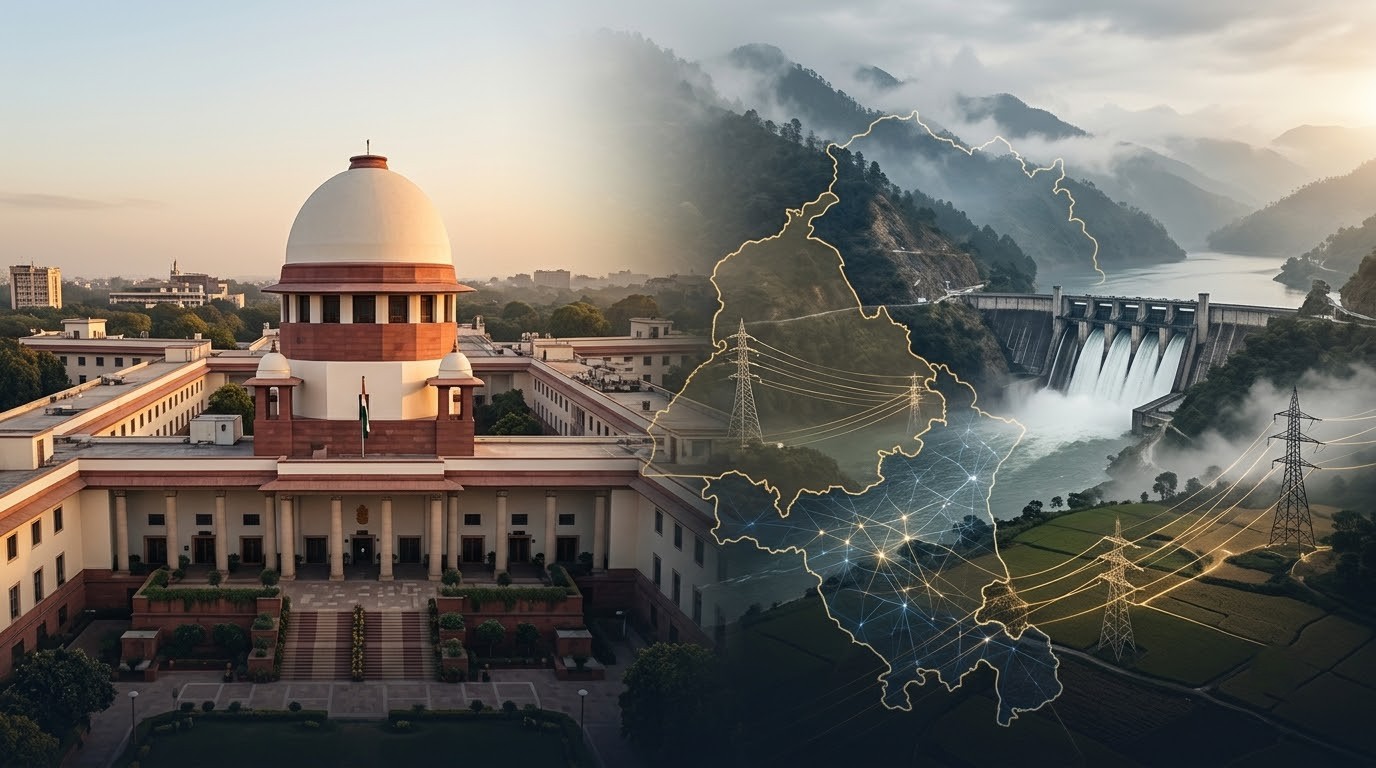
A three-judge Bench of the Supreme Court comprising Chief Justice of India Surya Kant and Justices Joymalya Bagchi and V. Mohana has brought closure to a protracted inter-State dispute concerning Himachal Pradesh's share in electricity generated by the Bhakra-Nangal and Beas hydroelectric projects. The Court approved a cashless settlement formula finalised following consultations facilitated by Attorney General R. Venkataramani with the participation of Himachal Pradesh, Punjab and Haryana.
How has the Supreme Court resolved Himachal Pradesh's power share dispute with Punjab and Haryana?
The Supreme Court has approved a cashless settlement under which Himachal Pradesh will receive 11,973 million units of electricity from Punjab and Haryana over 20 years, giving effect to its 7.19% entitlement in the Bhakra-Nangal and Beas projects while adjusting for historical capital expenditure.
The arrangement operationalises the State's 7.19% entitlement in the hydroelectric projects. The Central Electricity Authority had originally assessed Himachal Pradesh's entitlement at 13,066 million units (MU). However, the final settlement figure of 11,973 MU accounts for an adjustment of Rs 420 crore towards the historical capital expenditure incurred in the construction of the dams. Significantly, the mechanism avoids inter-State monetary transfers, providing for the adjustment to be reflected directly through the electricity allocation mechanism.
Dispute over implementation timeline
The duration for implementing the entitlement emerged as the primary point of disagreement among the States. Himachal Pradesh advocated for the entire allocation to be delivered within a 10-year period. In contrast, Punjab sought a 30-year timeframe for the settlement. The Attorney General had suggested a middle path of 15 years for implementation.
After considering the competing positions, the Supreme Court settled on a 20-year schedule. The Bench determined that this period balanced the urgency expressed by Himachal Pradesh with the practical constraints highlighted by Punjab and Haryana.
Comparison of proposed implementation timelines
Party | Proposed Duration |
|---|---|
Himachal Pradesh | 10 years |
Punjab | 30 years |
Attorney General | 15 years |
Supreme Court (Final) | 20 years |
Effect on 2011 decree
The decision provides a concrete framework for giving effect to the Supreme Court's 2011 decree, which had recognised Himachal Pradesh's entitlement but remained unimplemented for over a decade. The dispute had remained unresolved for several decades, with the States unable to agree on the modality for transferring the power share.
The cashless settlement formula endorsed by the Court represents a departure from conventional monetary compensation models. By structuring the adjustment for historical capital costs through the electricity allocation itself, the arrangement eliminates the need for direct financial transactions between the State governments, thereby reducing administrative friction and ensuring a steady flow of power to Himachal Pradesh over the next two decades.
The Attorney General's facilitation of the consultations was instrumental in narrowing the differences between the States. The participation of all three States in the negotiated settlement underscores the consensual nature of the final arrangement, which now carries the Court's imprimatur for enforcement.