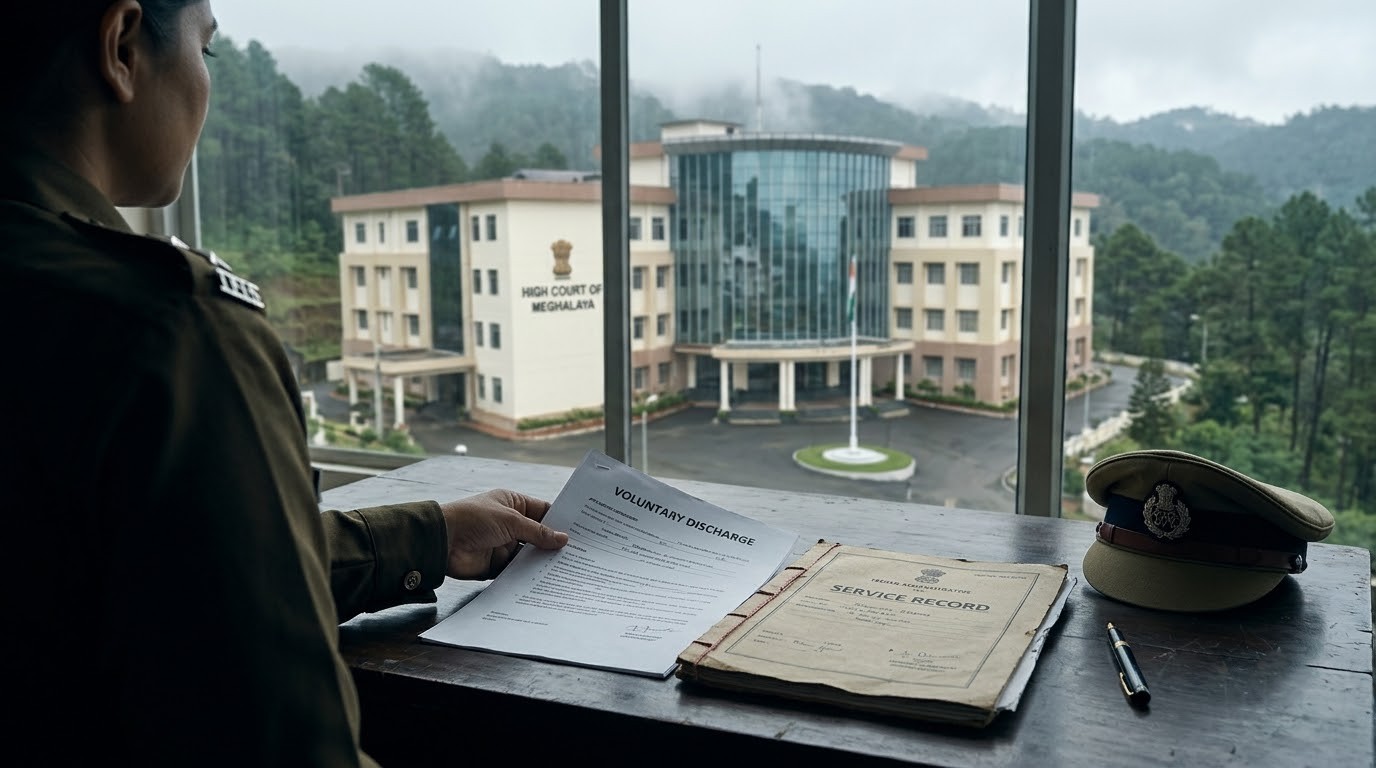
The Meghalaya High Court has dismissed a pension claim filed by a former Assam Rifles Rifleman, holding that voluntary discharge from service on one's own request entails the forfeiture of all past service and disentitles the employee from invoking pensionary benefits under Rule 49(2) of the Central Civil Services (Pension) Rules, 1972. The Court further rejected the petition on the grounds of inordinate delay and laches.
Factual Background
The petitioner, L. Pearlson, was appointed as a Rifleman (General Duty) in the Assam Rifles on January 3, 1986. He was discharged from service on June 30, 1999, after rendering over 13 years of service. The petitioner claimed that his discharge was not voluntary, alleging that his signatures were obtained on a pre-typed document without his consent.
The respondents, however, contended that the petitioner had sought premature discharge in 1998 on extreme compassionate grounds owing to his wife's illness. They produced a discharge certificate and a certificate dated December 23, 1998, which established that the petitioner had acknowledged he would not be entitled to pensionary benefits upon such discharge. Following the rejection of his pension request by the authorities on November 5, 2021, the petitioner approached the High Court challenging the decision.
Court's Findings on Voluntariness and Delay
The Court examined the documentary evidence on record, specifically the discharge certificate and the certificate dated December 23, 1998. It observed that these documents conclusively established that the petitioner had sought discharge on compassionate grounds and was fully aware that he would forfeit pensionary benefits. The Court found no merit in the petitioner's belated allegation that his signatures were obtained fraudulently.
Additionally, the Court noted that the petitioner had challenged his discharge only in 2021, nearly 22 years after the event, without furnishing any plausible explanation for the inordinate delay. The plea was therefore barred by laches and delay.
Interaction Between Rule 26(1) and Rule 49(2) of CCS (Pension) Rules, 1972
On the substantive question of pension entitlement, the Court analysed the interplay between Rule 26(1) and Rule 49(2) of the Central Civil Services (Pension) Rules, 1972. The petitioner had sought to invoke Rule 49(2), which provides for pensionary benefits upon completion of 10 years of qualifying service.
The Court held that voluntary resignation or discharge on one's own request attracts Rule 26(1), which expressly provides for the forfeiture of past service. Placing the two provisions in juxtaposition, the Court clarified that since Rule 26(1) operates as a statutory bar to future service benefits in cases of voluntary resignation, Rule 49(2) becomes inapplicable in such a scenario. An employee cannot circumvent the forfeiture mandated by Rule 26(1) by relying on the qualifying service threshold under Rule 49(2).
What is the legal effect of voluntary discharge on pension entitlement under the CCS (Pension) Rules, 1972? ?
Voluntary discharge on one's own request is treated as resignation under Rule 26(1) of the CCS (Pension) Rules, 1972, resulting in the forfeiture of all past service. Consequently, the employee is disentitled to pensionary benefits under Rule 49(2), as Rule 26(1) operates as a statutory bar that renders Rule 49(2) inapplicable.
Operative Orders
Accordingly, the Court dismissed the writ petition. However, it directed the respondents to release the petitioner's terminal dues, specifically Rs 5,656 towards the Individual Running Ledger Account (IRLA) and Rs 53,642 towards the General Provident Fund (GPF) account, within a period of 30 days, if not already paid. The decision was delivered on October 29, 2024.