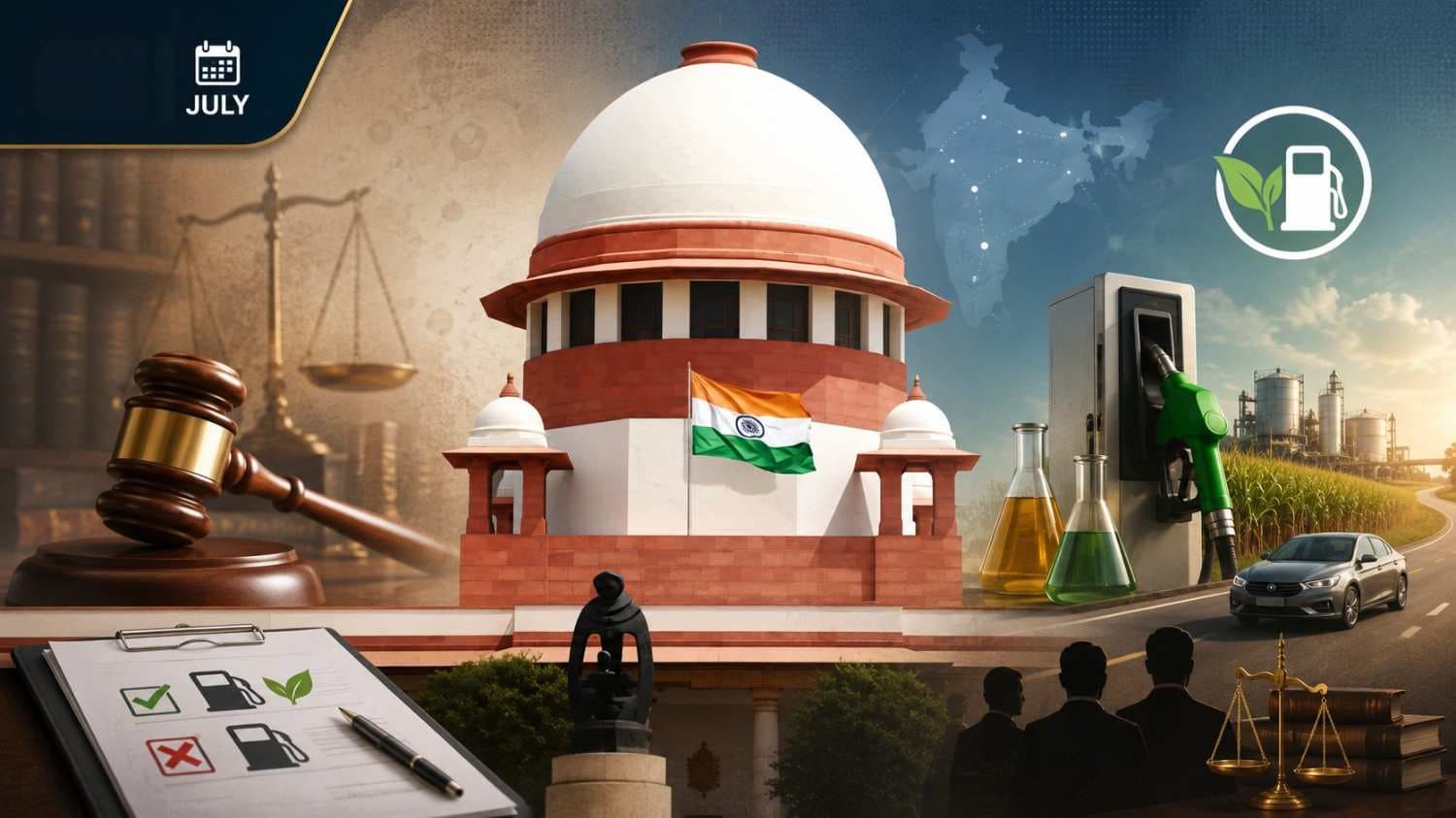
The public interest litigation was filed in August 2025 by advocate Akshay Malhotra. The petitioner did not oppose the ethanol blending programme in principle but sought that users of vehicles manufactured before 2023 be provided with the option of purchasing ethanol‑free petrol. The petition highlighted that in jurisdictions such as the United States, Brazil and the European Union, ethanol‑free petrol continues to be sold alongside blended fuels, with clear labelling at retail outlets enabling consumers to make an informed choice.
The petitioner relied on the 2021 report of NITI Aayog, which recommended that the retail price of ethanol‑blended fuels be lower than that of unblended petrol to compensate for the reduction in calorific value. The petitioner noted that, despite the nationwide rollout of E20 petrol, pump prices had remained unchanged, thereby depriving consumers of the price adjustment envisaged by the policy advisory body.
Further, the petitioner quoted the opinion expressed by the Society of Indian Automobile Manufacturers (SIAM) in the same NITI Aayog report, which described the non‑availability of E10 fuel as a critical concern for the existing vehicle fleet. SIAM had recommended that E10 be made available on a pan‑India basis as a protection grade fuel for older vehicles.
When the matter came before the Supreme Court on 1 September 2025, a bench comprising Chief Justice of India BR Gavai and Justice K Vinod Chandran heard the submissions. Although formal notice had not yet been issued on the petition, the Attorney General for India, R Venkataramani, appeared to oppose the plea. The Attorney General questioned the bona fides of the petitioner, characterising him as a “name lender” for external forces attempting to undermine the Union Government’s ethanol blending policy, which the Centre asserted was aimed at reducing dependence on imported petroleum and bolstering domestic agriculture.
After hearing the brief arguments, the Supreme Court dismissed the petition summarily within a few minutes. The Court did not elaborate on the merits of the plea but the order effectively closed the avenue for judicial review of the E20 policy at that stage.
Karnataka High Court Directions on Ethanol Quota
While the Supreme Court’s decision settled the PIL, the issue resurfaced in May 2026 when the Centre announced its intention to introduce higher ethanol blends beyond E20. Around the same period, a petition was pending before the Karnataka High Court filed by VINP Distilleries and Sugars Pvt Ltd, an ethanol manufacturer. The petitioner had secured a tender to supply ethanol to Bharat Petroleum Corporation Ltd for the financial year 2025‑26, with a contracted quantity of 9.26 crore litres. However, the oil marketing company allotted only 3.92 crore litres for supply under the tender.
The petitioner sought an enhancement of the allotted quota to meet the tendered volume. The Karnataka High Court, after considering the submissions, directed the oil marketing companies to examine the petitioner’s plea for an increased supply quota and to take appropriate action in accordance with the terms of the tender and the prevailing ethanol blending policy.
The High Court’s direction did not adjudicate the validity of the E20 policy itself but addressed the contractual and operational aspect of ethanol supply, thereby providing relief to the manufacturer while the broader policy debate continued at the national level.
Taken together, the judicial pronouncements illustrate the limited scope of court intervention in the ethanol blending debate. The Supreme Court’s summary dismissal of the PIL left the policy executive‑driven, whereas the Karnataka High Court’s order dealt with a discrete supply‑side dispute, leaving the broader question of fuel compatibility and consumer choice to be resolved through administrative and legislative channels.