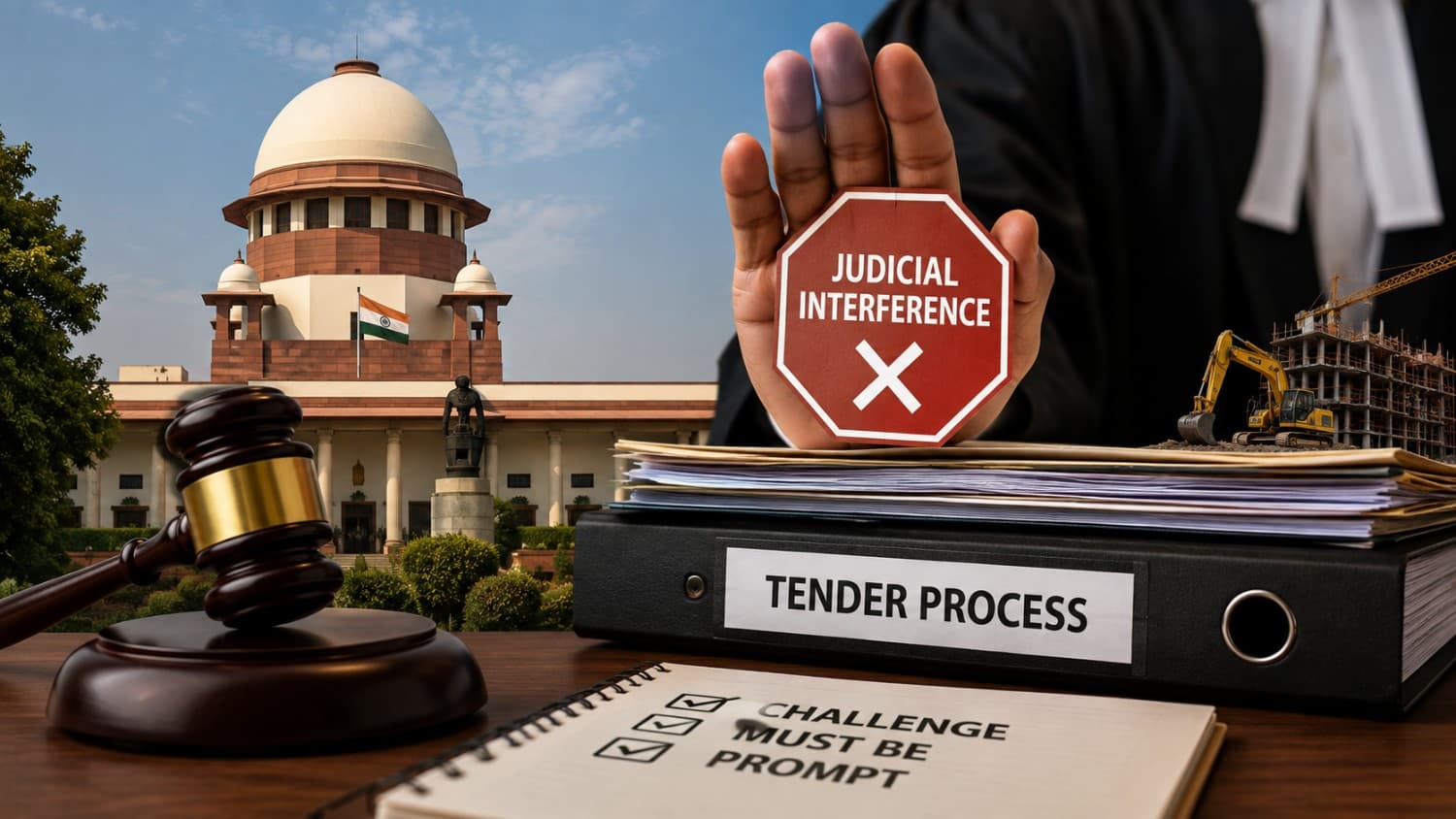
The Supreme Court on Tuesday dismissed appeals challenging the tender conditions for the procurement of sports goods and outdoor gymnasium equipment for government schools in Delhi, observing that judicial interference at an advanced stage of the tender process is not warranted and may unfairly disrupt the interests of bidders who have complied with the process.
A bench comprising Justice KV Viswanathan and Justice Arun Palli noted that the tender notices were issued on December 22, 2025, with the bidding deadline set for January 13, 2026. The writ petition challenging the tender conditions was filed only on April 1, 2026, approximately four months after the publication of the tender.
The Court highlighted that by the time the challenge was raised, substantial progress had been made in the procurement process. One of the six tenders had already been awarded, while the remaining tenders had advanced through document verification, physical demonstration, and had reached the stage of financial evaluation.
The judgment, authored by Justice Palli, observed that tender schedules operate within compressed and purpose-bound timelines. It stated that a delay of four months, while appearing modest in calendar terms, may represent a critical phase in the tender lifecycle — between invitation and evaluation, evaluation and selection, and ultimately, the crystallization of competing interests.
The Court emphasized that delay in such matters cannot be assessed merely by counting days but must be evaluated by reference to what has transpired during the intervening period, whose rights have arisen, and what public consequences would follow from unsettling the process at that stage.
The bench held that those who participated in the tender process, fulfilled all eligibility criteria, and underwent rigorous technical evaluation had acquired certain rights and interests by the verge of final price bid evaluation. To stall the process at that point to accommodate a belated challenge would be unfair and unjust to such bidders.
The Court further held that a challenge to an eligibility condition accrues on the very day the condition is published. A bidder who considers itself excluded or rendered ineligible by an allegedly arbitrary condition must raise the grievance at the earliest opportunity. The appellants, despite having notice of the tender conditions from the inception, chose to remain silent for four months before approaching the High Court.
The Court noted that the appellants had challenged a condition requiring sports equipment suppliers to maintain a fully functional office in Delhi and a warehouse in Delhi or the National Capital Region for the previous three years. The condition was justified by the procuring authority on the grounds that equipment might need to be supplied at short notice.
The appellants had relied on the Supreme Court’s 2025 decision in Vinishma Technologies Pvt. Ltd. v. State of Chhattisgarh, where a tender condition requiring prior supply experience specifically to state government agencies in Chhattisgarh was held to be arbitrary and discriminatory. The Supreme Court, however, distinguished that precedent, noting that the Delhi condition was tied to logistical readiness and proximity for timely supply, which served a legitimate public purpose.
The procurement involved sports and gymnasium equipment worth approximately ₹34 crore, intended for approximately 16 lakh school students across Delhi. The Court observed that a substantial portion of the procurement had come to a standstill due to the litigation, thereby defeating the public purpose behind the tender.
The bench concluded that judicial discretion must be exercised with extreme circumspection to prevent fence-sitters, proxies, and unscrupulous litigants from exploiting delayed challenges to disrupt ongoing procurement processes. It reiterated that timely action is essential in tender disputes to protect both the integrity of the process and the rights of compliant participants.