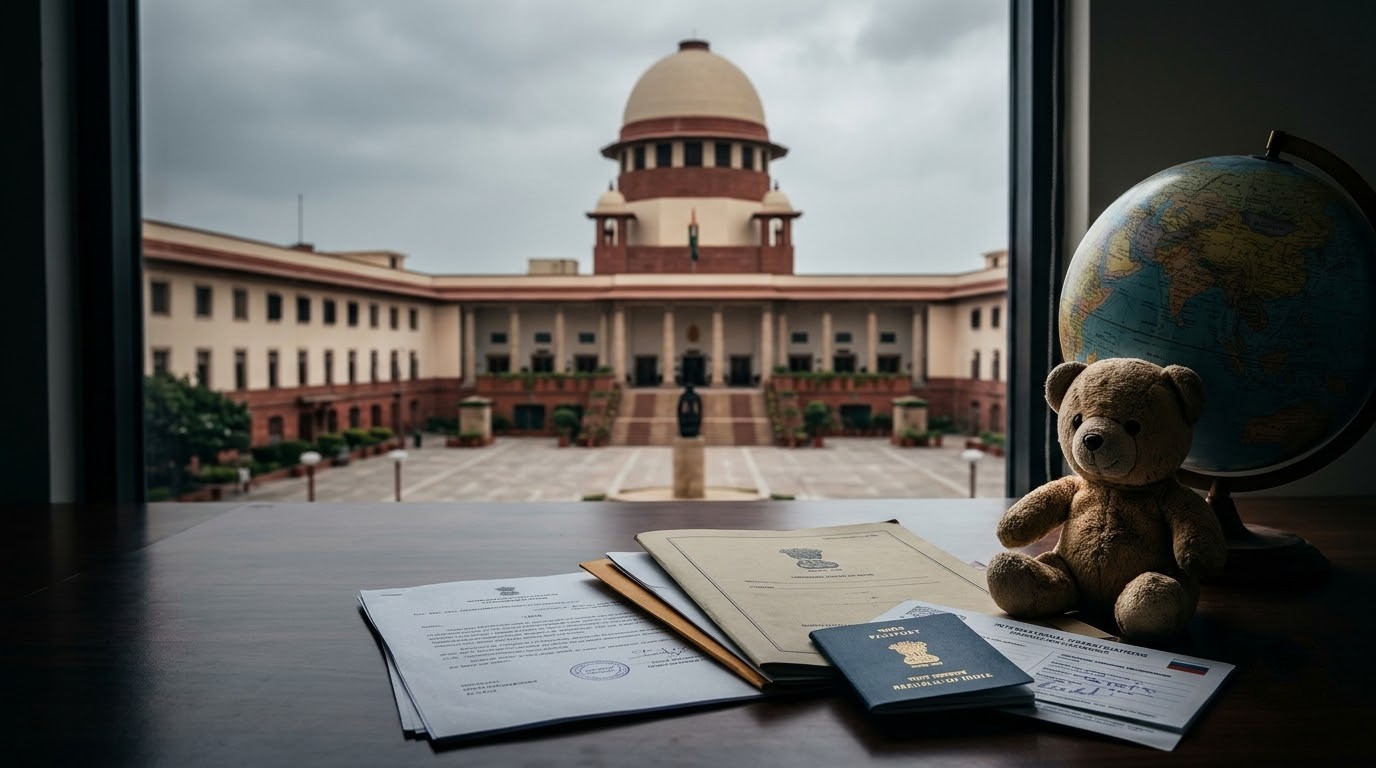
The Supreme Court has directed the Central government to deploy its full diplomatic and legal apparatus to secure the return of a six-year-old child who was removed to Russia by his mother in violation of the Court's custody orders. A Bench comprising Justices Dipankar Datta and Sheel Nagu passed the order on November 3 in the matter Viktoriia Basu v. State of West Bengal, observing that the Court's dignity was at stake following the mother's unauthorised departure with the child.
Factual Background and Custody Proceedings
The dispute originated between Viktoriia Basu, a Russian national residing in India since 2019, and her estranged husband, Saikat Basu. In 2023, Ms. Basu approached the Supreme Court under Article 32 of the Constitution seeking a writ of habeas corpus for the production of their son, alleging denial of access. The Court exercised its jurisdiction as parens patriae—acting as guardian of a person unable to protect their own interests—to regulate interim custody arrangements.
Following failed mediation and temporary accommodation at Banga Bhawan in Delhi, the Court formalised a shared custody arrangement on May 22, 2025. Under this order, the child was to reside with the mother for three days a week and the father for the remaining four days. On July 7, 2025, the father informed the Court that the mother and child were missing. A Delhi Police investigation established that Ms. Basu had travelled from Delhi to Narkatiaganj in Bihar, crossed into Nepal, and proceeded to Russia via Sharjah in the United Arab Emirates.
Court's Observations on Interference with Justice
On August 1, 2025, the Supreme Court clarified that the child was, for all practical purposes, in its custody. The Bench took serious exception to the mother's conduct, noting that her departure through Nepal, assisted by the Russian Embassy, amounted to interference with the administration of justice. During the November 3 hearing, the Court orally remarked that the mother could not be allowed to take advantage of the leniency shown during proceedings. The Bench stated that the Russian Federation was presumed to be aware of the situation and directed the Centre to throw its full weight behind the repatriation effort.
Diplomatic and Investigative Steps Undertaken
The Court's directions have triggered a multi-agency response spanning several months. The Ministry of External Affairs (MEA) was instructed to engage the Indian Embassy in Moscow to establish contact with the mother and child. By September 26, 2025, Interpol had issued a Blue Corner Notice against Ms. Basu and a Yellow Corner Notice for the child. The Indian Embassy in Moscow addressed the Russian Prosecutor General on September 18 and 22 seeking investigative assistance, though no response had been received at that time.
The Delhi Police were directed to coordinate with Nepalese authorities and the Russian Embassy in New Delhi to pursue custody of persons suspected of involvement in the alleged offence and contempt of court. In a parallel criminal proceeding before the Saket Court, the Delhi Police disclosed on October 23 that a Red Corner Notice had been issued against Ms. Basu and a formal extradition request had been transmitted through the Ministry of Home Affairs, the MEA, and the Indian Embassy in Moscow. The Supreme Court noted that these criminal proceedings were distinct from its own directions.
Supreme Court Directs Centre to Bring Back Child Taken to Russia
The Supreme Court has ordered the Central government to take all urgent diplomatic and legal measures to repatriate a six-year-old child removed to Russia by his mother in breach of the Court's custody orders, holding that her departure constituted a direct affront to the administration of justice and the Court's parens patriae jurisdiction.
Notice Type | Issuing Authority | Subject | Purpose |
|---|---|---|---|
Blue Corner Notice | Interpol | Viktoriia Basu | Locate/identify person of interest in criminal investigation |
Yellow Corner Notice | Interpol | Child | Locate missing person |
Red Corner Notice | Interpol | Viktoriia Basu | Seek provisional arrest for extradition |
Interim Measures and Future Course
Given the complexity of securing physical return, the Bench proposed an interim arrangement whereby the child and mother could be connected with the father via video conference, preserving their anonymity without requiring immediate repatriation. The Indian Embassy in Russia was tasked with presenting this proposal to Russian authorities, and the MEA was directed to place the questionnaire and outcome of discussions on record. The Court has made clear that it will not relent on the primary objective of restoring the child to its jurisdiction, emphasising that the integrity of judicial orders must be upheld irrespective of international borders.