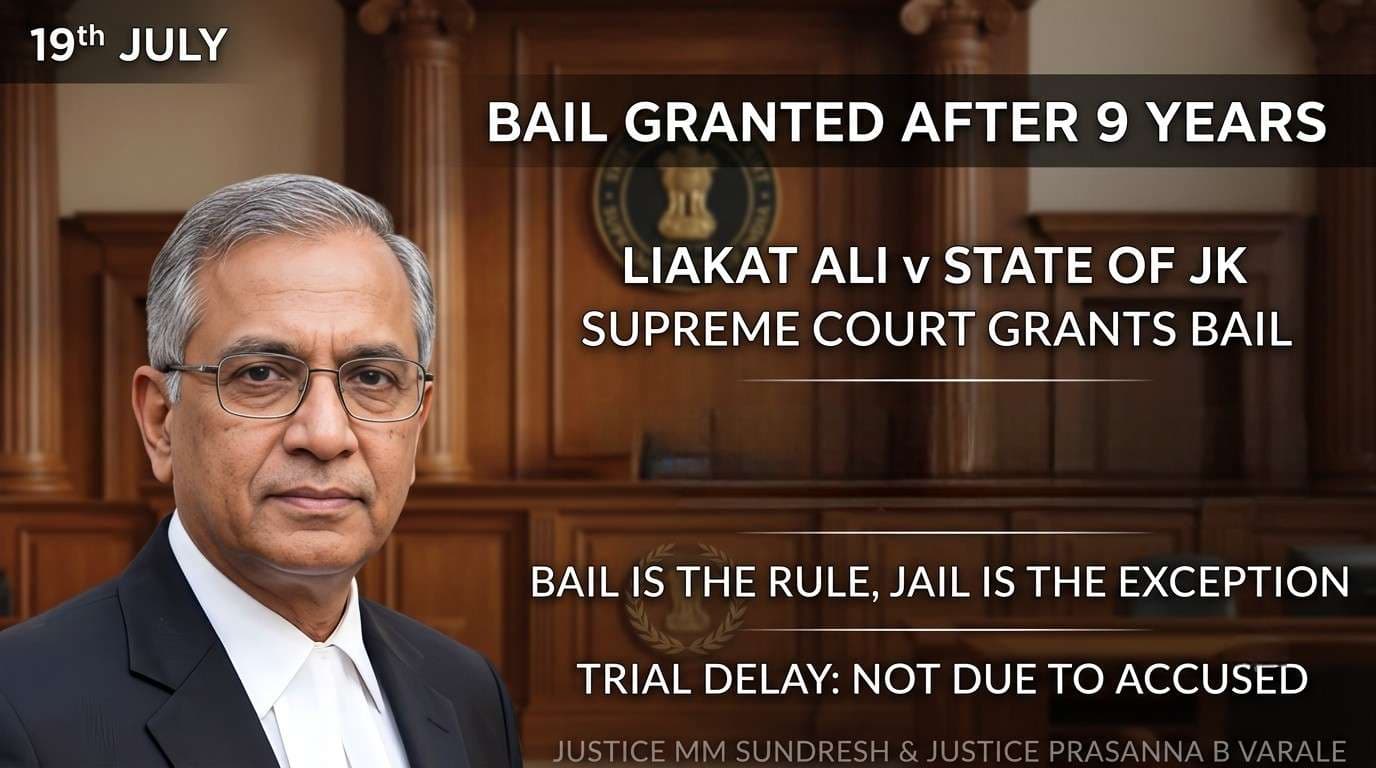
The Supreme Court of India, comprising Justice MM Sundresh and Justice Prasanna B Varale, granted bail to Liakat Ali in the matter Liakat Ali v State of Jammu and Kashmir. The accused had been in judicial custody for nine years and two months following his arrest in connection with the alleged kidnapping and murder of a nineteen‑year‑old in 2017. The Court noted that the continued delay in trial and the prolonged incarceration shocked its judicial conscience.
The Bench observed that the petitioner was a teenager at the time of the alleged offence and that the prosecution’s case rested entirely on circumstantial evidence, namely the claim that the deceased was last seen with the accused before he went missing. It further recorded that only twelve of the thirty prosecution witnesses had been examined so far and that the delay in the trial was not attributable to the accused.
Invoking its powers under Article 32 of the Constitution, the Court emphasized that an accused is presumed innocent until proved guilty after trial. It reiterated the well‑settled principle that bail is the rule and jail is the exception, and that this principle must be borne in mind while considering bail applications, especially where trial proceedings are unduly delayed.
The Court also highlighted the duty of the trial court and the prosecuting agency to expedite the conduct of trial when an accused remains in custody. It stated that when the accused is under incarceration, it is incumbent upon the Court and the prosecuting agency to expedite the conduct of the trial. Finding that the trial in the 2017 case was unlikely to conclude any time soon, the Bench ordered the release of Liakat Ali subject to bail conditions that the concerned trial court may impose.
During the bail proceedings before the district court in Jammu, the accused’s counsel had pointed out the snail‑pace of the trial and the reliance on circumstantial evidence. The district court had dismissed the bail plea in 2023, prompting the accused to approach the Supreme Court. The Supreme Court noted that the accused had denied the allegations and had remained in custody for over nine years despite the lack of progress in the trial.
Advocate Ranjeet Kumar, along with Advocates Simanta Kumar, TR Naval and Sushma Kumari, instructed by Advocate‑on‑Record Dr Pratap Singh Nerwal, appeared for Liakat Ali. Advocate Parth Awasthi, instructed by Advocate‑on‑Record Pashupathi Nath Razdan, represented the Jammu and Kashmir administration.
The order reflects the Court’s concern over undue delay in criminal trials and its willingness to intervene to protect the liberty of an accused who has already suffered prolonged incarceration without fault on his part. The grant of bail is conditional upon the trial court imposing suitable safeguards to ensure the presence of the accused during further proceedings.