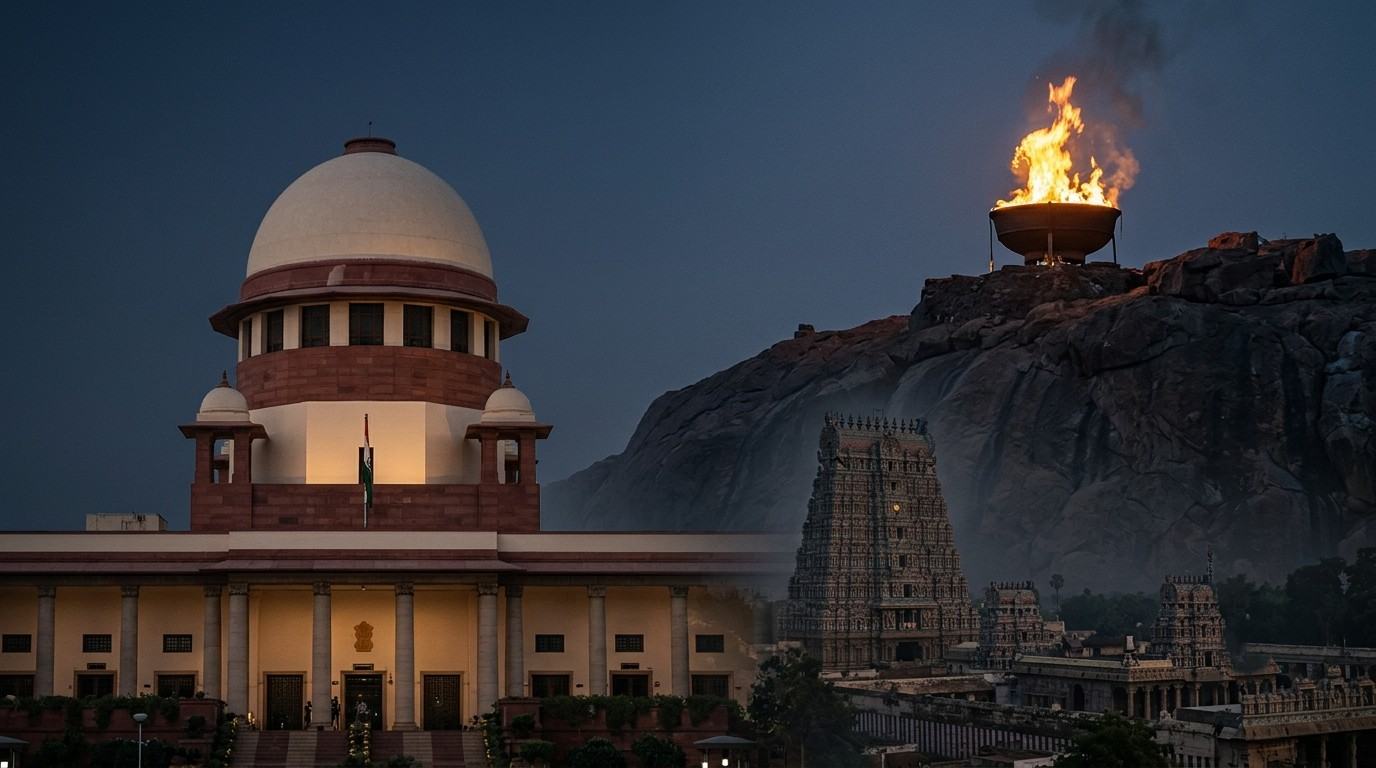
The Supreme Court on November 25 declined to initiate suo motu contempt proceedings against the Tamil Nadu government for non-compliance with its November 20 order permitting the lighting of the Karthigai Deepam at the disputed Deepathoon atop Thiruparankundram hill in Madurai. A Bench comprising Justices Aravind Kumar and Vipul Pancholi granted liberty to the aggrieved parties to file a separate contempt petition against the authorities.
Background of the Dispute
The controversy originated from a plea by devotee Rama Ravikumar seeking permission to light the traditional Karthigai Deepam at the Deepathoon, a stone pillar situated on Thiruparankundram hill. The matter reached the Madras High Court, which issued directions concerning the lighting of the ceremonial lamp at the disputed location. The Tamil Nadu government subsequently challenged the High Court's directions before the Supreme Court.
On November 20, the Supreme Court passed an order permitting a small team authorised by the temple administration to light the Karthigai Deepam at the disputed Deepathoon on November 24 as a one-time arrangement. The Madurai District Collector, Nishant Krishn, was entrusted with supervising the exercise and coordinating with the concerned authorities. The Court also directed the Collector to submit a compliance report within three days after the festival.
State's Explanation for Non-Compliance
During the hearing on November 25, Senior Advocate Gopal Sankaranarayanan, appearing for the District Collector, submitted that despite efforts by the district administration, the lamp could not be lit at the designated pillar. The Collector, in an affidavit filed before the Court, stated that he had made efforts to ensure compliance with the Supreme Court's directions. However, the temple administration allegedly refused to permit the ritual at the disputed location, maintaining that such an exercise would be contrary to its established customs and religious practices.
Consequently, the ceremonial lamp was lit at the traditional Deepa Mandapam near the Uchipillaiyar Temple instead of the Deepathoon. The temple administration reportedly contended that the disputed pillar was a British-era survey stone and not a designated religious lamp-lighting location. The District Collector also tendered an apology before the Supreme Court for the non-compliance.
Petitioner's Allegations and Court's Disposition
Petitioner Rama Ravikumar alleged that the State had failed to honour its assurance regarding implementation of the Supreme Court's directions. He questioned the role of the temple administration in preventing compliance with the judicial order and sought contempt action against the authorities for allegedly disobeying the Court's directions.
The Bench declined to initiate contempt proceedings suo motu. Senior Advocate Guru Krishnakumar informed the Court that a contempt petition would be filed shortly and sought permission to mention the matter at 12:30 PM. The Court granted the requested liberty.
What was the Supreme Court's November 20 order regarding the Thiruparankundram Deepam?
The Supreme Court permitted a small team authorised by the temple administration to light the Karthigai Deepam at the disputed Deepathoon on November 24 as a one-time arrangement. The Madurai District Collector was directed to supervise the exercise and submit a compliance report within three days.
Pending Adjudication
The larger dispute concerning the site, religious customs, and competing claims remains pending for final adjudication. The latest proceedings have underscored the tension between judicial directions and the administrative autonomy of temple administrations in matters of religious practice. The Court's refusal to initiate suo motu contempt, while granting liberty to file a formal petition, indicates a procedural approach to enforcing its directives amidst competing administrative and religious assertions.