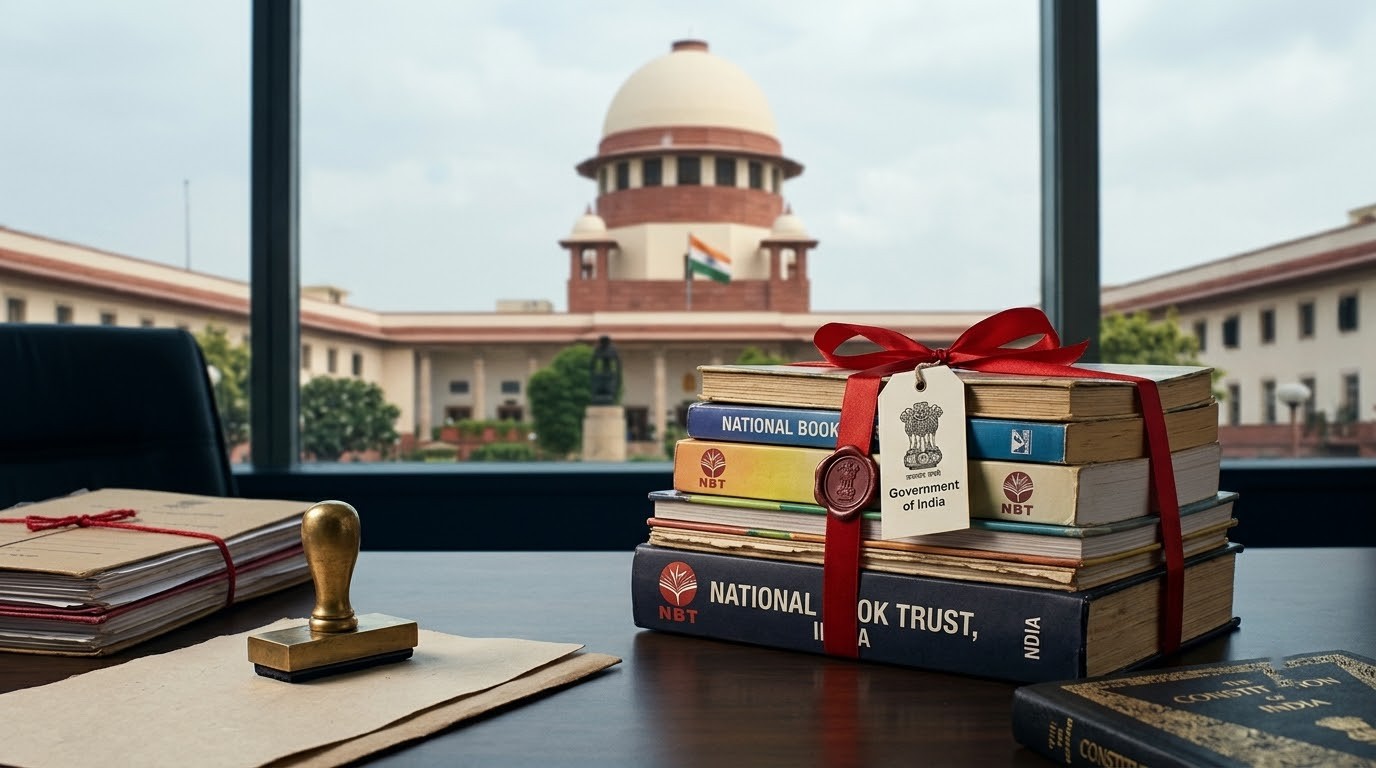
A Bench of the Supreme Court comprising Justice Prashant Kumar Mishra and Justice Augustine George Masih has held that the National Book Trust (NBT) is an 'authority' within the meaning of Article 12 of the Constitution. The Court dismissed an appeal filed by the Trust against a Delhi High Court judgment which had declared it to be 'State' for the purpose of enforcing fundamental rights. The ruling reaffirms that the test for determining 'State' status requires a cumulative assessment of financial, functional, and administrative domination by the Government, rather than a narrow focus on revenue generation or legal form.
What is the test for determining whether a body qualifies as 'State' under Article 12?
The Court applied the principles from Ajay Hasia and Pradeep Kumar Biswas, holding that the inquiry requires a cumulative assessment of financial, functional, and administrative control by the Government. Mere performance of public functions or independent revenue generation does not automatically exclude a body from Article 12 if pervasive governmental control exists over its constitution, governance, and audit.
Government Control Over Constitution and Governance
The Court observed that the Government exercises control beginning from the creation of the Trust. Established through Government resolutions, the Trust's governing composition is substantially determined by the State. The Government appoints the Chairman, nominates members to its governing bodies, and retains control over the tenure of the Chairman's office. This structural involvement, the Bench noted, goes far beyond limited regulatory supervision.
Financial Administration and Audit
The judgment highlighted that Government participation permeates the Trust's financial administration. The rules concerning the Trust's accounts and the audit by the Comptroller and Auditor General (CAG) demonstrate that governmental involvement in financial affairs is structurally embedded. The Court rejected the argument that the Trust's independent revenue from publication sales diluted this control, stating that financial autonomy in one aspect cannot be isolated from the regulatory structure governing the body's composition, management, and supervision.
Registration as Society Does Not Exclude Article 12
Addressing the Trust's contention that its registration as a society under the Societies Registration Act insulated it from Article 12, the Court held that the legal form of incorporation is not decisive. The inquiry is not confined to the organisational form but extends to the actual nature of governmental control. The Bench observed that the Trust satisfies the test of being financially, functionally, and administratively dominated by the Government, with that control being particular and pervasive in character.
Scope of the Declaration
The Court clarified that the declaration of 'State' status under Article 12 does not convert the Trust into a Government department or automatically render its employees civil servants. Consequently, the protections available to Government servants under Articles 309, 310, and 311 of the Constitution do not flow automatically from this finding. The nature of the Trust's functions must be considered alongside the extent of governmental control; performance of public functions alone would not automatically attract Article 12.
Factor | Court's Finding |
|---|---|
Constitution | Established by Government resolutions; Government participates in creation. |
Governing Composition | Government appoints Chairman; nominates members; controls tenure. |
Financial Administration | Government participates in financial administration; rules and audit structurally embedded. |
Audit Mechanism | Accounts audited by Comptroller and Auditor General (CAG). |
Independent Revenue | Revenue from publications does not displace pervasive governmental control. |
Legal Form | Registration as society does not exclude Article 12 applicability. |
The appeal was dismissed, thereby upholding the Delhi High Court's judgment. Senior Advocate Sanjay Jain appeared as Amicus Curiae, assisted by Advocate Harshita Sukhija.