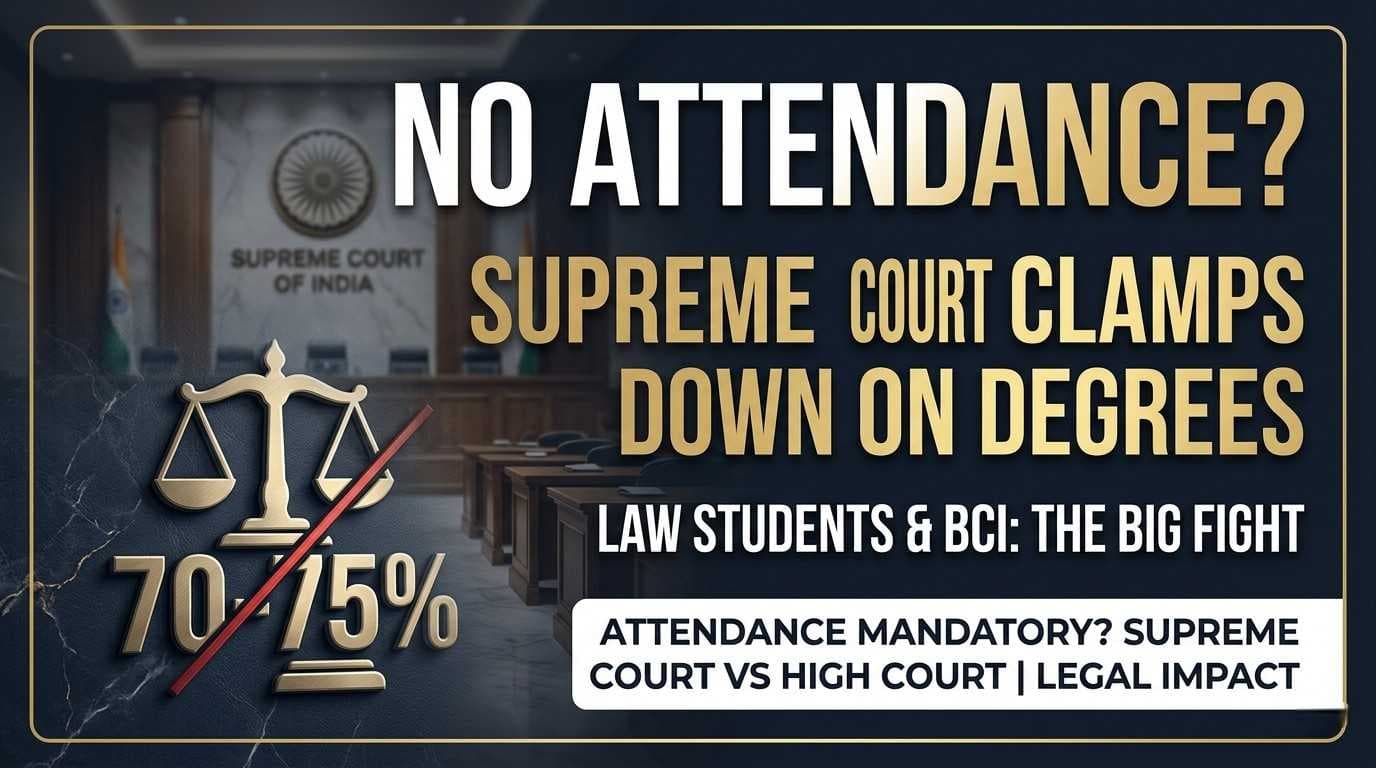
The Supreme Court of India has raised critical questions regarding a Delhi High Court decision that restrained a law school from debarring students due to shortfalls in attendance. This intervention highlights a growing tension between judicial empathy for students and the rigid professional standards mandated by the Bar Council of India (BCI). The apex court’s scrutiny suggests a potential pivot back toward strict adherence to academic discipline within professional courses, particularly in the field of legal education.
The controversy began when the Delhi High Court granted relief to students who failed to meet the mandatory 70% to 75% attendance threshold. The lower court had previously ruled in favor of allowing these students to sit for examinations, citing various compassionate grounds. However, the Supreme Court has expressed reservations about this approach, noting that professional degrees require a level of rigor that cannot be maintained if attendance requirements are treated as mere formalities or optional guidelines.
Central to the Supreme Court's observation is the role of the Bar Council of India (BCI) as the apex regulatory body for legal education. The BCI rules explicitly state that students must attend a minimum percentage of classes to qualify for a degree and subsequent enrollment at the Bar. The apex court noted that if high courts continue to grant ad-hoc waivers, it could lead to a systemic dilution of the quality of legal professionals entering the workforce, effectively undermining the BCI’s regulatory authority.
The bench emphasized that "regularity and discipline" are the hallmarks of the legal profession. By questioning the High Court’s leniency, the Supreme Court is signaling that the classroom environment is an essential component of legal training that cannot be substituted by self-study or compensated for by exam performance alone. The court suggested that habitual absenteeism should not be regularized through judicial intervention unless there are extraordinary and legally recognized circumstances.
Furthermore, the court touched upon the precedent such rulings set for educational institutions across the country. If students believe that the judiciary will provide a safety net for low attendance, it could lead to widespread non-compliance with university statutes. This, in turn, places educational administrators in a difficult position, as they struggle to enforce the very rules designed to maintain the integrity and accreditation of their academic programs.
From an expert legal perspective, this case underscores the "rule-based" versus "equity-based" conflict in administrative law. While the High Court attempted to exercise its equitable jurisdiction to save the students' academic years, the Supreme Court appears more inclined to uphold the "rule of law" and statutory compliance. The apex court’s line of questioning indicates that personal hardships, while regrettable, may not always justify the bypassing of mandatory professional training requirements.
The social and professional implications of this ruling are significant for the entire Indian higher education system. It serves as a reminder to students that professional courses carry a higher burden of responsibility. The Supreme Court’s skepticism toward "attendance waivers" suggests that the judiciary may no longer be willing to act as a grievance redressal forum for students who fail to meet the basic administrative criteria set by their respective governing councils.
Ultimately, the Supreme Court’s final decision in this matter will likely redefine the boundaries of judicial interference in academic policy. By prioritizing the standards of the legal profession over individual student convenience, the court aims to ensure that the title of "Advocate" remains associated with a rigorous and disciplined educational background. This case marks a vital moment in reaffirming that professional excellence begins with the discipline of the classroom.