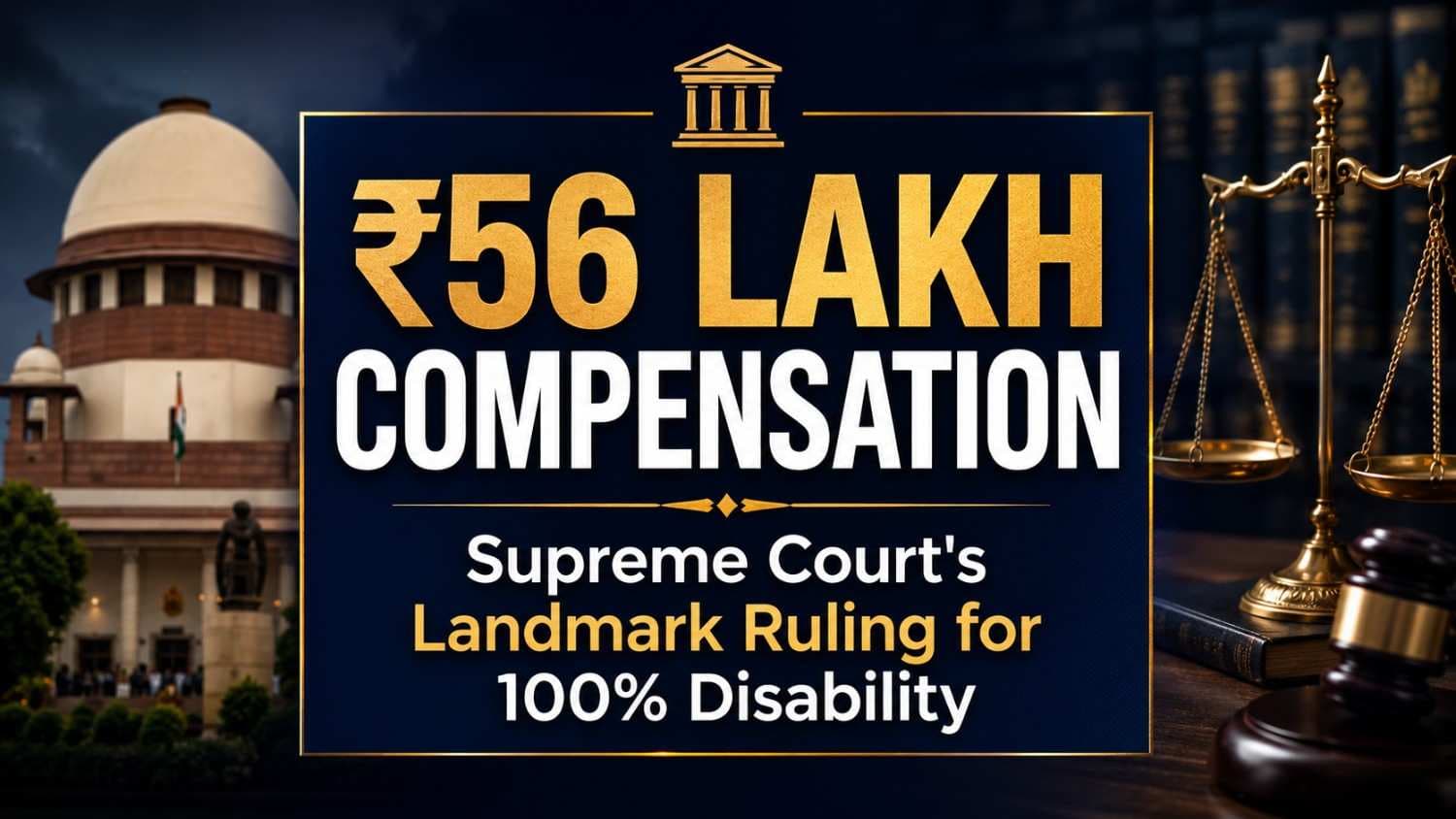
In a significant judgment that reinforces the principle of "just compensation," the Supreme Court of India has enhanced the compensation awarded to a young girl who was left 100% disabled following a tragic motor accident at the age of 14. Moving beyond a mere mathematical calculation of loss, the Court highlighted the profound human suffering and the lifelong challenges faced by victims of severe accidents.
The Bench, comprising Justice Abhay S. Oka and Justice Rajesh Bindal, emphasized that while no amount of money can truly restore a person’s physical health or lost childhood, the law must ensure that the victim is provided with enough financial support to live a life of dignity.
The Background of the Case
The case dates back to an unfortunate road accident involving a 14-year-old girl. The victim was hit by a rashly driven vehicle, resulting in catastrophic injuries. Medical evaluations confirmed that the girl suffered from $100\%$ permanent functional disability. This meant she would be dependent on others for her most basic needs for the rest of her life.
The legal journey began at the Motor Accident Claims Tribunal (MACT), which awarded a certain amount of compensation. Dissatisfied with the quantum, the family moved the High Court. While the High Court did increase the amount, the family felt the award still failed to account for the reality of rising medical costs, the need for a lifelong attendant, and the loss of future marriage prospects and earnings. This led them to the doors of the Supreme Court.
The Core Legal Issue: What is "Just Compensation"?
Under the Motor Vehicles Act, the primary duty of the Courts is to determine "just compensation." The Supreme Court observed that in cases of permanent disability, especially involving children, the calculation cannot be restricted to just immediate medical bills.
The Court looked at several key factors:
- Loss of Future Earnings: Even though the victim was a student, the Court must estimate what she could have earned in the future.
- Attendant Charges: Since she is $100\%$ disabled, she requires a full-time caregiver.
- Non-Pecuniary Damages: This includes "Pain and Suffering," "Loss of Amenities of Life," and "Loss of Marriage Prospects."
Breaking Down the Supreme Court’s Decision
1. Future Income and "Future Prospects"
One of the most critical aspects of the judgment was the assessment of future income. The Court noted that even if a child is not yet an earning member, they have the potential to build a career. Following the precedent set in cases like Kajal v. Jagdish Chand, the Court applied the "Future Prospects" rule, adding a percentage to the assumed income to account for inflation and career growth.
2. The Multiplier Method
The Court used the standard "Multiplier Method" to calculate the total loss. Given the victim was 14 years old, the appropriate multiplier was applied to ensure the fund would last her entire lifetime.
3. Attendant Charges: A Lifelong Necessity
The High Court had previously awarded a lower amount for attendant charges. However, the Supreme Court took a more realistic view. It noted that as the victim ages, her parents may not always be able to provide physical care. Therefore, the cost of hiring a professional attendant must be calculated based on minimum wages and projected over her lifetime. The Court increased this component significantly.
4. Loss of Marriage Prospects and Amenities
The Court expressed deep empathy for the victim, noting that the accident had effectively robbed her of the chance to lead a "normal" social life, including the possibility of marriage and the simple joys of physical movement (amenities). For this, the Court awarded substantial damages under non-pecuniary heads.
The Final Award: ₹56.64 Lakhs
After meticulously recalculating every head of the claim, the Supreme Court enhanced the total compensation to approximately ₹56.64 Lakhs. The Court also directed that this amount be paid with interest (typically $6\%$ to $9\%$ per annum) from the date of the claim petition.
The Court directed the insurance company to deposit the enhanced amount within a specified period, ensuring that the family receives the funds without further procedural delays.
Why This Judgment Matters
This ruling serves as a vital precedent for several reasons:
- Dignity Over Arithmetic: It reminds lower courts and tribunals that compensation is about restoring dignity, not just fulfilling a legal formula.
- Realistic Attendant Costs: By recognizing the high cost of lifelong care, the Court has provided a roadmap for how attendant charges should be calculated in cases of $100\%$ disability.
- Protection of Minors: It highlights the judiciary's role as a guardian for minors who suffer life-altering injuries, ensuring their future is financially secure.
Comparison with Professional Legal Portals
Similar to reports on Live Law and Bar & Bench, this case underscores the shifting trend in Indian tort law toward more victim-centric awards. Legal experts suggest that this judgment will be frequently cited in future MACT cases where victims are young and have suffered total disability.
Conclusion
The Supreme Court’s decision to grant ₹56 Lakhs to a 14-year-old victim is a testament to the "healing touch" of the judiciary. While the physical scars of the accident remain, the financial security provided by this judgment ensures that the victim will not be a burden on society and can afford the specialized care she requires. It is a landmark moment for personal injury law in India, emphasizing that justice must be both compassionate and comprehensive.