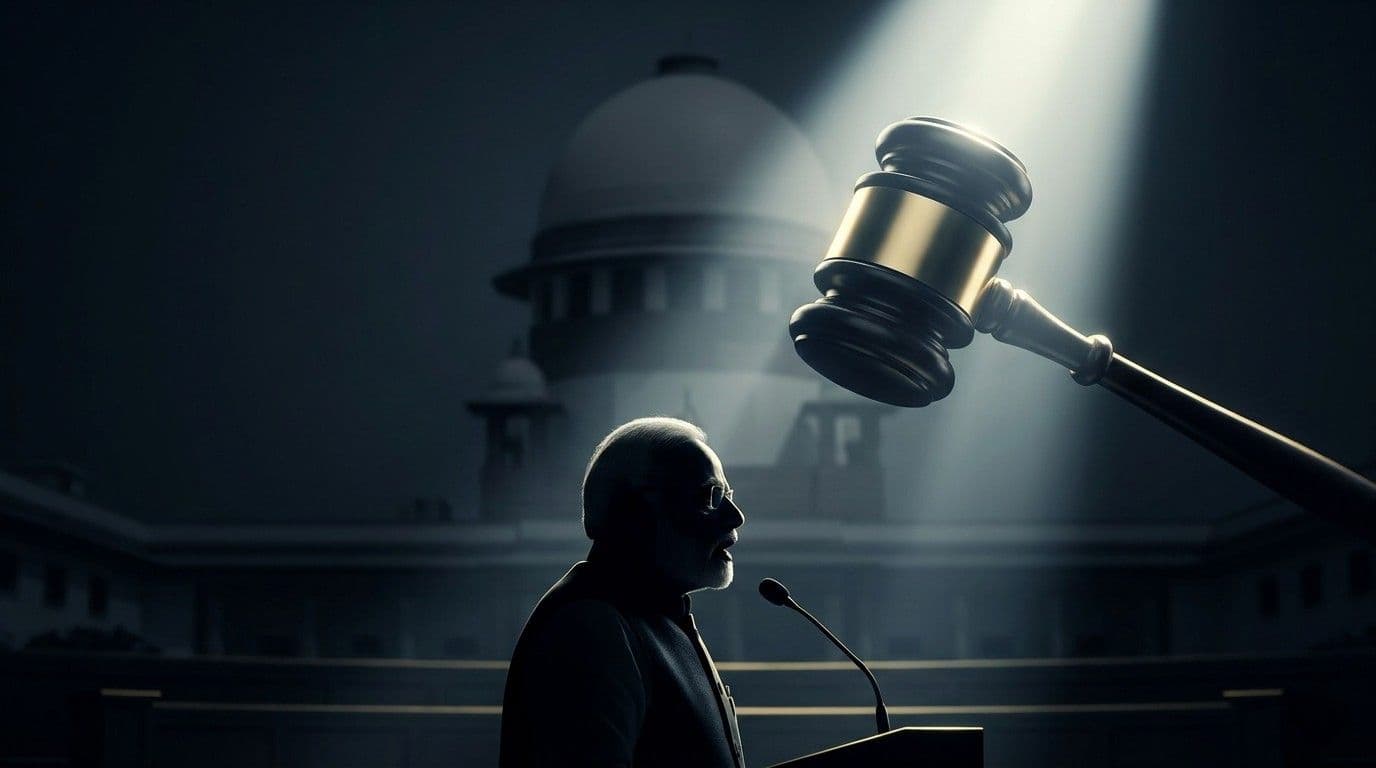
A fresh legal challenge has been brought before the Supreme Court of India regarding the ongoing controversy surrounding comments made by DMK leader and Tamil Nadu Leader of the Opposition, Udhayanidhi Stalin. In an application filed within an existing contempt petition (Amita Sachdeva v. Udhayanidhi Stalin), a petitioner has formally drawn the apex court's attention to new remarks delivered by Stalin on May 12, 2026, during legislative proceedings inside the Tamil Nadu Assembly. The application contends that these statements constitute a wilful disregard for ongoing judicial proceedings and the court's prior expressions of disapproval.
The genesis of this prolonged legal battle trace back to September 2023, when Stalin drew national scrutiny by comparing "Sanatana Dharma" to infectious diseases like malaria and dengue, advocating for its elimination on the grounds that it was inherently rooted in caste-based discrimination. While those original comments triggered multiple criminal complaints across several states, the Supreme Court subsequently intervened to consolidate the scattered First Information Reports (FIRs) and granted Stalin protection from physical appearances in lower courts, later ruling in 2025 that no fresh complaints could be entertained without the apex court's explicit permission.
The current legal friction arises from Stalin’s recent address in the Tamil Nadu Assembly. While raising a grievance regarding the protocol order of the state invocation song (Tamil Thai Vazhthu) during a recent governmental ceremony, the Leader of the Opposition explicitly reiterated his stance, stating on the floor of the House that "Sanatana Dharma, which divides people, must certainly be abolished." The petitioner argues that making such remarks while the matter remains actively sub judice before a bench comprising Justices Vikram Nath, Sandeep Mehta, and Vijay Bishnoi demonstrates an intentional bypass of judicial propriety.
This development highlights a complex constitutional conflict between legislative privilege and judicial overwatch. Under Article 194 of the Constitution, members of state legislatures enjoy absolute immunity regarding anything said on the floor of the House, a protective shield designed to ensure uninhibited legislative debate. However, the petitioner's strategy of filing this within an active contempt framework attempts to test whether speech protected inside an Assembly can still be treated as a continuous factor in evaluating a litigant's conduct and "wilful disregard" before the highest court of the land.
In response to the mounting political and legal pushback following his Assembly address, Stalin offered a public clarification, arguing that his interpretation of "destroying Sanatana" has been consistently misconstrued by political opponents. He maintained that his critique does not imply that citizens should cease visiting temples or practicing their faith. Instead, he argued that his remarks merely echo the social philosophies of reformers like Periyar, Dr. B.R. Ambedkar, and C.N. Annadurai, aiming strictly at dismantling institutional structures that divide society into rigid hierarchical castes.
The Supreme Court is scheduled to consider this fresh application on May 19, 2026. The upcoming hearing will likely force the apex court to navigate the narrow boundary between a politician's freedom of speech, the absolute privileges extended to legislative proceedings, and the authority of the judiciary to regulate the public conduct of a respondent during the pendency of a constitutional challenge.