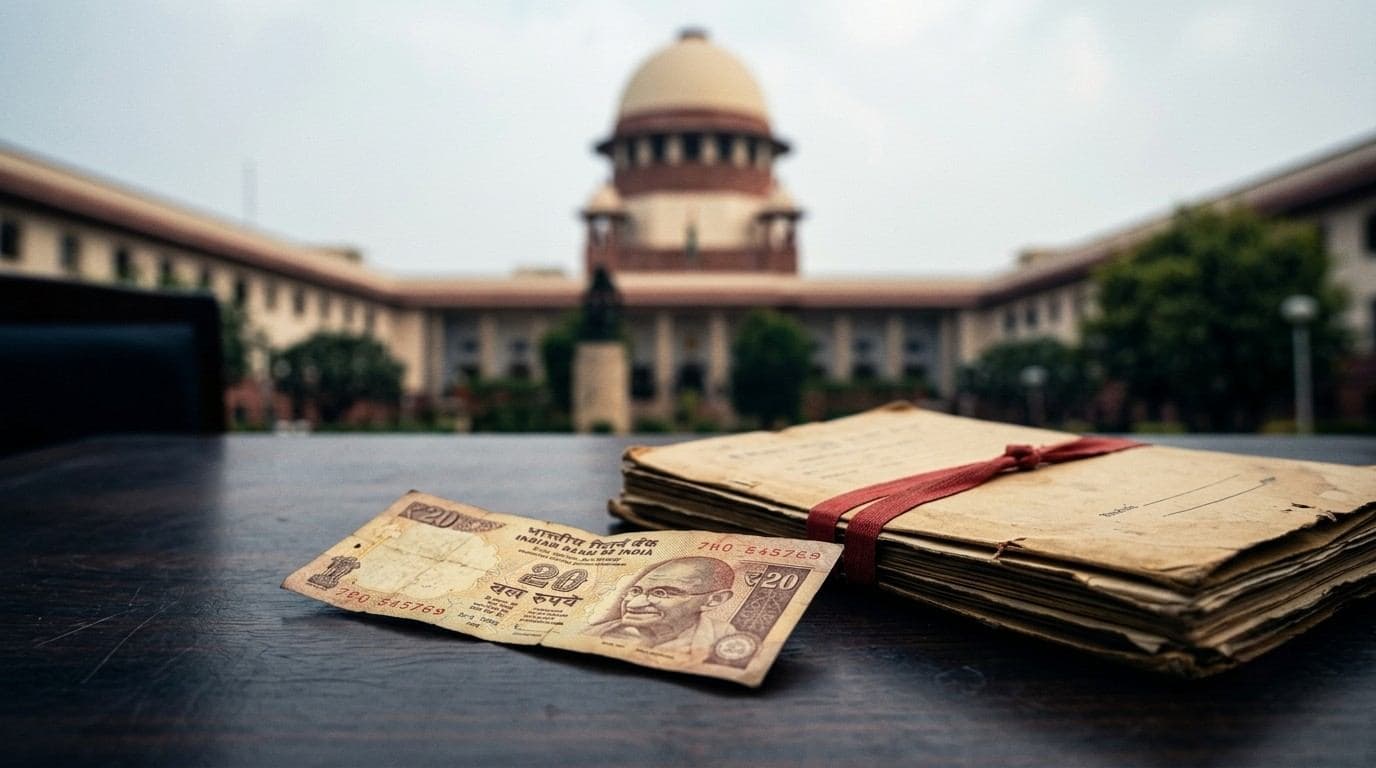
The Supreme Court on Wednesday acquitted Rafikmiya Ahmedmiya Malek and another government employee in a corruption case that had been pending for nearly three decades, arising from a complaint filed in February 1996. The case pertained to an alleged demand for a bribe of Rs 120 for issuing an income certificate at the Bechri Gram panchayat office in Gujarat. The complainant, a student seeking the certificate for educational concessions, approached the Anti-Corruption Bureau after allegedly being asked to pay Rs 100 to the Talati-cum-Mantri and Rs 20 to the peon working under him.
The Bureau laid a trap, instructing the student to carry Rs 120 in marked currency notes treated with a detectable chemical powder. After receiving the income certificate, the student handed a Rs 20 note to the peon. A raiding party then intervened and recovered the marked note from the peon’s possession. The Talati-cum-Mantri was not found in possession of the remaining Rs 100. Both employees were convicted by the trial court in 1999 under Sections 7 and 13(1)(d) of the Prevention of Corruption Act, 1988, and the Gujarat High Court affirmed the conviction in 2015.
Before the Supreme Court, the accused challenged the prosecution’s case on the ground that the essential element of demand was never proved. The Bench, comprising Justices Ujjal Bhuyan and Atul S Chandurkar, examined the evidence and found material inconsistencies in the complainant’s statements. It noted that in a separate proceeding, the student had stated that the Talati-cum-Mantri initially demanded Rs 200, which was later reduced to Rs 120 as a settlement — a version that did not align with his testimony before the trial court, where he cited a demand of Rs 120 outright.
The Court further observed that despite being instructed to hand over the entire Rs 120 only upon a demand being made, the student gave only Rs 20 to the peon, who was standing near the Talati-cum-Mantri at the time and did not question why the full amount was not handed over. This conduct, the Court noted, raised doubt about whether a demand of Rs 120 had actually been made.
Crucially, during cross-examination before the trial court, the student admitted that the peon had never demanded any money from him. The Court emphasized that the Rs 20 was handed over only after the income certificate had already been prepared and delivered to the student, undermining the prosecution’s narrative that the payment was made as part of a bribe demand.
Considering these facts, the Court held that the mere recovery of Rs 20 from the peon could not trigger the presumption of guilt under Section 20 of the Prevention of Corruption Act in the absence of proof of demand. It stated that if the initial demand is not established, the recovery of the amount cannot revive the prosecution’s case to sustain a conviction.
The Court also noted that the peon’s explanation — that the Rs 20 was given to him because Eid was to be celebrated the next day — could be plausible and was not adequately rebutted by the prosecution.
Additionally, the Bench found that the sanction to prosecute the Talati-cum-Mantri was invalid, as it had been granted by an officer lacking the competence to do so under the relevant provisions. This procedural defect further undermined the validity of the prosecution.
Taking into account the lack of proven demand, inconsistencies in the complainant’s account, the timing of the payment, and the invalid sanction, the Supreme Court set aside the convictions recorded by the lower courts and acquitted both accused. The judgment concludes a legal battle that spanned 30 years, underscoring the Court’s insistence on strict adherence to the foundational requirements of criminal liability in corruption cases.