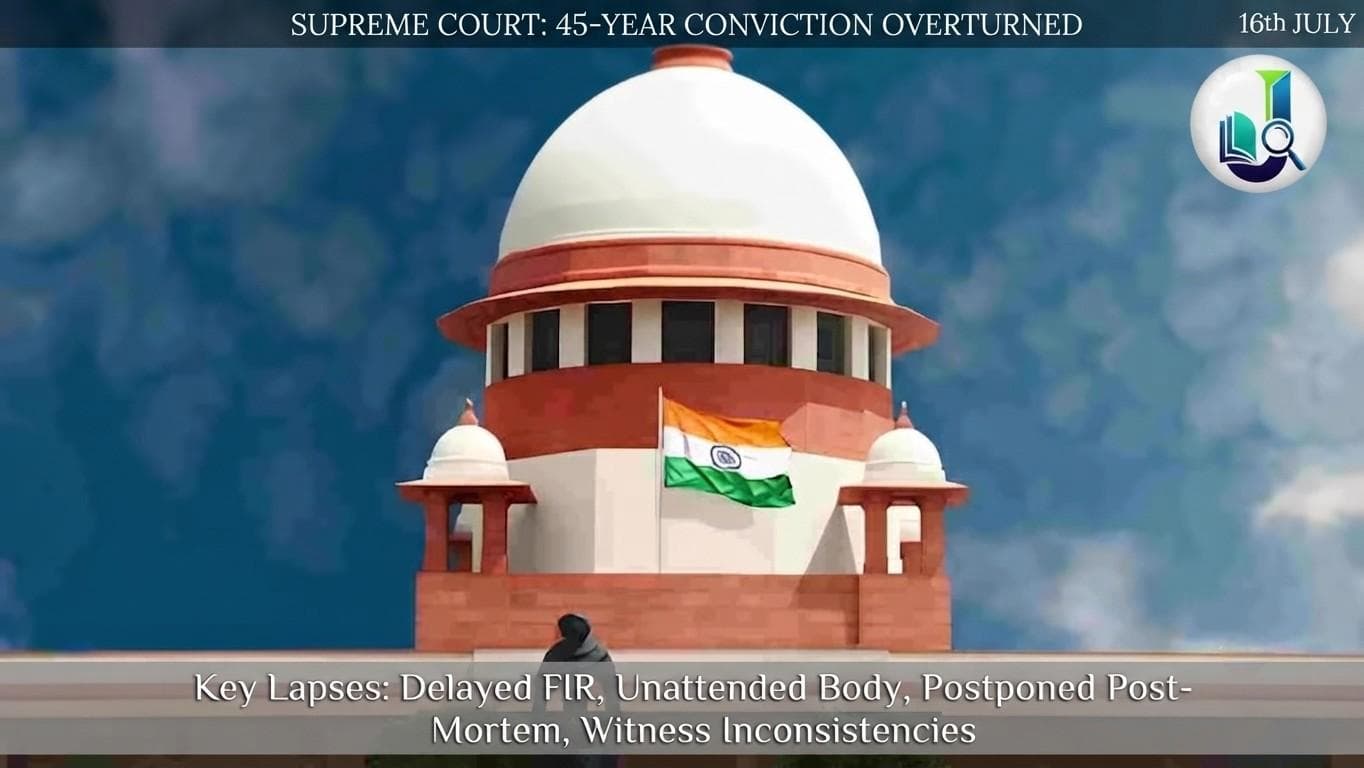
The Bench comprising Justice Vikram Nath and Justice Sandeep Mehta allowed the criminal appeals filed by Subedar, Hira Lal and Raj Bux, thereby acquitting the three appellants who had been convicted under Sections 148 and 302 read with Section 149 of the Indian Penal Code for the alleged murder of Harihar Saran. The trial court had recorded a conviction in 1981 and the Allahabad High Court had affirmed that judgment in 2011. The Supreme Court, while hearing the appeals, concluded that the prosecution had failed to prove the guilt of the accused beyond reasonable doubt.
The Court traced the origins of the case to the incident that occurred on 28 June 1977 near Kanchanpur village in Gonda district, Uttar Pradesh. According to the prosecution version, the deceased was assaulted by six accused armed with spears, lathis and other weapons while returning from a cattle fair. The prosecution relied on the testimony of eyewitnesses and the First Information Report lodged at 7.10 p.m. on the day of the occurrence.
The Bench examined the procedural aspects of the investigation and identified several irregularities that, taken together, undermined the credibility of the prosecution narrative. It observed that although the FIR was purportedly registered at 7.10 p.m. on 28 June, the deceased’s body remained at the scene throughout the night without any effort by the police or the family to secure or preserve it. The Court described this circumstance as striking and glaring, noting that neither the investigating agency nor the relatives of the victim took any step to safeguard the body.
Further, the post‑mortem examination was conducted only on 30 June, almost two days after the alleged incident, without any satisfactory explanation for the delay. The inquest proceedings were similarly postponed to the next day. The Bench held that these lapses, when considered alongside the delay in transmitting the FIR to the jurisdictional Magistrate, raised genuine suspicion about the fairness and integrity of the investigation.
Regarding the FIR, the Court noted that although the document was said to have been lodged on 28 June, it reached the Magistrate only on 30 June. The Bench clarified that mere delay in forwarding the FIR is not, by itself, fatal to the prosecution case. However, when such delay is accompanied by circumstances that suggest the possibility of ante‑timing, ante‑dating or fabrication, it assumes considerable significance. The Court found that the delay in this case was not isolated; it was supported by the unattended body, the delayed post‑mortem, the postponed inquest and contradictory accounts concerning the persons who accompanied the complainant to the police station.
On the question of eyewitness testimony, the Bench pointed out a material inconsistency. The complainant (PW‑1) stated that only one witness had accompanied him to the police station to lodge the FIR, whereas the General Diary recorded the presence of two other relatives. The Court observed that this discrepancy struck at the very genesis of the prosecution case and cast doubt on the authenticity of the alleged eyewitnesses.
The Bench further remarked that the prosecution story appeared to have been tailored after the fact to create the presence of the alleged eye‑witnesses at the crime scene. It stated that the FIR was ante‑timed and the prosecution narrative was subsequently constructed to suit the delayed report. The Court emphasized that when allegations of ante‑timing or fabrication are not merely speculative but find substantive support from the attendant circumstances appearing on the record, the delay in forwarding the FIR acquires considerable significance.
Taking into account the cumulative effect of these infirmities, the Supreme Court held that the prosecution had failed to establish the guilt of the accused beyond reasonable doubt. Consequently, the judgments of the trial court and the High Court were set aside, and the appeals of Subedar, Hira Lal and Raj Bux were allowed. The Court also noted that the appeals against two other accused had abated due to their deaths during the pendency of the proceedings, and one accused had died while the appeal was pending before the High Court.
The decision underscores the importance of a meticulous and transparent investigation, particularly in cases relying heavily on eyewitness testimony and timely documentation. The Bench’s reasoning serves as a reminder that procedural irregularities, when coupled with substantive doubts about evidence, can undermine the foundation of a prosecution and necessitate acquittal even after prolonged litigation.