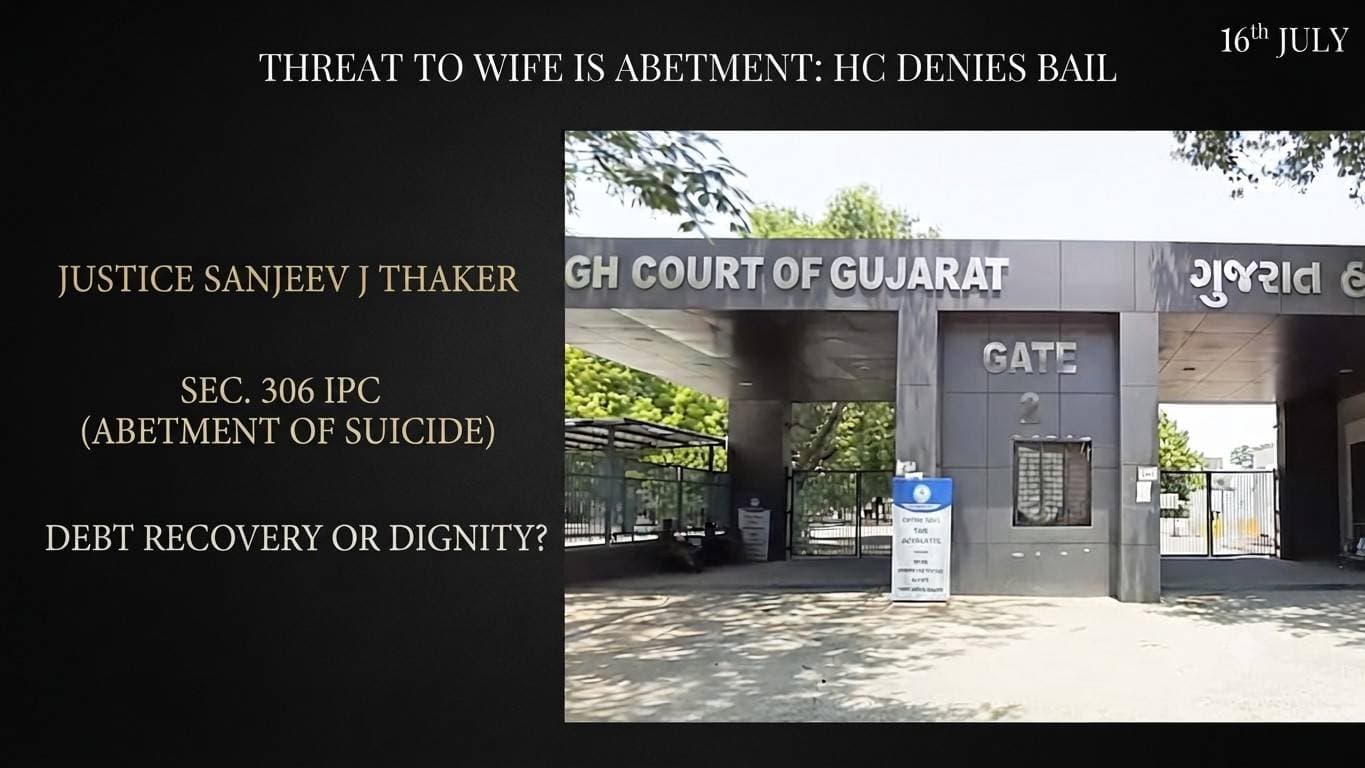
The Gujarat High Court, presided over by Justice Sanjeev J Thaker, considered an application for anticipatory bail filed by two persons accused of abetting the suicide of a debtor. The prosecution alleged that the accused, in an effort to recover an outstanding loan, threatened the debtor that his wife would be forced into prostitution if the amount was not repaid. The Court was required to determine whether such conduct amounted to abetment of suicide under Section 306 of the Indian Penal Code and whether the anticipatory bail plea could be entertained.
Justice Thaker observed that the threat directed at the debtor’s wife struck at the fundamental dignity, honour and sanctity of the family unit. He noted that for any ordinary person, the prospect of being unable to safeguard the dignity and bodily autonomy of one’s spouse is capable of generating severe mental anguish. The Court held that such anguish, when coupled with a direct threat to compel a woman into prostitution, creates a situation where the victim may be driven to take his own life. Consequently, the act of issuing the threat cannot be characterised merely as a loan recovery tactic; it possesses the essential ingredients of abetment of suicide.
The Court further explained that anticipatory bail is an extraordinary remedy granted only when the accused demonstrates a reasonable apprehension of arrest and when the allegations do not prima facie disclose a grave offence. In the present matter, the allegations, if proven, would attract punishment under Section 306 IPC, which prescribes imprisonment up to ten years and fine. The Court emphasised that the seriousness of the offence, coupled with the degrading nature of the threat, weighed against granting anticipatory bail.
Referring to settled principles, the Court stated that the liberty of an individual cannot be allowed to impede the investigation of an offence that strikes at the core of personal dignity and familial honour. It added that the threat to force a woman into prostitution is not a mere civil dispute over debt but a criminal act that exploits gender‑based vulnerability and undermines the constitutional guarantee of dignity under Article 21.
Accordingly, the Gujarat High Court dismissed the anticipatory bail application, directing the trial court to proceed with the investigation and to ensure that the accused remain available for questioning. The order makes clear that any attempt to recover a loan by threatening to compel a debtor’s female relative into prostitution will be treated as abetment of suicide and will not be shielded by anticipatory bail.
The decision underscores the judiciary’s approach to offences that intertwine economic coercion with sexual exploitation and violence against women. It signals that courts will scrutinise the underlying intent behind threats made in the context of debt recovery and will not permit such conduct to be minimised as a private commercial matter. The ruling also reinforces the protective scope of Section 306 IPC, extending its applicability to situations where the psychological pressure exerted on a debtor, through threats against family honour, is sufficient to provoke suicidal intent.