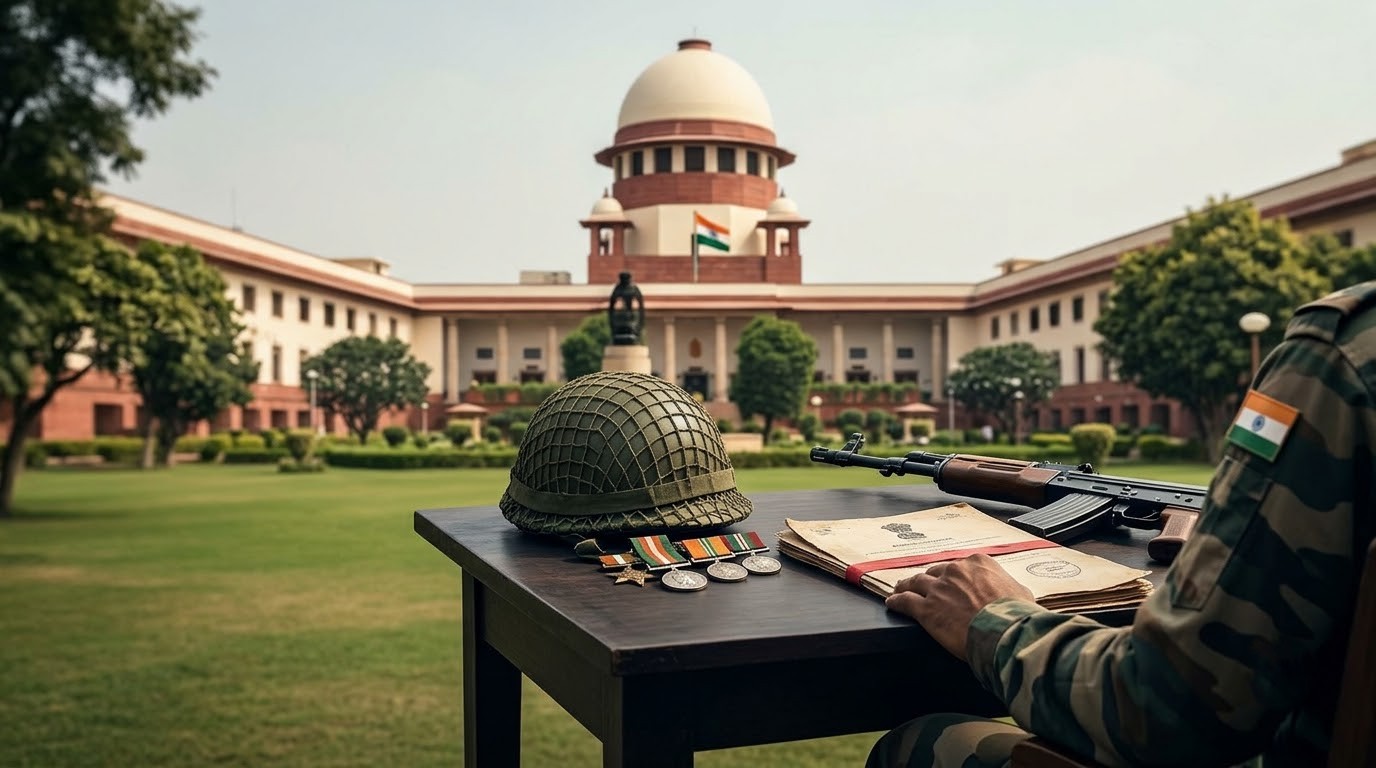
The Supreme Court has delivered a landmark ruling establishing that an accidental gunshot injury sustained by an Army personnel from his own service weapon during operational duties qualifies as a battle casualty, thereby making the individual eligible for the enhanced War Injury Element of pension. A judicial bench comprising Justice Satish Chandra Sharma and Justice Nongmeikapam Kotiswar Singh allowed an appeal filed by a retired Army Subedar Major, overturning a contrary decision rendered by the Armed Forces Tribunal. The litigation arose from an incident on August 7, 2002, wherein the appellant sustained a gunshot wound to his left thigh, resulting in significant damage to his femoral vein, while he was deployed in Jammu and Kashmir under Operation Rakshak.
Does an accidental gunshot injury from one's own service weapon qualify for a war injury pension?
Yes, the Supreme Court held that an accidental gunshot injury sustained from an individual's own service weapon during operational duties qualifies as a battle casualty for war injury pension. The bench clarified that the source of the bullet does not automatically render a wound self-inflicted, provided the incident occurred in operational areas and the injury is grievous.
Following the incident, the Release Medical Board assessed the appellant's permanent disability at forty percent and formally attributed it to military service. Despite this medical evaluation, the Army authorities restricted his financial relief to the ordinary disability element of pension. The Armed Forces Tribunal subsequently dismissed his application seeking the enhanced war injury element on the ground that the competent authority had not issued final battle casualty approval and that his personal details were missing from a designated digital database. Challenging this denial, the appellant approached the apex court through legal counsel.
Evaluation Stage | Authority View | Supreme Court Finding |
|---|---|---|
Medical Board | Assessed 40 percent disability attributable to service | Accepted medical attribution and grievous nature of injury |
Armed Forces Tribunal | Rejected war injury pension due to missing digital database entry | Set aside Tribunal ruling, relying instead on contemporaneous records |
Union Government | Argued absence of original records and final MP-5 approval | Rejected argument, noting records were destroyed in official custody during 2014 floods |
Examining the regulatory framework, the bench evaluated Paragraph 69 of Army Order 1/2003/MP, which outlines two mandatory requirements for categorizing an injury as a battle casualty: the occurrence must take place within prescribed operational parameters, and the resultant injury must be grievous. The Court observed that contemporaneous official documents, specifically Part II Order Number BC-59, formally recorded the occurrence under the heading of battle casualty wound during Operation Rakshak and Operation Parakram. Furthermore, a formal battle casualty certificate issued by Signals Records corroborated these facts alongside medical findings confirming the grievous nature of the harm.
Addressing the classification of self-inflicted injuries, the bench emphasized that the mere fact that a projectile originates from a claimant's personal weapon does not justify labelling the act as intentionally self-inflicted. Accidental discharges can transpire due to external impacts, sudden falls, trigger snagging, mechanical malfunctions, or inadvertent pressure. Such occurrences remain distinct from deliberate self-harm. The Court also addressed contentions regarding missing original documentation, observing that official records had perished in the 2014 floods while remaining inside official custody. The absence of a digital database entry merely represented a lack of subsequent corroboration rather than affirmative proof capable of discrediting surviving contemporaneous records.
Concluding the proceedings, the bench directed the Union Government to disburse the enhanced War Injury Element of pension to the appellant, computed from the exact date of his retirement, subject to an adjustment for the ordinary disability element already paid. The Court mandated that the revised pension payment order and accumulated arrears be issued within a strict timeline of three months.