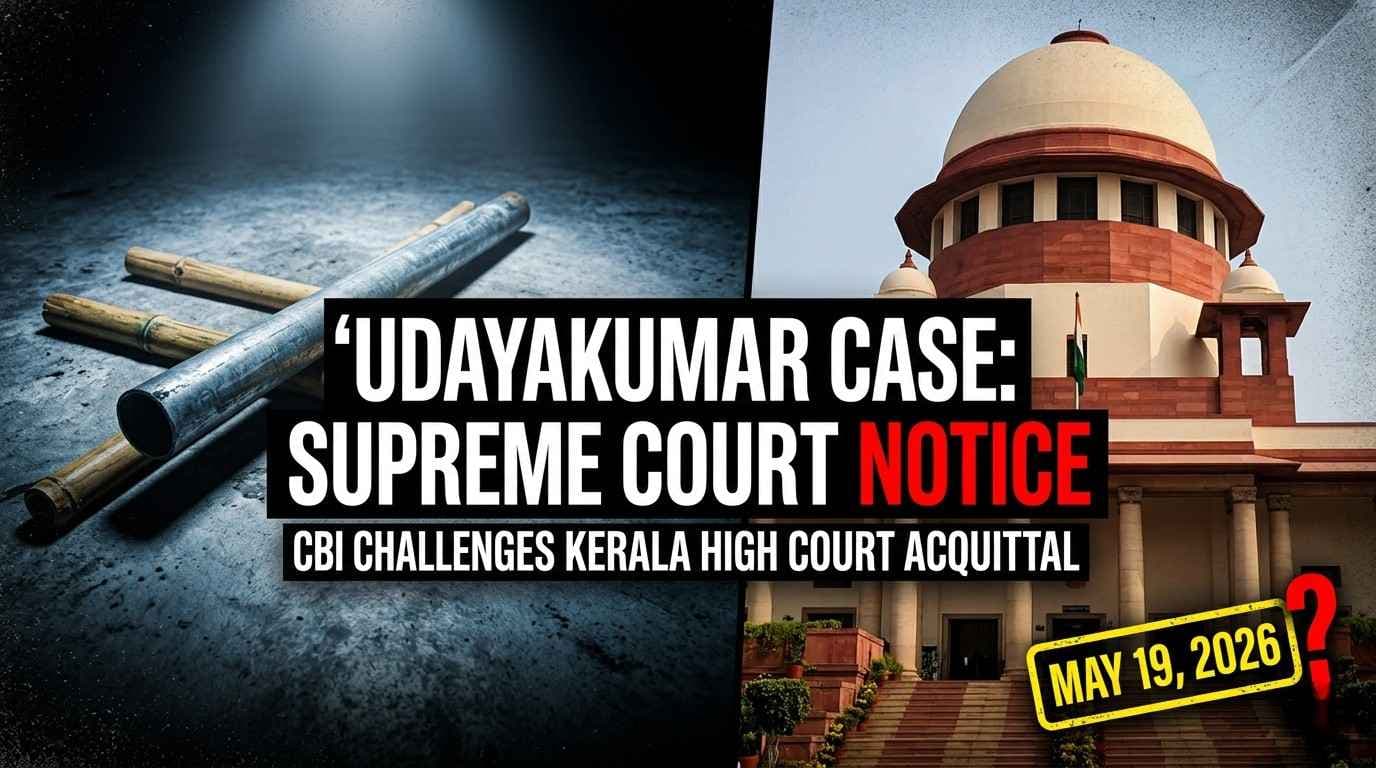
The Supreme Court of India has issued notices to four former Kerala police personnel on a plea filed by the Central Bureau of Investigation (CBI). The agency is challenging a Kerala High Court judgment that acquitted the officers in the high-profile 2005 Udayakumar custodial death case. A bench comprising Justice Vikram Nath and Justice Sandeep Mehta issued the notice on Friday, seeking responses from the accused by May 19, 2026.
This legal development revisits the tragic death of 28-year-old Udayakumar, who was picked up by police from a park in Thiruvananthapuram on September 27, 2005. Prosecution records suggest he was taken to the Fort Police Station and later to the Circle Inspector’s office for interrogation. He was declared dead later that night at a medical college hospital, with a post-mortem revealing severe crush injuries to his thighs caused by a "GI pipe" and bamboo canes.
The CBI’s appeal targets Jitha Kumar K, T Ajith Kumar, EK Sabu, and TK Haridas. In 2018, a special CBI court had sentenced the principal accused to death and convicted senior officers for conspiracy and destruction of evidence. However, the Kerala High Court later set aside these convictions, characterizing the CBI’s investigation as "tainted" and "flawed," particularly criticizing the procedure used to turn witnesses into approvers.
At the heart of the CBI's challenge is the assertion that the High Court overlooked critical evidence regarding the brutal nature of the custodial torture. The prosecution had alleged that senior officers, including a former Circle Inspector and Assistant Commissioner, conspired to shield the primary offenders. This included stopping entries in the General Diary and fabricating backdated records to justify the illegal detention.
The "Uruttikkola" (rolling) method used on Udayakumar became a symbol of custodial violence in Kerala, sparking years of legal battles led by his mother, Prabhavathi Amma. It was her persistence that led the High Court to hand over the investigation to the CBI in 2008 after allegations of a state police cover-up. The current Supreme Court intervention represents a significant moment in her two-decade quest for justice.
The High Court's acquittal was based largely on procedural illegalities, including the filing of pardon applications before a court it deemed lacked jurisdiction. The CBI now argues before the apex court that these procedural technicalities should not outweigh the substantive evidence of a custodial murder. The agency contends that the acquittal has led to a failure of justice for a victim who suffered over 40 injuries while in state custody.
The Supreme Court’s decision to hear the Special Leave Petition (SLP) brings back into focus the accountability of law enforcement agencies in cases of custodial torture. Legal experts suggest that the outcome of this appeal will likely address the standards required for proving a conspiracy among superior officers during a custodial death. It also places the conduct of the investigating agency back under the judicial scanner.
As the matter moves toward the May hearing, the legal community and human rights activists are watching closely. The Udayakumar case remains a landmark in Indian jurisprudence regarding the rights of detainees and the limits of police power. Whether the Supreme Court will restore the trial court's conviction or uphold the High Court's acquittal will be a defining moment for judicial oversight in Kerala.