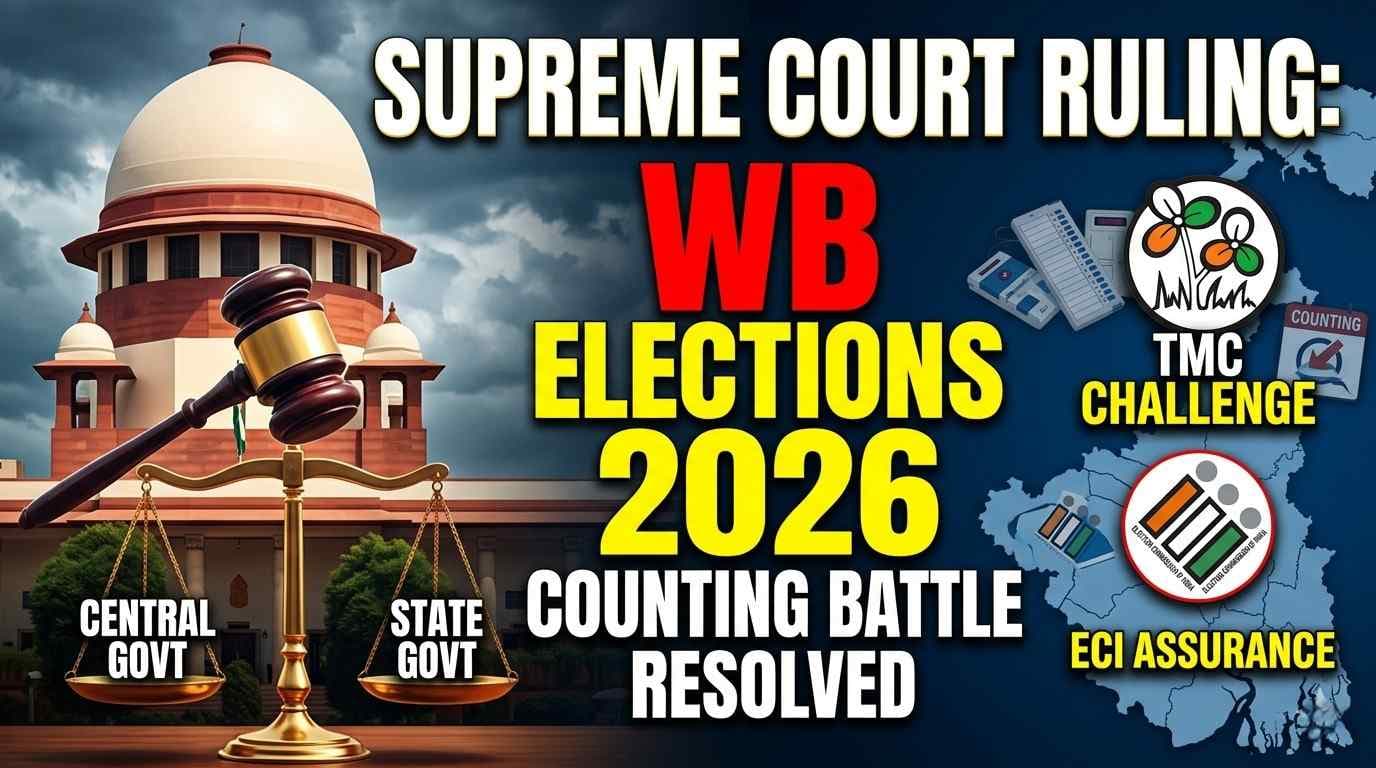
The Supreme Court of India recently concluded a high-stakes legal battle concerning the counting process for the 2026 West Bengal Assembly elections. A special bench comprising Justice PS Narasimha and Justice Joymalya Bagchi disposed of a petition filed by the All India Trinamool Congress (AITC) that challenged the Election Commission’s decision to deploy Central Government and PSU employees as counting supervisors and assistants. The Court’s decision came after receiving a crucial assurance from the Election Commission of India (ECI) that state government nominees would not be entirely excluded from the procedure.
The controversy began when the Additional Chief Electoral Officer of West Bengal issued a communication mandating that at least one official at every counting table must be a Central Government or PSU employee. The TMC moved the court, arguing that this move was unprecedented and created an unnecessary imbalance. They contended that since "micro-observers" are already drawn from central services, extending this to supervisors and assistants resulted in a disproportionate representation of central personnel, potentially compromising the "level playing field."
During the hearing, the Supreme Court focused on the ECI’s circular dated April 13, 2026. The counsel for the ECI, Senior Advocate DS Naidu, clarified that this circular actually provides for the inclusion of a state government nominee in the counting process. The Court took this statement on record, emphasizing that the directive must be followed in "letter and spirit." By doing so, the bench ensured that while the ECI maintains its administrative discretion, the state’s administrative machinery is not sidelined.
The bench expressed a notable perspective on the perceived bias of government employees. Justice Narasimha and Justice Bagchi remarked that it is a "fallacy" to assume that state employees are inherently loyal to the state’s ruling party or that central employees are biased toward the Union government. The Court reiterated that once an official is drafted for election duty, they function under the singular authority of the ECI, transcending their usual administrative ties to perform a neutral constitutional role.
The TMC had also raised concerns that the directive was issued without a consultative exercise and was not made public, reaching only the District Election Officers. However, the Supreme Court noted that the primary objective is to ensure transparency and integrity in the counting of votes. With the ECI confirming that the existing handbook and circulars allow for a mix of personnel, the Court felt that the apprehensions regarding a "central take-over" of the counting halls were sufficiently addressed.
Furthermore, the judiciary highlighted the existing safeguards that protect the sanctity of the vote count. These include the presence of counting agents from every contesting political party at every table, as well as mandatory CCTV surveillance. The bench suggested that these measures, combined with the oversight of the ECI, provide a robust defense against any potential irregularities, making the source of the staff’s salary—state or center—less relevant to the final outcome.
This ruling serves as a significant precedent for the management of high-stakes regional elections. It reinforces the idea that the Election Commission has the ultimate prerogative to decide on the deployment of staff to ensure public confidence. By disposing of the plea without further orders, the Supreme Court signaled its trust in the ECI’s institutional capacity to conduct the counting on May 4, 2026, in a fair and transparent manner.
In conclusion, the Supreme Court’s intervention provided a balanced resolution to a volatile political dispute. By holding the ECI to its own guidelines regarding state nominees, the Court ensured that the federal structure of Indian elections is respected. As West Bengal prepares for the final tally, this judgment ensures that the focus remains on the democratic will of the people, guarded by a neutral and multi-layered administrative process.