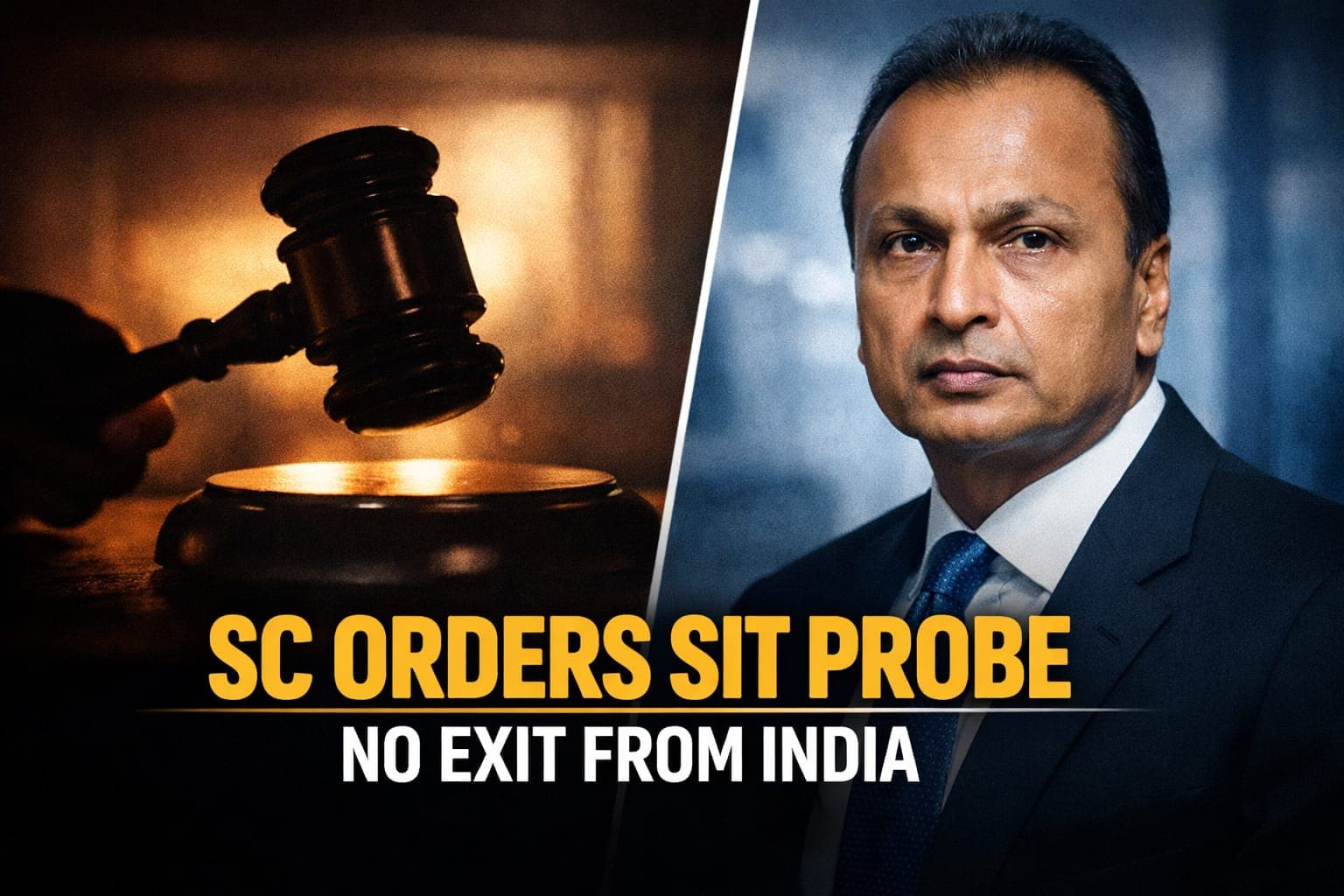
New Delhi: In a major development concerning one of the largest alleged corporate frauds in India, the Supreme Court on Wednesday directed the Enforcement Directorate (ED) to constitute a Special Investigation Team (SIT) to probe allegations of large-scale bank fraud involving Reliance Communications (RCOM), its group entities, and its promoter Anil Ambani.
A Bench comprising Chief Justice of India (CJI) Surya Kant, Justice Joymalya Bagchi, and Justice Vipul Pancholi emphasized the need for a focused and high-level investigation into the matter, which involves outstanding dues running into tens of thousands of crores.
The Court was hearing a petition filed by EAS Sarma, a former Secretary to the Government of India, who sought a court-monitored investigation into the financial dealings of RCOM. The petitioner argued that the current probes by the Central Bureau of Investigation (CBI) and the ED were inadequate and slow.
Addressing the Enforcement Directorate, the Court noted: "ED is well advised to constitute a SIT comprising senior officers and take all the measures so that the ongoing probe is taken to a logical conclusion."
To ensure accountability, the Bench directed both the CBI and the ED to file status reports every month. The Court expressed concern over the "unexplained delay" in the investigation so far, noting that while the allegations involve the siphoning of massive public funds, the agencies have taken significant time to act.
A significant highlight of the hearing was the undertaking given by Anil Ambani's legal team. Amid apprehensions raised by the petitioner and the government that the businessman might flee the country before the probe concludes, Senior Advocate Mukul Rohatgi, representing Ambani, gave a categorical assurance to the Bench.
"He will not leave without the permission of this court," Rohatgi told the Bench.
This statement sparked a sharp exchange between Rohatgi and Solicitor General (SG) Tushar Mehta. The SG reminded the Court of a past instance where a similar undertaking was given for a client who eventually fled. However, Rohatgi retorted that his client had returned and settled significant dues with the government.
The Court ultimately recorded the undertaking in its order, making it legally binding that Ambani cannot travel abroad without the specific "leave" (permission) of the Supreme Court.
The Supreme Court expanded the scope of the investigation beyond just the corporate house. It directed the CBI to specifically investigate the role of bank officials who were in charge when these massive loans were sanctioned and released.
The Court observed that such a large-scale fraud could potentially involve "insider help" or collusion. "It is imperative for CBI to probe the conduct of bank officials to check if funds were released with the collusion of bank officers," the order stated.
The Bench directed the CBI to look into the "nexus, collusion, and conspiracy" to see if the funds were intentionally diverted with the knowledge of the lenders.
The core of the dispute lies in how the money disappeared. According to the petition, RCOM and its subsidiaries (Reliance Infratel and Reliance Telecom) received loans worth ₹31,580 crore between 2013 and 2017 from a consortium of banks led by the State Bank of India (SBI).
A forensic audit later revealed:
- Diversion of Funds: Money meant for business operations was allegedly used to repay unrelated loans.
- Circular Routing: Funds were allegedly moved through a complex web of companies to disguise the "evergreening" of loans (taking new loans to pay old ones).
- Liquidation of Assets: Investments in mutual funds and fixed deposits were reportedly liquidated immediately after being created.
While Advocate Prashant Bhushan, appearing for the petitioner, called it the "largest corporate fraud" and argued that the "kingpin" had not been arrested, Anil Ambani’s counsel argued that this was a case of business failure, not crime.
"People do go bankrupt. It is not a new thing," Rohatgi argued, maintaining that there was no "siphoning" of funds. However, the Solicitor General countered this by pointing out that a forensic audit conducted by outside experts had clearly flagged the movement of funds as "siphoning."
The hearing also touched upon a growing concern in the Indian financial sector: the misuse of the Insolvency and Bankruptcy Code (IBC).
Prashant Bhushan pointed out a startling figure: Reliance Communications Infra had outstanding dues of ₹47,000 crore, but was sold off in bankruptcy for just ₹455 crore—merely 1% of the total debt. He further alleged that the assets were sold to a company belonging to Anil Ambani's brother, Mukesh Ambani.
CJI Surya Kant expressed deep concern over how the IBC platform is being utilized: "Unfortunately, IBC platform now is being misused like anything. You get the company, all the assets undervalued. Then you indulge in kind of an auction which is also a pre-planned move. Friends or family come and buy."
The Solicitor General agreed, noting that the "haircut" (the loss banks take on unpaid loans) in such cases is "phenomenal." He assured the Court that the Government of India is seriously examining these systemic issues within the IBC framework.
The Court also took a critical view of the State Bank of India’s conduct. The petition highlighted that although SBI received a forensic audit report in October 2020, it waited nearly five years—until August 2025—to file a formal complaint.
The petitioner termed this a sign of "institutional complicity," suggesting that the delay allowed the accused parties more time. The Court has now asked the agencies to act "promptly, independently, and fairly" to make up for this lost time.
The Supreme Court has demanded a "dispassionate" and "skillful" investigation. The following steps are expected in the coming weeks:
- SIT Formation: The ED must form the Special Investigation Team comprising senior officers immediately.
- Monthly Status Reports: Both the CBI and ED must update the Court every month on their progress.
- Travel Restrictions: Anil Ambani remains under a court-monitored travel restriction.
- Banker Probe: The CBI will begin questioning bank officials to identify any internal conspiracy.
The matter is scheduled for further hearing in four weeks, by which time the first set of status reports must be submitted to the Bench.
Case Title: EAS Sarma v. Union of India
Bench: CJI Surya Kant, Justice Joymalya Bagchi, and Justice Vipul Pancholi