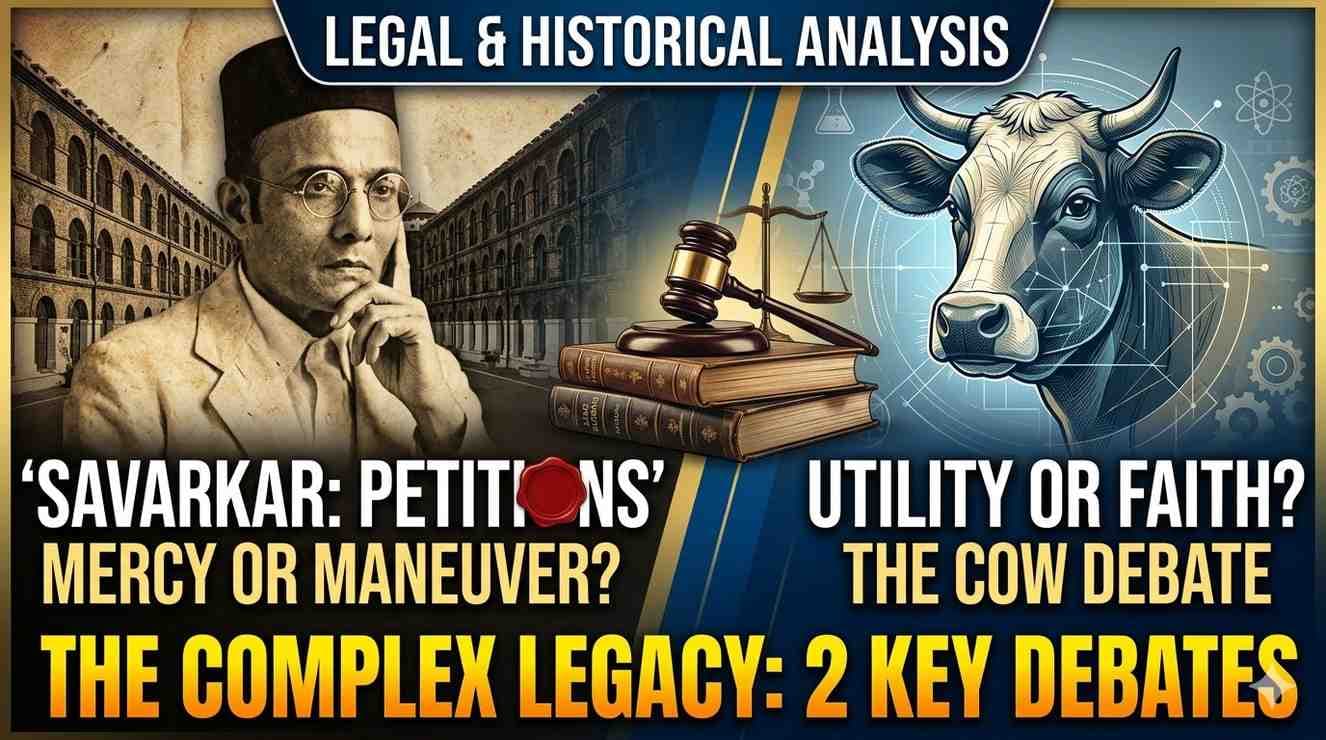
Recent legal and historical discussions have once again brought the complex legacy of Vinayak Damodar Savarkar into the spotlight, focusing on two distinct but frequently debated aspects: his mercy petitions from the Andaman Cellular Jail and his unconventional views on the utility of animals. These topics, often raised during litigation involving historical narratives or defamation, provide a window into the intersection of political philosophy and colonial-era legal strategies.
One of the most persistent points of contention involves the series of mercy petitions Savarkar submitted to the British government during his incarceration. Critics often point to these documents as evidence of a compromise, while his proponents argue they were tactical maneuvers used by political prisoners of the era to secure release and resume their work for the national movement. From a legal perspective, these petitions highlight the rigid and often brutal framework of the colonial penal system, where "clemency" was often the only procedural route available to prisoners of the state.
The discussion also delves into Savarkar’s specific philosophical stance regarding the cow, which differed significantly from the traditional religious veneration often seen in Indian society. Savarkar famously described the cow as a "useful animal" rather than a deity, advocating for a rationalist approach to animal husbandry. He argued that the value of the animal lay in its contribution to the economy and agriculture, rather than in its status as a religious icon. This pragmatic view remains a point of deep academic and legal debate when analyzing the evolution of secularism and Hindutva.
The frequency of Savarkar's petitions—noted by some historians as being filed five times—serves as a case study in the persistence of legal appeals under absolute monarchical or colonial authority. Legal scholars often analyze these documents not just for their content, but for the language of the era, where formal "submission" was a mandatory linguistic requirement of any legal prayer for relief. This historical context is essential for understanding the transition from colonial subjects to citizens with fundamental rights.
Furthermore, the legal discourse around Savarkar often touches upon the limits of historical interpretation in the modern courtroom. As various states debate the inclusion or exclusion of his life story in educational curricula, the judiciary is frequently called upon to decide what constitutes a "fair comment" on historical figures. The balance between protecting a figure's reputation and upholding the right to historical critique is a delicate one that continues to evolve through contemporary case law.
The pragmatic side of Savarkar’s writings, particularly his insistence on science and utility over superstition, continues to be a subject of interest for those studying Indian social reform movements. By treating the cow as an "economic asset," Savarkar sought to modernize Indian thought, even as he remained a staunch nationalist. This duality creates a complex narrative that lawyers and historians must navigate when his ideas are invoked in public or legal forums.
In the context of modern legal frameworks, these discussions underscore the importance of primary sources. Whether it is the exact wording of a petition from 1913 or an essay on animal utility from the 1930s, the reliance on original texts is crucial for resolving disputes over historical accuracy. The courts have often emphasized that historical figures must be understood within the socio-political climate of their own time rather than being judged solely by contemporary standards.
Ultimately, the ongoing focus on Savarkar’s petitions and his views on "useful animals" reflects the broader struggle to define the national identity of modern India. As these debates move from political stages to legal chambers, they reinforce the role of the judiciary as a mediator in the "history wars." Understanding these nuances is vital for anyone engaged in the study of Indian law, history, and the philosophical foundations of the state.