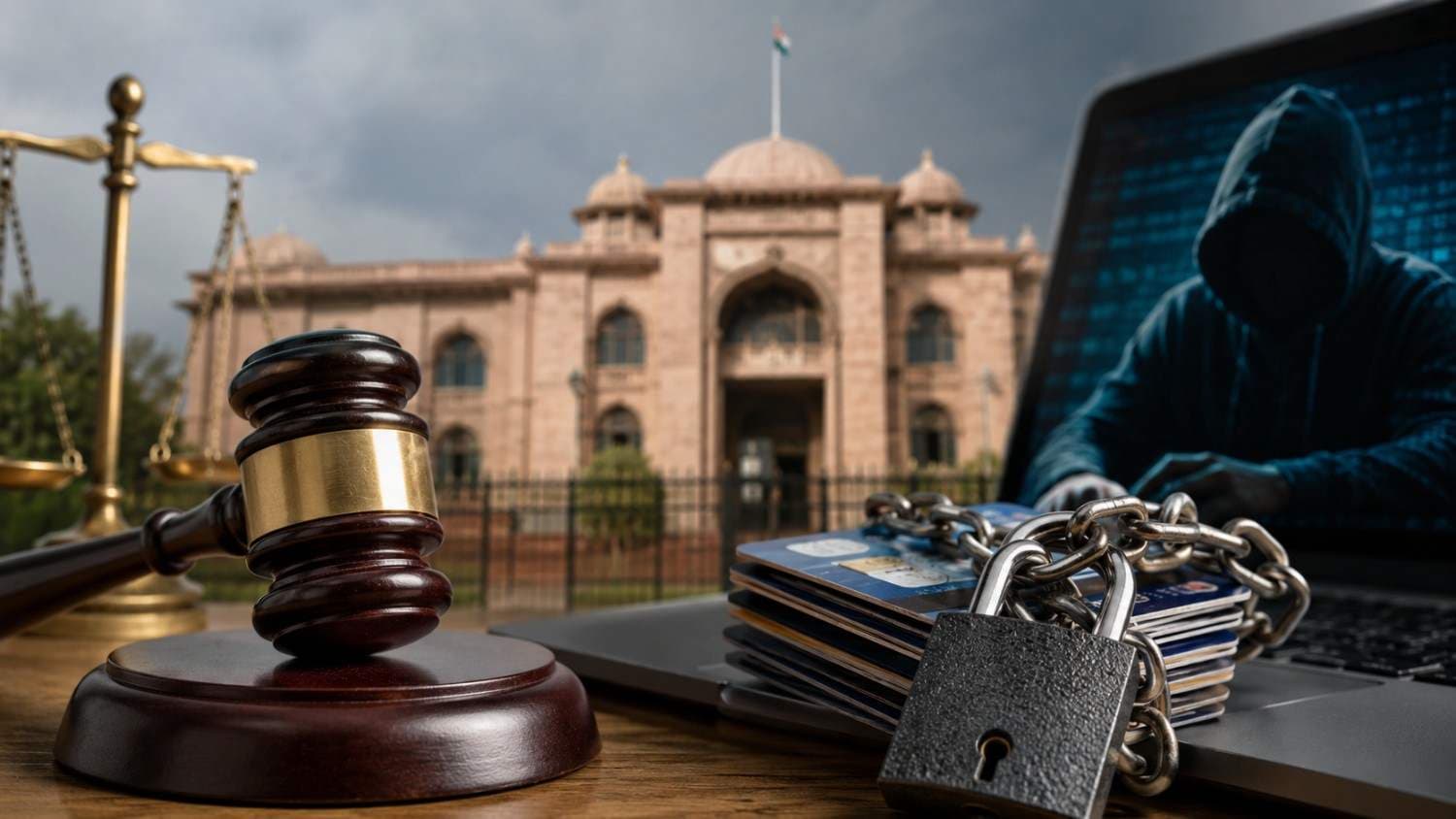
Rajasthan High Court Mandates Proportionality in Bank Account Freezing for Cybercrime Investigations
The Rajasthan High Court recently issued a comprehensive set of guidelines aimed at regulating the freezing of bank accounts by banks and investigating agencies in the context of cybercrime investigations. The directive, issued by Justice Anand Sharma in the case of Balaji Enterprises v. RBI, seeks to ensure that such actions adhere to principles of proportionality and do not result in an indiscriminate blanket freeze on account holders' funds.
Court's Rationale on Investigative Powers
The High Court acknowledged the State's crucial duty to protect victims of cyber fraud and prevent the dissipation of illicit funds. However, the Court underscored that investigative powers are not absolute and must always be exercised within the constitutional parameters of legality, reasonableness, and proportionality. Justice Sharma observed that the gravity of cybercrime, while significant, cannot justify the abandonment of safeguards designed to protect innocent citizens from arbitrary state action. The Court highlighted instances where entire bank accounts, containing substantially larger sums, were frozen despite the alleged cyber fraud involving relatively small amounts, sometimes as low as ₹100 or ₹1,000.
Key Directive on Limiting Restraints
The Court specifically directed that in situations where the amount linked to an alleged cyber fraud can be clearly identified, the standard procedure should involve placing a lien or hold solely on that specific amount. This approach would allow the account holder to continue operating the remaining balance in their account. This directive addresses concerns raised by petitioners who challenged the freezing or debit-freezing of their accounts based on communications from various investigating agencies, often leading to disproportionate restrictions.
Comprehensive Guidelines for Freezing Bank Accounts
To ensure a balanced approach, the Rajasthan High Court laid down the following broad guidelines for banks and investigating agencies:
No Indefinite Blanket Freeze
The Court mandated that a bank account cannot be subjected to an indefinite, complete debit freeze based merely on vague, unverified, or cryptic communications from investigating authorities. Specific and substantiated grounds are required for any such action.
Record Connection Between Account and Offence
Before imposing or continuing any financial restraint, the investigating officer must diligently identify and record material evidence demonstrating a prima facie connection between the specific bank account or transaction and the offence under investigation. This ensures a factual basis for the action.
Ordinarily Limit Restraint to Disputed Amount
If the amount in dispute can be precisely identified, the restraint should ordinarily be limited to that specific sum through a lien or hold. A complete freeze of the entire account is permissible only when compelling reasons necessitate a wider restriction, and the directions outlined in Jinat Bano must be strictly adhered to.
Reasons for Freezing Entire Account
Should a complete freeze of an entire account be deemed necessary, perhaps due to the nature of the offence, evidence of repeated suspicious transactions, indicators of a mule account, the account holder's conscious involvement, or difficulties in segregating proceeds of crime, specific and detailed reasons must be recorded and communicated to the bank. This ensures transparency and accountability.
Report Seizures to Magistrate
If the action taken by an investigating agency constitutes a seizure under Section 106 of the Bharatiya Nagarik Suraksha Sanhita (BNSS), it is imperative that such action be reported immediately to the competent magistrate. This ensures judicial oversight of significant investigative steps.
Follow Attachment Procedure
In instances where an investigating agency seeks to attach property as proceeds of crime, it must strictly follow the procedure outlined in Section 107 of the BNSS and approach the competent court or magistrate for necessary orders. This ensures due process in property attachment.
Periodic Review of Continuing Freezes
A bank account freeze cannot remain in force indefinitely solely because an investigation is ongoing. The investigating officer and their supervisory officer are required to periodically review the necessity of the continuing restraint, ensuring it remains justified by the evolving circumstances of the probe.
Withdraw Unnecessary Restraints Immediately
If the investigation reveals that the account holder has no connection with the alleged offence, or if the disputed amount is no longer required to be retained, the restraint on the account must be lifted without any delay. This protects innocent parties from prolonged inconvenience.
De-freeze Accounts After Investigation Ends
Instructions to lift the restraint must be issued promptly and without avoidable delay once the investigation concludes, a closure report is filed, the account holder is exonerated, or the account or amount is no longer required for investigative purposes.
Provide Sufficient Details to the Bank
Communications from investigating agencies directing a restraint should, to the extent permissible, clearly identify the case, the specific account, the relevant transaction, the amount involved, and the legal basis for the action. This enables banks to act precisely and lawfully.
Banks Cannot Expand a Limited Request
Banks are prohibited from mechanically converting a request to hold a particular transaction amount into a blanket freeze of the entire account, unless the communication and accompanying material legally justify such wider action. Banks must exercise discretion and adhere to the scope of the request.
Distinguish Banking Restrictions from Police Restraints
The Court clarified that restrictions independently imposed under Know Your Customer (KYC) norms, anti-money laundering (AML) regulations, fraud-risk management protocols, or other regulatory requirements will continue to be governed by applicable law and Reserve Bank of India (RBI) directions. Banks must clearly distinguish these internal banking restrictions from restraints imposed at the behest of police or cybercrime authorities.
Conclusion
These guidelines from the Rajasthan High Court aim to strike a balance between the imperative of combating cybercrime and safeguarding the rights of account holders against arbitrary and disproportionate state action, ensuring that financial restraints are applied judiciously and with due regard for legal and constitutional principles.