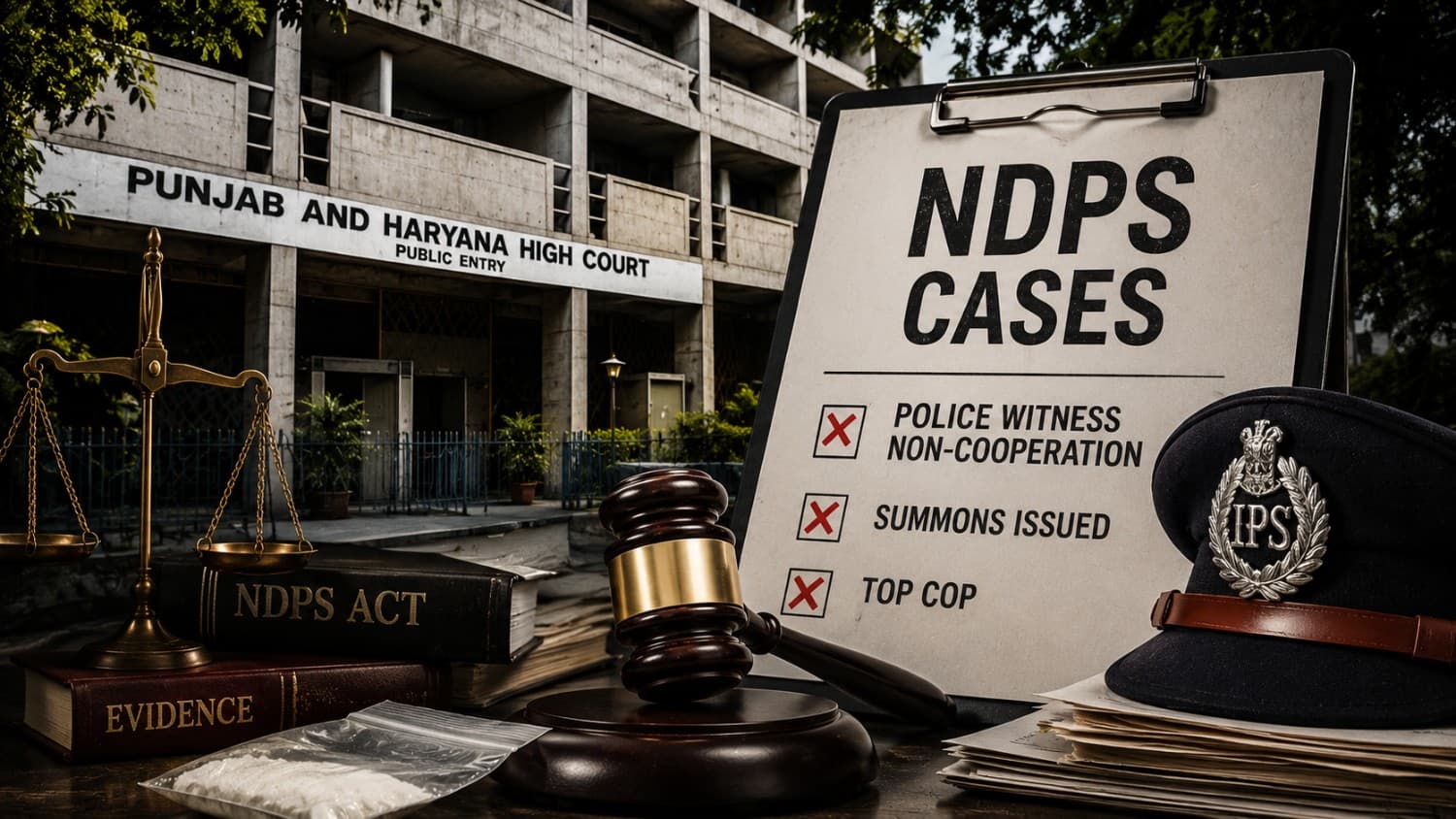
The Punjab and Haryana High Court on Tuesday expressed serious concern over the persistent non-attendance of police witnesses in trials under the Narcotic Drugs and Psychotropic Substances (NDPS) Act, 1985, stating that such conduct not only frustrates the right of the accused to a speedy trial but also gravely undermines the administration of criminal justice.
Justice Sumeet Goel, while hearing the second bail plea of an accused in a case involving the recovery of 2.48 kg of heroin, observed that official witnesses—most of whom are police personnel—consistently fail to appear before trial courts despite the issuance of bailable and even non-bailable warrants. The Court noted that in several instances, bailable warrants remain unexecuted for extended periods, resulting in routine adjournments and indefinite stalling of proceedings.
The Court described this pattern as a 'deeply disturbing and systemic lapse in the prosecutorial mechanism', emphasizing that judicial time is being wasted not on adjudicating the merits of the case but on compelling the prosecution to fulfill its basic duty of producing witnesses.
It further observed that while police act with urgency in registering FIRs and making arrests, that same urgency dissipates once the case reaches the trial stage. The Court stressed that the filing of a challan does not mark the conclusion of prosecutorial responsibility but merely initiates the obligation to diligently pursue the case to its lawful conclusion.
In the present matter, the accused has been in custody since March 28, 2025. Counsel for the petitioner stated that none of the prosecution witnesses cited in the case have been examined to date, despite repeated issuance of non-bailable warrants against them. Considering the prolonged delay and the failure of the prosecution to produce its witnesses, the Court granted interim bail to the accused till the next date of hearing.
The Court made clear that it cannot ignore the conduct of the prosecution, stating that the abdication of duty by official witnesses—employees of the State—erodes public confidence in the justice delivery system and emboldens criminal elements by projecting an image of prosecutorial apathy. Such conduct, the Court added, sets a dangerous precedent where procedural laxity overrides judicial efficacy.
The Court also highlighted that the delay compromises the deterrent effect of the NDPS Act and allows for the potential recycling of narcotic offenders into society during the pendency of trial, thereby frustrating the legislative objective of the statute.
It further held that such dereliction by State officials, particularly serving police personnel, constitutes an affront to both the rule of law and societal welfare. The Court emphasized that senior police officers, including Superintendents of Police (SP) and Senior Superintendents of Police (SSP) at the district level, are under a bounden duty to monitor and ensure the attendance of their subordinates for tendering evidence before the concerned trial court.
The Court termed this 'exhibition of laxity and apathy' by police officials as deserving of redressal and called out the apparent abdication of duty by senior police leadership. It stated that such conduct is not only a serious affront to the authority of the judicial process but also an abdication of the prosecution's obligation to bring its own case to a lawful conclusion.
Considering the gravity of the situation, the Court directed the Director General of Police (Law and Order), Punjab to remain present before it on September 21, 2026, to explain the persistent failure of police witnesses to appear before trial courts despite the issuance of repeated non-bailable warrants against them.
The accused was represented by advocates LS Sekhon, MS Sweedel and GS Gill, while the State was represented by Deputy Advocate General Hemant Aggarwal.