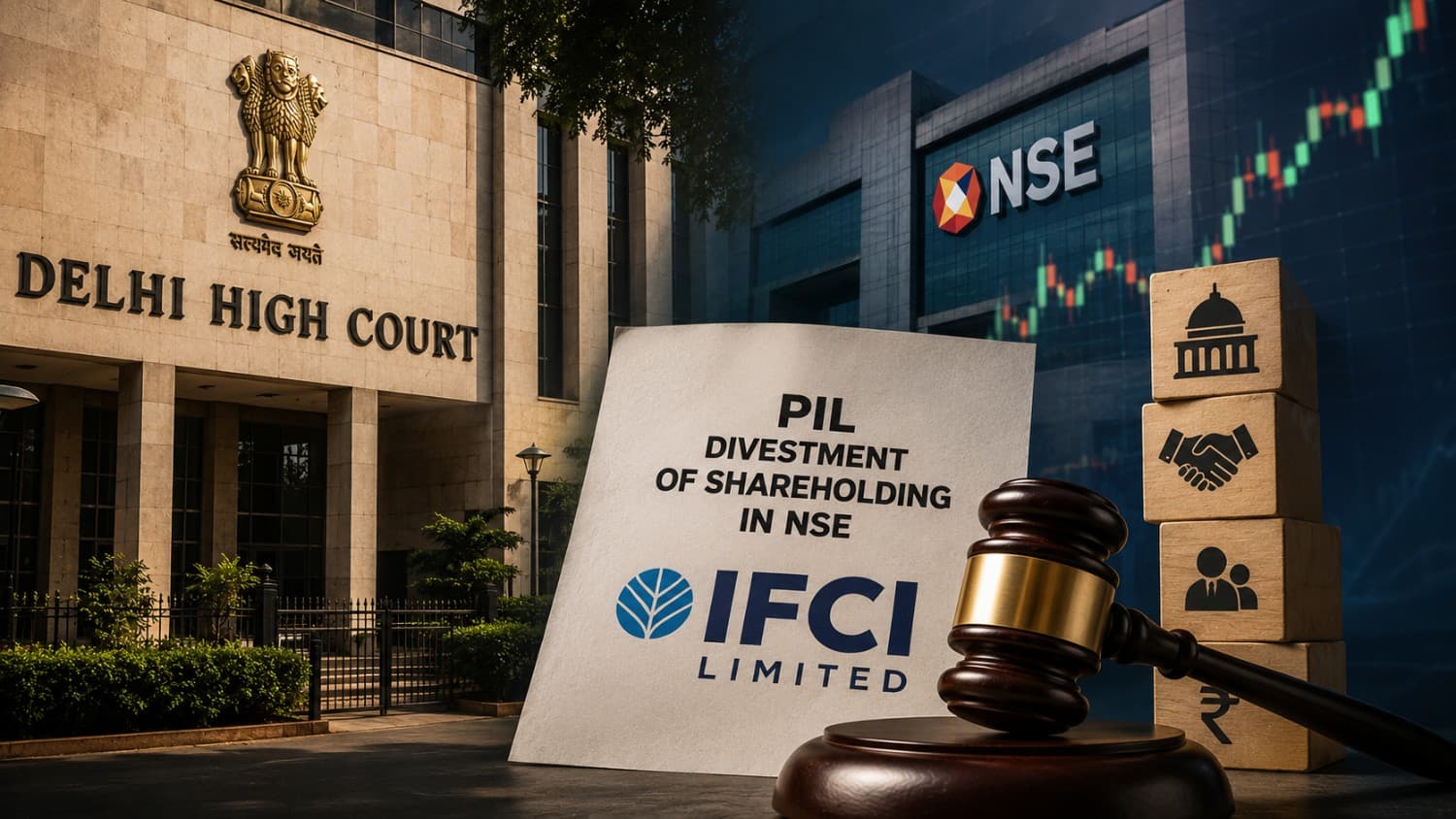
The Delhi High Court dismissed a public interest litigation (PIL) challenging the divestment of Industrial Finance Corporation of India Limited’s (IFCI) shareholding in the National Stock Exchange of India Limited (NSE), holding that the petitioner had approached the court without the required candour by suppressing the pendency of a substantially similar PIL before the Bombay High Court.
The petitioner had alleged irregularities in IFCI’s divestment of 11,25,000 equity shares of NSE during the financial year 2015-16 in four tranches to DVI Fund, Soach Global and two undisclosed transferees for a consideration of ₹440.93 crores. It was claimed that the undervaluation of these shares resulted in a notional loss of approximately ₹12,121.13 crores to the public exchequer, based on a comparison with NSE’s present unlisted-market valuation of approximately ₹5,00,000 crores.
The petitioner further stated that IFCI held 24,97,750 equity shares of NSE as on 31 March 2015, constituting 5.55% of its paid-up equity share capital. The divestment was said to have prompted media reports and inquiries by the Serious Fraud Investigation Office into former Chairmen and Managing Directors of IFCI. Complaints were lodged with the Union Minister for Finance and Corporate Affairs and the Director, CBI.
In response, IFCI stated, vide its communication dated 1 July 2026, that the divestment had been conducted with the approval of the Securities and Exchange Board of India (SEBI), following due process, applicable regulatory guidelines and a competitive bidding process carried out through IDFC Securities Limited. NSE had filed its Draft Red Herring Prospectus with SEBI on 17 June 2026, structured as an Offer for Sale by existing shareholders.
The Division Bench, comprising Chief Justice DK Upadhyaya and Justice Tejas Karia, noted that the petitioner had filed a PIL on overlapping issues before the Bombay High Court, which was instituted prior to the present petition. Despite this, the petitioner failed to disclose the pendency of the Bombay proceedings and made an averment to the contrary on oath in paragraph 41 of the current PIL.
The Court observed that the petitioner, by suppressing the Bombay Writ and giving a false statement under oath, could not be said to have approached the Court with the candour expected of a litigant invoking PIL jurisdiction. It held that the present PIL was liable to be dismissed on this ground alone, without consideration of its merits.
The Bench further examined the substance of the two proceedings. In the Bombay High Court PIL, the petitioner had sought a direction to NSE to disclose, on affidavit, its promoter group, shareholders and ultimate beneficiaries, along with relevant know-your-customer documents. In the Delhi High Court PIL, the relief sought was a direction to SEBI and NSE to require DVI Fund, Soach Global and similarly placed entities to disclose their complete chain of ownership and control up to their ultimate beneficial owners.
The Court found that the reliefs sought in both proceedings were, in substance, similar and pertained to the same shareholding in the same company. It rejected the petitioner’s contention that the Bombay Writ was unconnected to the present PIL, stating that the grounds urged and the prayers sought in the Bombay proceedings substantially traversed the subject matter raised in the Delhi petition.
The Court concluded that the petitioner had resorted to clever drafting in an attempt to camouflage the prayers in the present PIL to make them appear distinct from those sought in the Bombay Writ. Upon considering the pendency of the Bombay Writ, its non-disclosure in the present proceedings, and the incorrect averment made on oath, the Court held that the present PIL had not been instituted bona fide or in public interest. It found that the petitioner had abused the process of law by instituting the present PIL on the basis of a stale news report of 2015 while suppressing the prior Bombay Writ concerning substantially the same issues.
Consequently, the Court dismissed the PIL and imposed costs of ₹5 lakh on the petitioner.