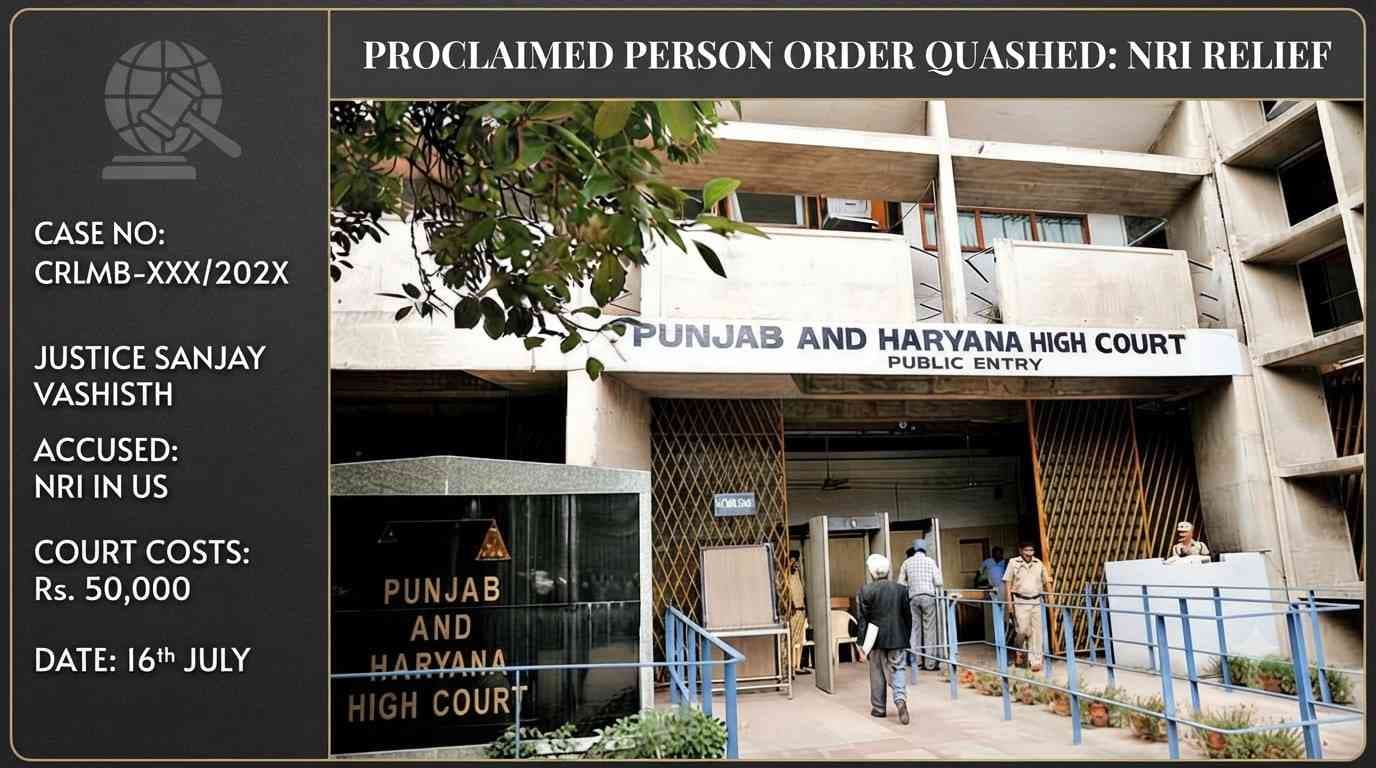
The Punjab and Haryana High Court has set aside an order that declared a woman residing in the United States as a proclaimed person in a criminal case pending before a trial court. The judgment was delivered by Justice Sanjay Vashisth. The court held that the proclaimed person order was untenable and directed that the accused be granted a single opportunity to surrender and participate in the proceedings, subject to the payment of Rs.50,000 as costs.
Under the Code of Criminal Procedure, a proclaimed person is someone who has been declared by a court to have absconded and is therefore liable to have his property attached and to be arrested without warrant. The provision is intended to secure the presence of an accused who is avoiding trial. The High Court examined whether the lower court’s proclamation was justified in the facts of the present case.
Justice Vashisth observed that the primary objective of every court is to examine the evidence and arrive at a just decision, not to expend disproportionate resources in tracking down an accused who has fled the jurisdiction. He emphasized that the criminal justice system must balance the interest of the State in securing the presence of the accused with the right of the individual to be heard. In this view, the court found that the proclamation served no useful purpose and amounted to an unnecessary expenditure of judicial time.
The High Court noted that the accused woman had been living in the United States for a considerable period and had not been evading the process of law deliberately. It considered that a blanket proclamation would be counterproductive and would hinder the possibility of her voluntary appearance. Consequently, the court set aside the proclaimed person order.
In lieu of the proclamation, the High Court granted the accused one chance to appear before the trial court. The opportunity is conditional upon her depositing Rs.50,000 as costs to be paid to the State. The court clarified that this condition is not a penalty but a measure to ensure that the accused bears a part of the expense incurred due to her absence.
The judgment also warned that failure to avail of this opportunity would result in the revival of the proclaimed person proceedings, and the State would be at liberty to pursue the attachment of property and other remedies available under the law. The High Court made it clear that the concession is a one‑time indulgence and that any further delay would attract the full rigour of the law.
Legal practitioners have noted that the decision underscores the judiciary’s reluctance to allow procedural tools to become ends in themselves. By refusing to let the proclaimed person mechanism devolve into a routine exercise, the High Court has reinforced the principle that criminal proceedings must be conducted efficiently and fairly. The order also signals to trial courts that they must scrutinise proclamations carefully and consider less burdensome alternatives before resorting to such drastic measures.
The ruling is expected to influence how lower courts handle cases involving accused persons residing abroad. It provides a clear benchmark: a proclaimed person order should not be sustained merely because the accused is outside the territorial jurisdiction; the court must first assess whether the accused has been afforded a reasonable chance to return and whether the proclamation serves any substantive purpose in the trial.
In sum, the Punjab and Haryana High Court’s judgment sets aside the proclaimed person declaration, offers the NRI accused a singular chance to appear on payment of costs, and reiterates that courts must avoid wasting undue time chasing absconding accused when the primary aim remains the examination of evidence and the delivery of justice.