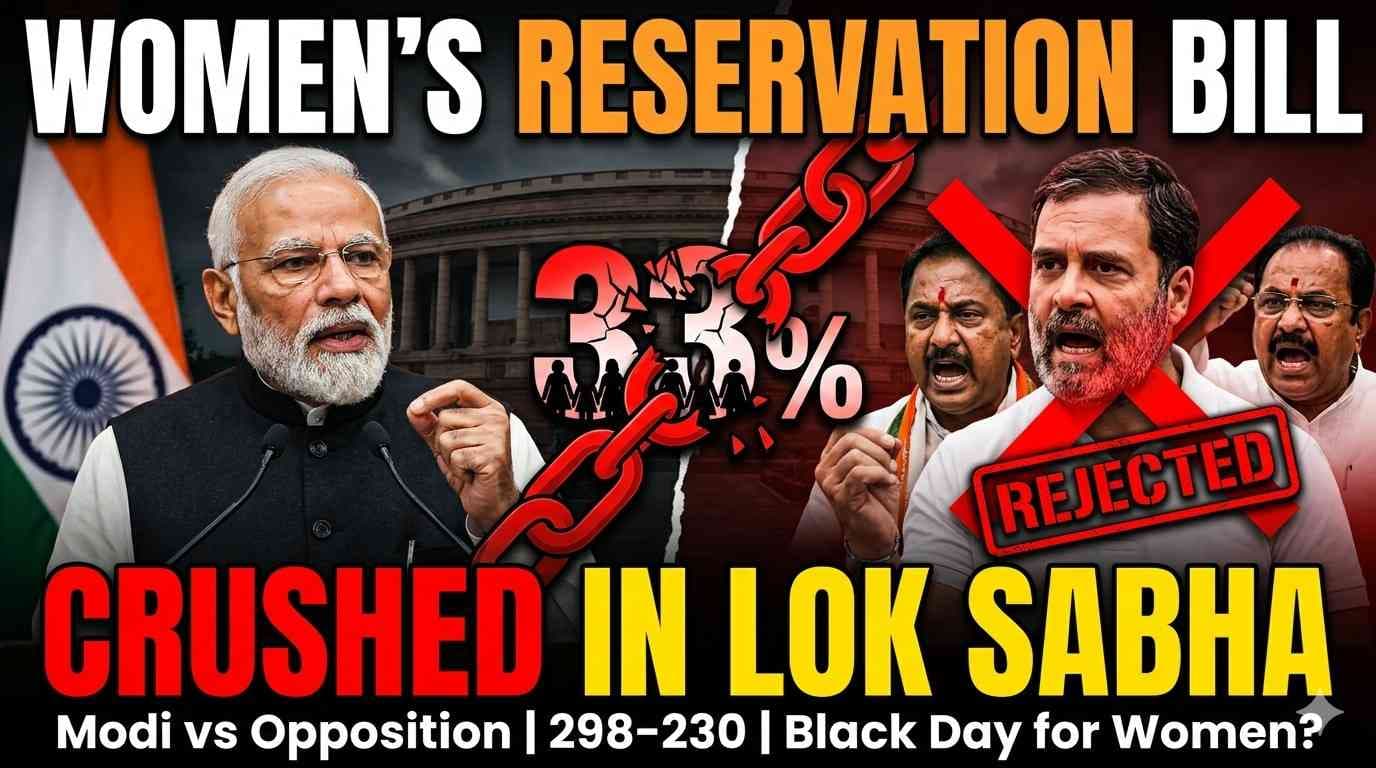
In a significant legislative setback, the Union Government's attempt to expedite the implementation of women's reservation was defeated in the Lok Sabha on Friday, April 17, 2026. The Constitution (131st Amendment) Bill, 2026, which sought to link the 33% quota for women with a fresh delimitation exercise based on the 2011 Census, failed to secure the mandatory two-thirds majority. While 298 members voted in favor, 230 voted against it, falling short of the 352 votes required for a constitutional amendment.
Addressing the nation on Saturday evening, April 18, Prime Minister Narendra Modi expressed firm determination to overcome this hurdle. He characterized the opposition’s move as an attempt to "commit foeticide of the idea of women’s representation" and asserted that the NDA government remains committed to removing all obstacles to empowering women in India's legislative bodies. The Prime Minister’s 30-minute address targeted the Congress and other opposition parties, labeling them "anti-reform" and accusing them of crushing the dreams of millions of women.
The defeated Bill was part of a larger legislative package that included two other related bills: one on delimitation and another regarding Union Territories. Following the defeat of the main constitutional amendment, the government decided to shelve the remaining two bills, stating that they could not be viewed in isolation. Union Minister for Parliamentary Affairs Kiren Rijiju remarked that the day would be remembered as a "black day" and a missed opportunity for a historic reform.
The opposition, led by the Congress and various regional parties like the DMK and TMC, remained united in their resistance. Leader of Opposition Rahul Gandhi argued that the Bill was less about women's empowerment and more a "blatant attempt" to alter the country's electoral map to the detriment of southern and northeastern states. He described the move as "anti-national," claiming it would unfairly diminish the representation of states that have successfully implemented population control measures.
Critics of the Bill, including TMC’s Derek O’Brien, accused the government of using women as a "decoy" to push through a controversial delimitation process. The opposition challenged the government to implement the existing 2023 Women's Reservation Law (Nari Shakti Vandan Adhiniyam) without linking it to the complex and politically sensitive issue of constituency redrawing. They have called for a simpler Bill that provides for the quota within the current sanctioned strength of the Lok Sabha.
Home Minister Amit Shah defended the government's stance in the House, clarifying that delimitation is necessary to correct the imbalance in the voter-to-MP ratio. He dismissed claims that southern representation would decrease, asserting that the reform was aimed at ensuring proportionality. However, the opposition maintained that any delimitation based on older census data or current population trends would inevitably penalize states with lower population growth.
Following the defeat, the Parliament was adjourned sine die, marking the conclusion of a high-stakes and polarized session. While the 2023 law for women's reservation still stands on the books, its implementation remains stalled by the requirement for a census and subsequent delimitation. The failure of the 131st Amendment indicates that the timeline for women taking their reserved seats in 2029 now faces significant procedural and political uncertainty.
As the political dust settles, the battle lines for the next electoral cycle appear firmly drawn around the issues of federalism, representation, and gender rights. The Prime Minister's vow to find "more chances" to push the reform suggests that the government may seek alternative legislative or administrative routes to fulfill its promise before the next general elections.