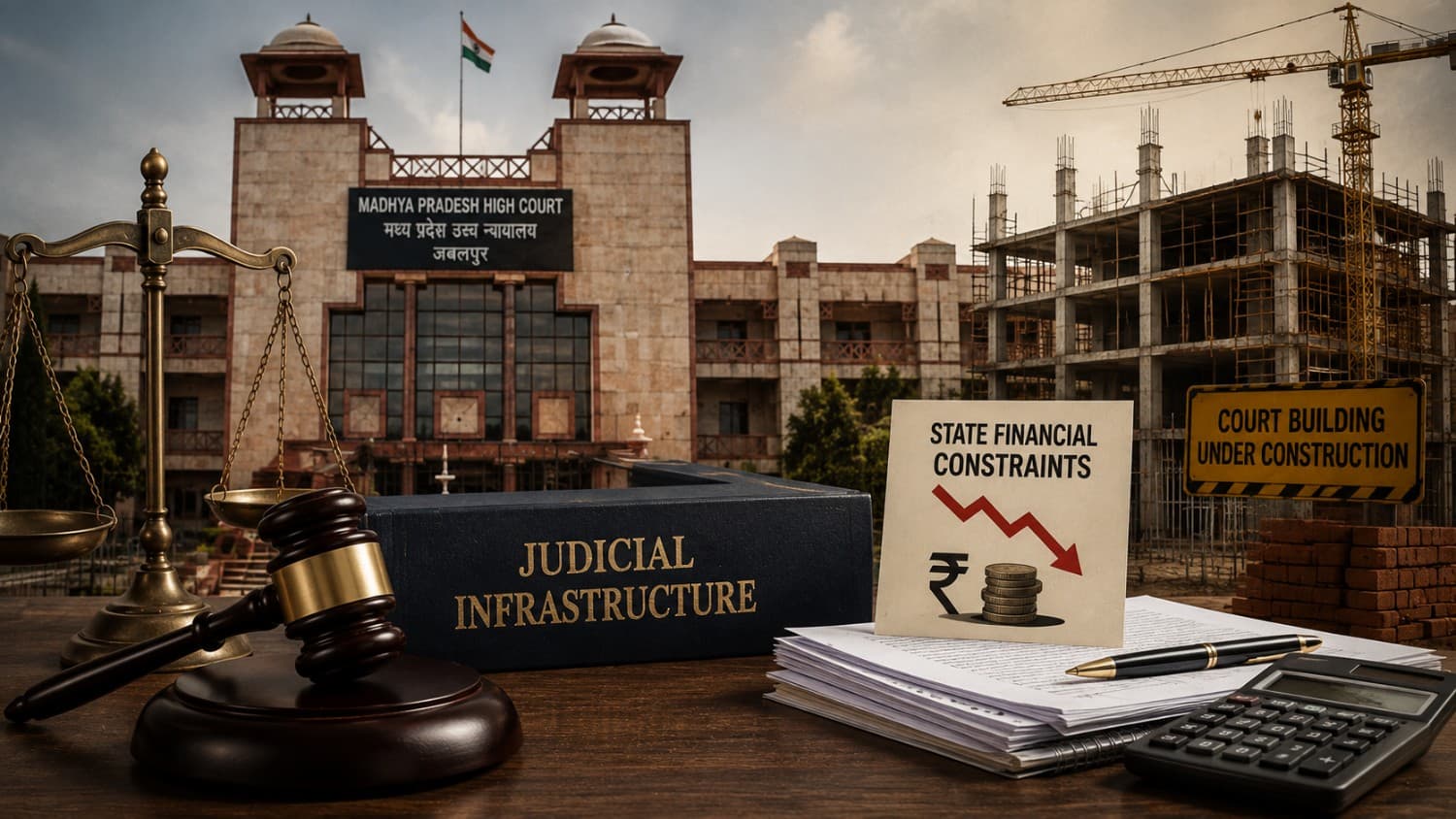
The Madhya Pradesh High Court has reminded the State Government of its constitutional obligation to provide adequate judicial infrastructure, stating that such facilities are not a matter of executive discretion but a duty owed to citizens under Article 21 of the Constitution.
A Division Bench comprising Acting Chief Justice Vivek Rusia and Justice Pradeep Mittal made these observations while hearing a public interest litigation originally filed concerning inadequate infrastructure at the District Court in Anuppur. The bench expanded the scope of the petition to address systemic delays in judicial infrastructure projects across the state.
The petition was filed by an advocate and Sanyojak of Jila Vikas Manch of Anuppur, seeking directions for the construction of a new District Court Building with 14 courtrooms. It was submitted that the district court currently operates from an old rented building lacking sufficient space and essential facilities, causing inconvenience to advocates, litigants, and the public.
The petitioner referred to a memorandum dated February 3, 2021, issued by the High Court, which had directed the Principal Secretary of the Law and Legislature Department to take prompt action on pending administrative and financial sanctions for the new building in Anuppur. Despite subsequent representations by the Bar Association seeking sanction for the construction, approval remained pending due to alleged budgetary constraints.
The State’s respondents had contended that sanction would be granted only when budgetary resources became available. However, the court noted that several years had passed without any approval being granted. The Ministry of Law and Justice had also communicated to the State, urging appropriate action on the Anuppur project, but no response was forthcoming.
In an earlier order, the bench had directed the Principal Secretary of Finance (Public Works Department) and the Secretary of the Law Department to explain why adequate budgetary provisions were not made for the construction of the court building, employees’ quarters, and residential quarters for judicial officers. The Registrar of Works and Inspection of the High Court Infrastructure Committee and the District Judiciary Infrastructure Committee were also directed to report on the status of ongoing projects related to these constructions.
The Advocate General informed the court that the Evaluation Committee had recommended a sanction of Rs 45 crores for the Anuppur project in its meeting on July 17, 2026, but the allocation had been delayed due to financial constraints.
The bench expressed concern over similar delays affecting other judicial infrastructure projects across the state. It directed the State Government to prioritise all pending projects that had been uploaded to the Enterprise Resource Planning (ERP) list.
In response, the Additional Chief Secretary (Finance) submitted that the budget allocated to the Law Department for the current financial year had been exhausted, citing completion of two major projects: the construction of 60 courtrooms in the High Court building at Jabalpur and the establishment of the MP Judicial Officers Academy, also in Jabalpur. The officer further stated that a proposal would be submitted for the 2027-28 financial year to secure funds for additional projects.
The bench referred to the Supreme Court’s judgment in All India Judges’ Association v. Union of India, reiterating that financial constraints cannot be invoked by the State to deny the judiciary proper infrastructure, working conditions, or administrative resources.
The court also highlighted the acute shortage of courtrooms in major cities such as Jabalpur and Bhopal, noting that criminal trials were not being conducted promptly and that undertrial prisoners remained in jail due to the lack of available court halls.
Emphasising the link between infrastructure and judicial efficiency, the bench observed that inadequate facilities contribute significantly to case pendency. It directed that, since no land is available for expansion within the existing court campus, the State must consider allotting additional land near the current court building for the construction of more courtrooms.
The court’s directions underscore that the provision of judicial infrastructure is a non-discretionary constitutional obligation, and delays caused by budgetary limitations do not absolve the State of its duty to ensure access to justice.