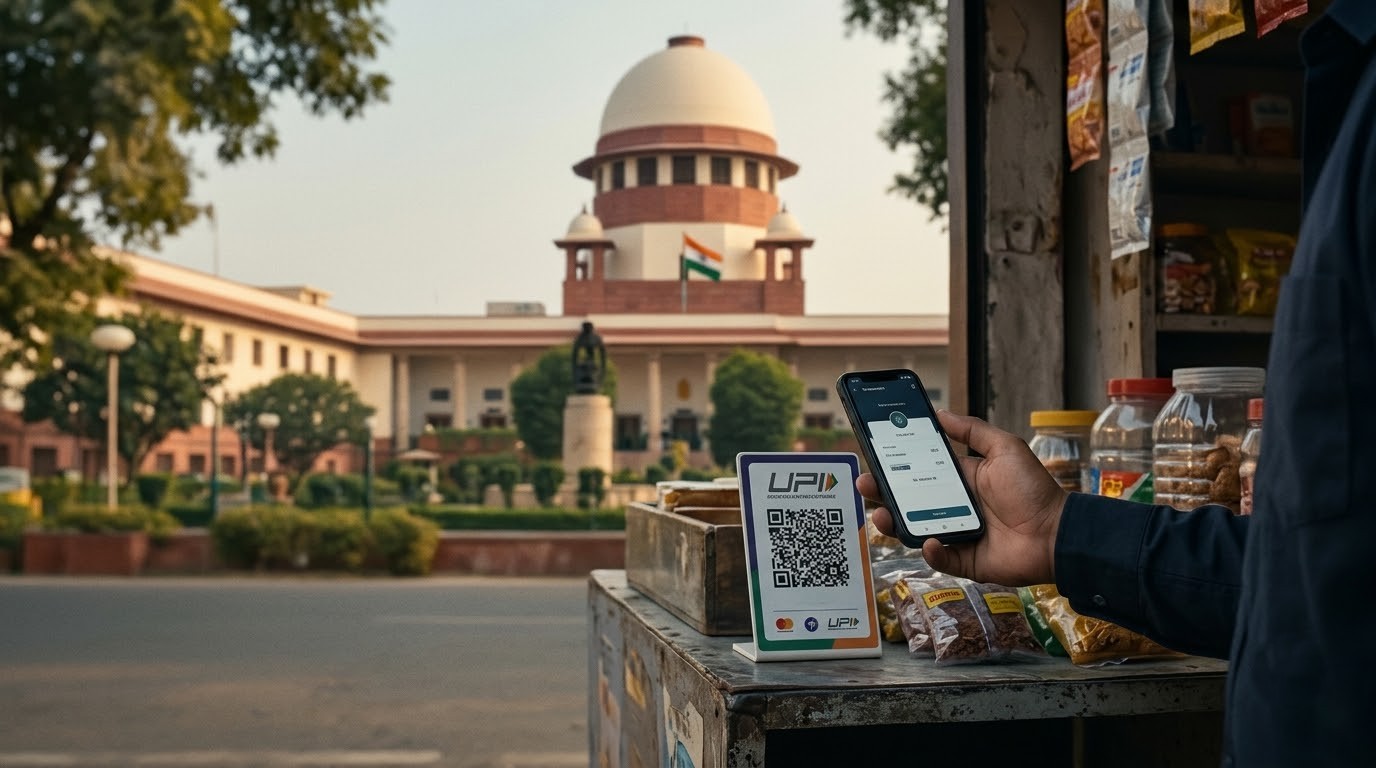
The National Payments Corporation of India (NPCI) has informed the Supreme Court that merchants are strictly prohibited from passing on Merchant Discount Rate (MDR) charges to customers under its revised framework for Unified Payments Interface (UPI) transactions. In a counter affidavit filed on November 3, the NPCI stated that the directive against passing on charges is a mandatory and binding obligation enforceable through service level agreements (SLAs) with Payment Service Providers (PSPs) and Third-Party Application Providers (TPAPs), and not merely a policy assurance.
The affidavit was filed in response to a petition challenging the amendment to Section 10A of the Payment and Settlement Systems Act, 2007, introduced through the Taxation and Other Laws (Amendment) Act, 2026, the subsequent Ministry of Finance notification, and the revised MDR framework announced in September. The Supreme Court had sought an affidavit explaining the basis for levying charges on UPI transactions above ₹2,000 from individuals to merchants.
What is the legal basis for NPCI's directive preventing merchants from passing on MDR charges to customers?
The NPCI submitted that non-compliance by a Payer PSP or TPAP with the circular's directive constitutes a breach of binding obligations under SLAs to abide by all NPCI circulars and directions. Such breach exposes the entity to compliance actions, including potential termination of UPI membership and facilities, making the non-pass-through directive legally enforceable through contractual mechanisms.
Scope and Incidence of Revised MDR Framework
The NPCI submitted that approximately 96% of person-to-merchant (P2M) transactions will remain unaffected by the revised MDR. The charge applies only to a small fraction—approximately 4%—of P2M transactions exceeding ₹2,000. The Corporation emphasised that person-to-person (P2P) transactions and transactions involving small merchants under the Person-to-Person Merchant (P2PM) category, covering merchants with monthly inward UPI credits up to ₹1 lakh, will continue to remain free.
The affidavit detailed that approximately 70% of UPI transactions are P2P transfers, while around 96% of P2M transactions are valued up to ₹2,000. Both categories remain free of MDR. For transactions above ₹2,000, the MDR will not exceed 0.4%, a rate the NPCI noted is far lower than charges imposed by other system providers for credit and debit cards.
Transaction Category | MDR Applicability | Threshold / Coverage |
|---|---|---|
Person-to-Person (P2P) | Zero MDR | All transactions |
P2M (Small Merchants / P2PM) | Zero MDR | Monthly inward UPI credits up to ₹1 lakh |
P2M (General) | Zero MDR | Transaction value up to ₹2,000 |
P2M (General) | MDR ≤ 0.4% | Transaction value above ₹2,000 |
Sustainability and Protection of Small Merchants
The NPCI argued that the narrow incidence of the charge—confined to high-value merchant transactions—demonstrates the framework is calibrated to raise revenue for the long-term sustainability of the UPI ecosystem from the class of transactions best placed to bear it. The affidavit stated that the framework excludes the very class of small merchants and street vendors whom the petitioner fears will bear indirect burdens.
Additionally, a dedicated fund is proposed to promote UPI adoption among small merchants with annual turnover up to ₹20 lakh, funded by 5% of each entity's MDR share, excluding specified industry-program categories. The NPCI refuted apprehensions that MDR charges would cause merchants to increase prices generally, submitting that a charge arising only occasionally and above a defined value affords less scope for merchants to recalibrate pricing across their entire customer base.