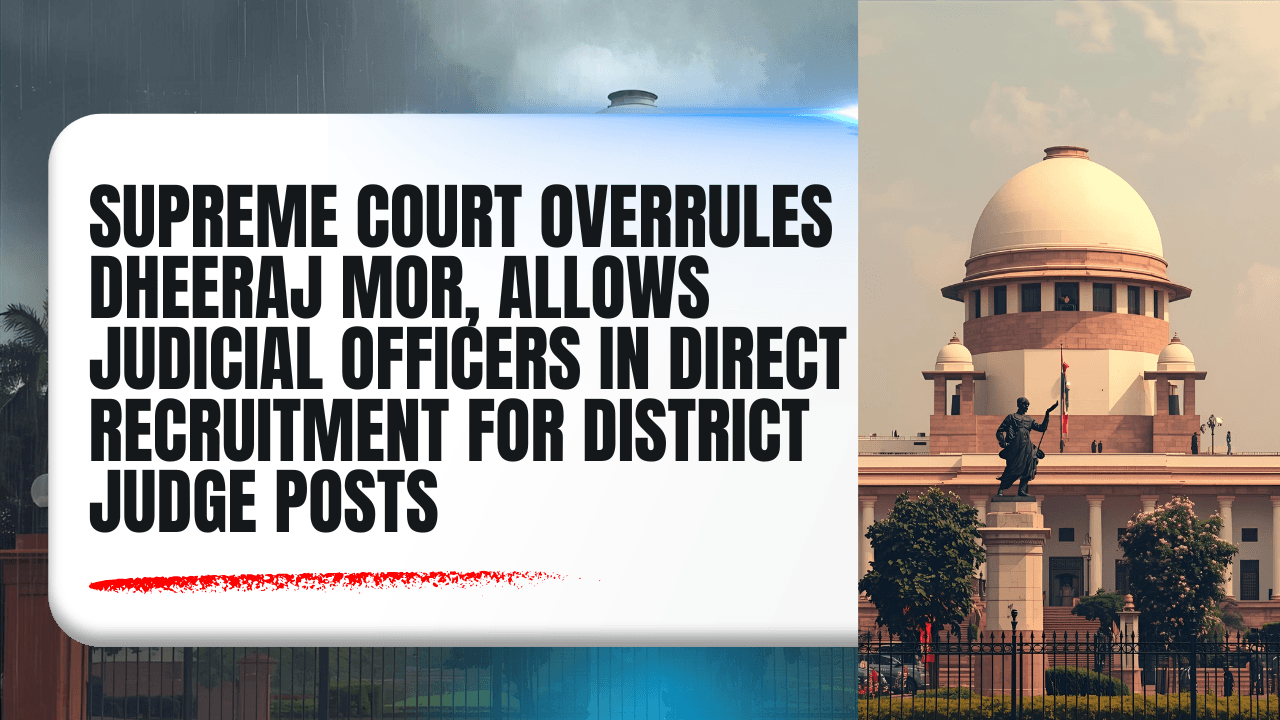
In a monumental decision with far-reaching implications for the Indian judiciary, a five-judge Constitution Bench of the Supreme Court on October 9, 2025, has cleared the path for serving judicial officers to compete for the post of District Judge through direct recruitment. Te judgment, delivered in the case of Rejanish K.V. v. K. Deepa and Others, expressly overrules the 2020 ruling in Dheeraj Mor v. High Court of Delhi and dismantles the long-standing barrier that confined judicial officers to the promotion channel
This landmark ruling reshapes the career trajectory for thousands of Civil Judges across the country and fundamentally alters the competitive landscape for practicing advocates aspiring to join the Higher Judicial Service.
The Old Rule: Why Judicial Officers Were Previously Barred
Until now, the appointment of District Judges was governed by a rigid "two-stream" theory derived from interpretations of Article 233 of the Constitution. The common understanding was:
Promotion: The exclusive channel for in-service judicial officers to be elevated based on seniority and merit.
Direct Recruitment: A 25% quota reserved exclusively for practicing advocates with a minimum of seven years of experience at the Bar.
This interpretation was cemented by the Supreme Court in Dheeraj Mor v. High Court of Delhi (2020) 7 SCC 401. The court reasoned that once an advocate joins the judicial service, they cease to be a "practicing advocate." Consequently, they were deemed ineligible for the direct recruitment channel. The operative part of the Dheeraj Mor judgment (paragraph 45) held that an incumbent "must be in practice as on the cut-off date and at the time of appointment he must not be in judicial service."
This created a strict dichotomy, forcing talented judicial officers, many with significant prior experience at the Bar, to wait for promotion, which could take years.
The Landmark Judgment: Deconstructing the Supreme Court's New Stance
The Constitution Bench in Rejanish K.V. conducted a deep textual and contextual analysis of Article 233, concluding that the previous interpretation was flawed. Here are the core pillars of its reasoning:
1. A Fresh Reading of Article 233
The court focused on the precise wording of Article 233(2):
"(2) A person not already in the service of the Union or of the State shall only be eligible to be appointed a district judge if he has been for not less than seven years an advocate or a pleader.."
The Bench held that interpreting this clause to exclude judicial officers renders the first part—"A person not already in the service..."—completely redundant. As noted in paragraphs 121 and 124 of the judgment, the correct interpretation is that the seven-year advocate experience requirement is a qualification specifically for candidates coming from the Bar, not for those already within the judicial service.
2. Merit Above All Else
The judgment powerfully asserts that the ultimate goal of any public service selection is "to secure the best and the most suitable person for the job" (paragraphs 149-151, citing Leela Dhar v. State of Rajasthan). Creating an artificial barrier that prevents meritorious judicial officers from competing alongside advocates was deemed counterproductive to enhancing the efficiency of the district judiciary. The court endorsed the Shetty Commission's view that such competition would allow the High Court to assess the best talent from both streams.
3. No Exclusive "Quota" for Advocates
In a crucial clarification, the Court ruled in paragraph 164 that the 25% direct recruitment channel is not an exclusive quota reserved for advocates. Instead, it is a competitive stream open to all eligible candidates who meet the prescribed criteria. To hold otherwise, the court stated, would be to create a reservation for advocates that is not contemplated by the Constitution.
4. Doctrine of Stare Decisis Set Ase
Addressing the argument that the decades-old precedent should not be disturbed, the Court held that the doctrine of stare decisis (to stand by decided matters) is not an inflexible rule. In paragraphs 165-169, the Bench concluded that the entire line of judgments from Satya Narain Singh (1985) to Dheeraj Mor (2020) had incorrectly interpreted the law laid down by earlier Constitution Benches. It stated that failing to correct a manifest error would amount to "perpetuating the injustice that has been meted out for decades."
The New Rules of the Game: Eligibility Criteria Redefined
As per the clear directions in paragraph 172 of the judgment, the eligibility criteria for direct recruitment to the post of District Judge are now as follows:
For Serving Judicial Officers:
Eligibility: You are now fully eligible to apply for direct recruitment.
Experience: You must have a combined experience of seven years as an advocate and a judicial officer. For example, four years of practice at the Bar followed by three years as a Civil Judge would make you eligible.
For Practicing Advocates:
Experience: You must have seven years of continuous practice.
Combined Experience: If you have previously served as a judicial officer, that experience can be combined with your years of practice to meet the seven-year requirement.
A Universal Requirement: The Age Bar
A minimum age of 35 years is now mandatory for all candidates, whether from the Bar or the judicial service, as on the date of application.
The Ripple Effect: What This Judgment Means For...
Judicial Officers (Civil Judges): This is a game-changer. It provides a faster, merit-based track to the Higher Judiciary, allowing talented officers to leapfrog the conventional, seniority-based promotion queue by proving their mettle in a competitive examination.
Practicing Advocates: The competition has intensified. The pool of applicants will now include experienced judicial officers who bring deep procedural knowledge, case management skills, and a judicial temperament to the table.
The Indian Judiciary: By broadening the talent pool, this decision aims to foster a more meritocratic system. As Justice M.M. Sundresh noted in his concurring opinion, "greater competition would result in better quality," strengthening the very foundation of the judiciary.
State Governments & High Courts: The clock is ticking. The Supreme Court has mandated them to amend their respective judicial service rules within three months to align with this judgment (paragraph 174).
FAQ: Your Questions Answered
Q1: Has the Dheeraj Mor judgment been completely overturned?
A: Yes. On the specific point of the eligibility of judicial officers for direct recruitment, the judgment in Dheeraj Mor has been expressly overruled and "do not lay down the correct proposition of law" (paragraph 17vi)).
Q2: I have been a Civil Judge for 4 years and practiced as an advocate for 3 years before that. Can I apply for the next District Judge exam?
A: Yes. Your combined experience is seven years (3+4), making you eligible under the new rules, provided you are at least 35 yea old.
Q3: Is the direct recruitment process now easier for judicial officers?
A: Not easier, but accessible. The judgment removes the barrier to entry, but selection remains a highly competitive process based purely on merit in a written exam and viva voce, where judicial officers will compete on a level playing field with advates.
Q4: Will this judgment apply to recruitments that are already underway?
A: The Court has clarified that the ruling will apply prospectively. It will not affect selection processes that have already been completed, except in specific cases where an interim order was passed by a court (paragraph 170).
Conclusion: A Step Towards a More Meritocratic Juciary
The Supreme Court's decision in Rejanish K.V. v. K. Deepa is more than just a legal recalibration; it is a philosophical shift. It prioritizes merit, broad-based competition, and an organic interpretation of the Constitution over rigid, historical classifications. By opening the doors of direct recruitment to deserving judicial officers, the Court has taken a definitive step towards strengthening the district judiciary, ensuring that the path to higher office is open to the best and brightest legal minds, whether they serve at the Bar or on the Bench