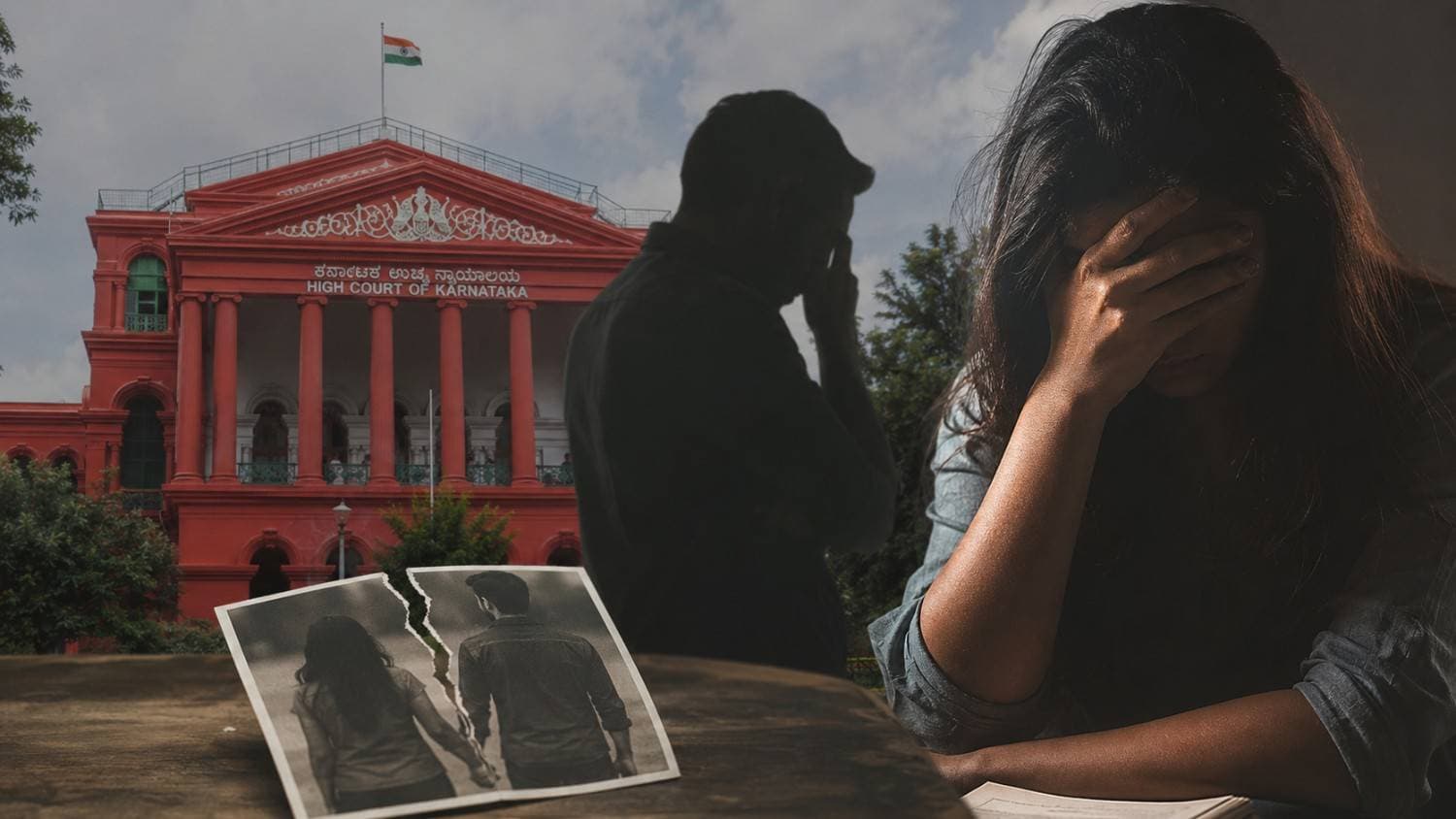
The Karnataka High Court has refused to quash criminal proceedings against a man accused of abetment to suicide under the Bharatiya Nyaya Sanhita, 2023, holding that the allegations, if taken cumulatively, prima facie disclose the ingredients of the offence and must be adjudicated at trial. The single judge bench of Justice M Nagaprasanna dismissed the petition seeking quashing of proceedings under Sections 75 (sexual harassment), 78 (stalking), and 108 (abetment to suicide) of the BNS, 2023.
The court observed that the case could not be characterised as one where the allegations were bereft of the ingredients of abetment. It emphasized that this was not a case of an angry word spoken in the heat of the moment, nor an isolated quarrel followed by suicide after a considerable hiatus, nor a case where the accused was sought to be prosecuted merely because he figured in the emotional landscape of the deceased. The allegations, the court said, travelled much farther.
The bench noted that the complaint and charge sheet, if read as a whole, prima facie depicted the deceased being progressively cornered—her refusal allegedly ignored, her privacy threatened, her workplace invaded by pursuit, her matrimonial prospects repeatedly sabotaged, and her apprehension that she would not be permitted to lead an independent life allegedly reinforced by the accused’s continued conduct. The court clarified that it was not deciding the truth of these allegations at this stage, but only whether they disclosed a prima facie case requiring trial.
Regarding the mens rea aspect, the court stated that it was yet to be ascertained in the trial. It referred to the facts that a 22-year-old woman pursuing nursing in Mysuru had allegedly committed suicide due to the accused’s acts of coercion and harassment, marking her second suicide attempt after being saved earlier that month.
According to the complaint filed by the mother of the deceased, the accused is a married man. The allegations include stalking the woman at her workplace, forcing her to accompany him on his motorcycle under the pretext of friendship, and gradually sabotaging her every marriage prospect by positioning himself as an 'obstacle'. The accused is also said to have taken her to Dharmasthala under the pretext of visiting temples and then threatened to circulate photographs of them together to malign her further. On another occasion, he allegedly claimed to be in a relationship with her, thereby sabotaging her marriage prospects.
The court noted that the deceased had repeatedly expressed her disinclination towards the accused, yet the alleged torment of coercion continued. It highlighted that the deceased had previously attempted suicide on July 5, 2025, and though the family had intervened, the accused allegedly persisted with his conduct, leading to her death on July 29, 2025.
The court observed that if the allegations ultimately stood proved, the earlier suicide attempt would assume considerable significance as a warning written in unmistakable terms. It stressed that despite such a warning, the accused allegedly persisted with the very conduct that had earlier driven the deceased to the brink.
The bench concluded that the life of a young woman had come to an abrupt end, and the prosecution alleged that before that end, there had been a sustained trail of pursuit, coercion, intimidation, and interference with her freedom to choose the course of her own life. Whether that trail ultimately led to the petitioner was a matter for the trial court to determine upon evidence. The court affirmed that it was not declaring the petitioner guilty but only declining to declare the prosecution groundless.