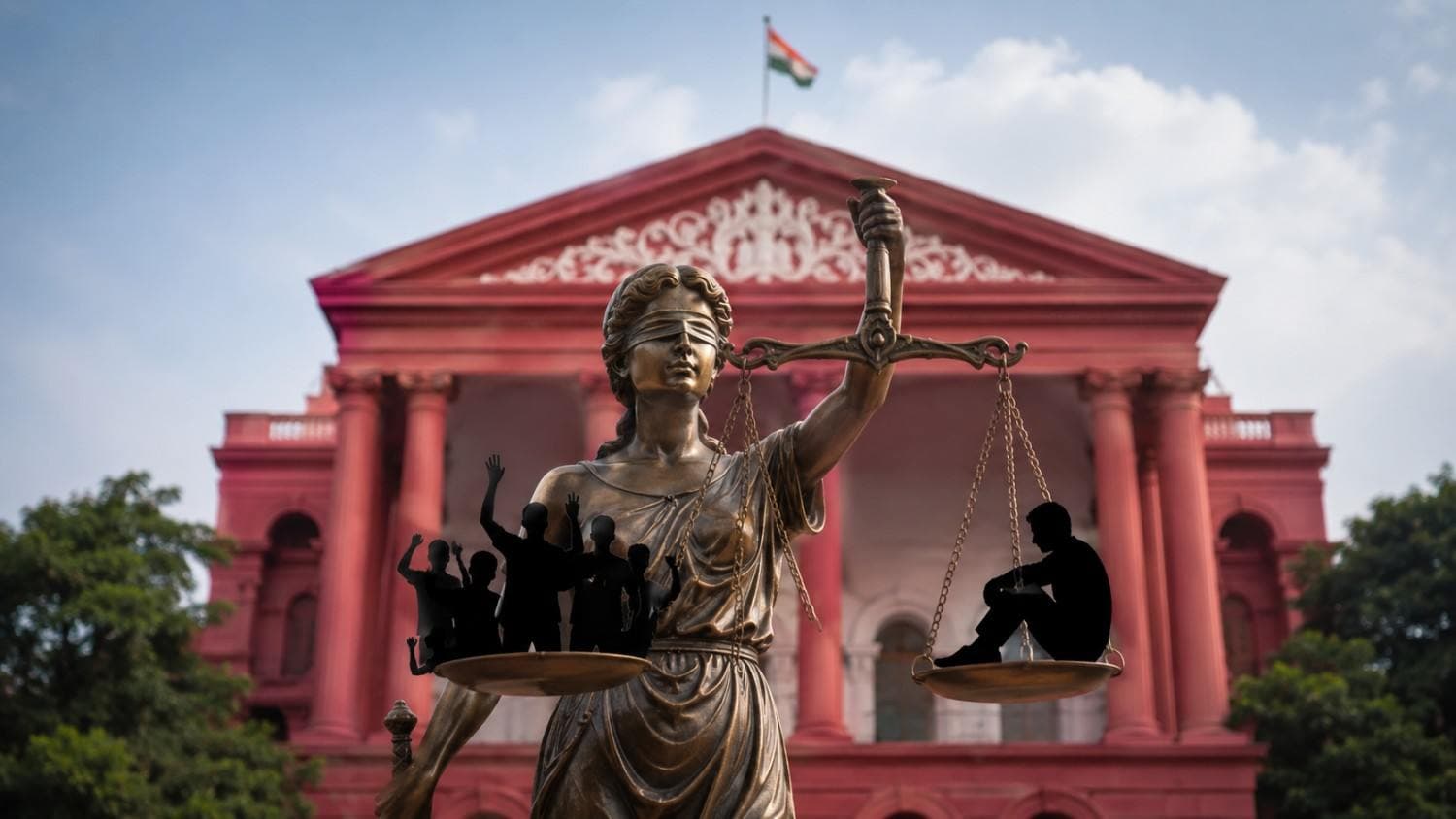
The Karnataka High Court has dismissed multiple pleas seeking cancellation of bail granted to persons accused in a mob lynching case where the victim was alleged to have chanted pro-Pakistan slogans. The single bench of Justice Vijaykumar A. Patil, while refusing to interfere with the bail orders, issued specific directions to ensure compliance with the Supreme Court guidelines laid down in Tehseen S Poonawalla v. Union of India.
The court observed that although the State Government had issued a government order along with a memo filed by the state indicating compliance with the Tehseen Poonawalla guidelines, the said order did not contain any provision for grant of interim compensation to the victim or the next of kin. The bench held that the State was required to formulate a scheme incorporating provision for interim compensation in consonance with the apex court guidelines.
Accordingly, the court directed the State Government to formulate a scheme for grant of interim compensation to the victim or the next of kin of the victim within three months of the passing of the order and to file a compliance report before the Court.
Regarding the procedural aspect, the court noted that the Sessions Court had committed a 'grave error' by failing to issue timely notice to the next of kin of the deceased before granting bail. However, the bench clarified that this lapse, by itself, would not warrant interference with the bail order.
The court further directed the Registrar (Judicial) to issue a necessary circular to the concerned branches in the High Court with a direction to raise objections if the victim is not arrayed as a party in cases involving mob violence or lynching. Similarly, the Principal District Judges were directed to issue necessary circulars to the concerned branches with a direction to raise objections under the same circumstance.
On the question of bail cancellation, the bench explained that to set aside an order granting bail, the court must analyse whether the order was illegal, perverse, unjustified or arbitrary. To cancel a grant of bail, it must examine whether supervening circumstances have occurred warranting cancellation, such as violation of bail conditions. The court reasoned that in the instant case, the charge sheet had already been filed, there is a six-month time limit for disposal of cases involving mob violence, and other accused had been granted bail by a coordinate bench on the same set of circumstances. It added that while the ground of parity cannot be mechanically applied to co-accused, the court must investigate the role of the accused. In this case, the crime of mob violence and lynching being collective in nature, no specific role could be assigned to an accused, and the facts and charges against the co-accused to whom bail was granted and the accused in the instant case were one and the same.
The bench opined that liberty should be curtailed only in exceptional circumstances. Although due procedure had not been followed, the accused had not violated any bail conditions, which formed the basis for not interfering with the bail order.
Senior Counsel Aruna Shyam appeared for the accused, SPP BN Jagadeesh appeared for the state, and Advocate Clifton D Rozario appeared for the next of kin.