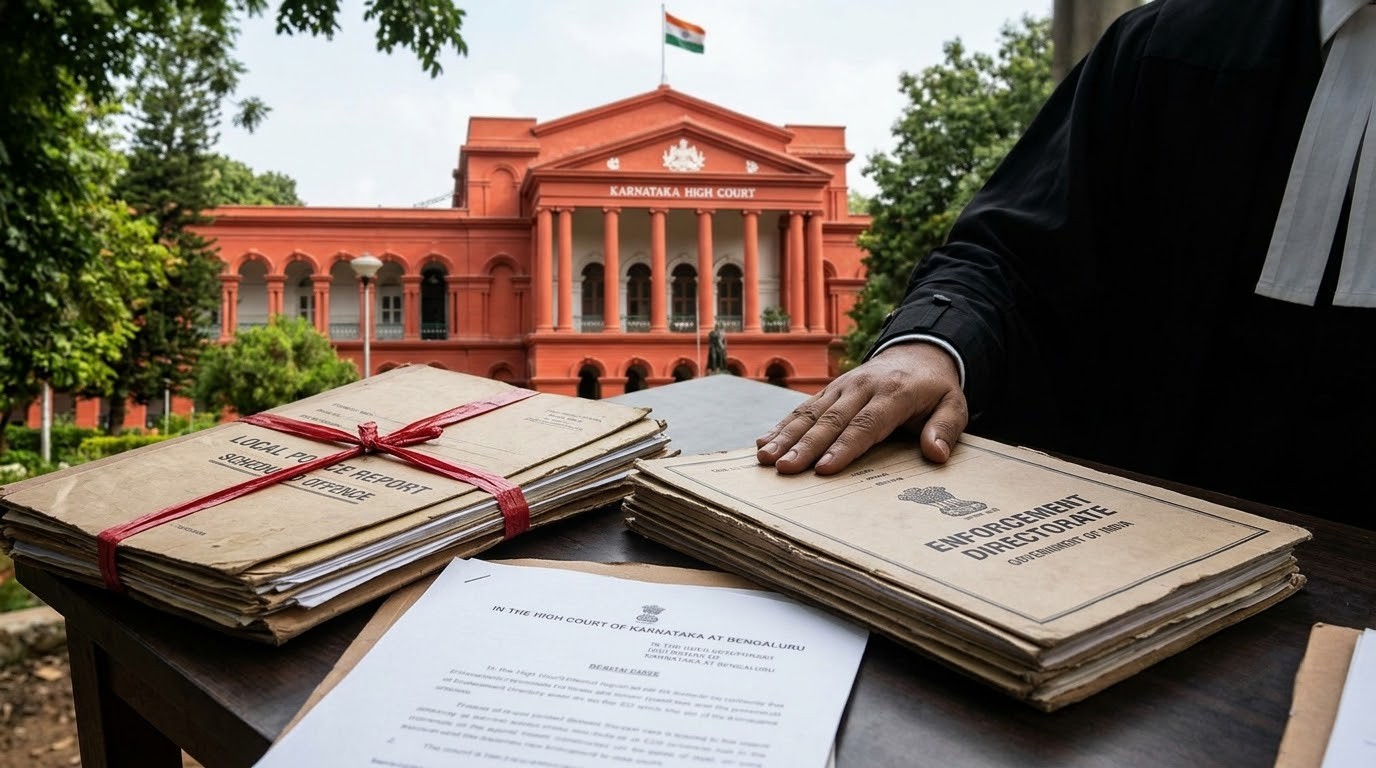
The Karnataka High Court has ruled that the Enforcement Directorate (ED) does not possess the authority to file a private complaint before a magistrate seeking investigation into a scheduled offence when local police refuse to act on information forwarded by the agency. Justice M I Arun, while quashing money laundering proceedings against Congress leader K Y Nanje Gowda and others, held that the ED is not a 'super cop' empowered to investigate any matter that comes to its notice. The court directed the agency to return seized articles to the petitioner.
Can ED Continue PMLA Investigation After Predicate Offence Is Closed?
The court held that proceedings under the Prevention of Money Laundering Act (PMLA) are derivative in nature and cannot continue once the predicate offence has been dismissed, regardless of whether the closure was on merits or technical grounds. The absence of a predicate offence extinguishes the foundation for money laundering proceedings.
Statutory Scheme Limits ED to Forwarding Information
The bench analysed Section 66(2) of the PMLA, which mandates that if the ED possesses material constituting a scheduled offence, it must forward the same to the concerned agency. The judgment clarified that the Act does not expressly empower the ED or its authorities to prefer a private complaint in respect of a scheduled offence and subsequently investigate the accused under PMLA on that basis. The power of the ED under the statute is derivative, not original, and it cannot initiate investigation suo motu based on a standalone suspicion of money laundering.
Background: Land Scam and Subsequent Job Scam Allegations
The case originated from allegations that Gowda, as Chairman of the Land Grant Committee of Malur, Kolar District, colluded with members to illegally recommend land grants totalling approximately 80 acres to 38 persons. A private complaint filed by social activist K C Rajanna in 2022 led to the registration of a case under various sections of the Indian Penal Code, including cheating and forgery. Subsequently, Gowda was appointed Chairman of the Kolar and Chikkaballapur Milk Union Ltd (KOMUL).
The ED treated the land scam case as a predicate offence and registered an Enforcement Case Information Report (ECIR) in 2023. During investigation, the ED claimed to have uncovered materials indicating a separate recruitment scam at KOMUL. Under Section 66(2) of the PMLA, the agency shared this material with the local police. However, the land scam case was subsequently dismissed for non-prosecution, and the local police did not act on the information regarding the alleged job scam.
ED's Private Complaint and Petitioners' Challenge
In 2024, after the local police declined to act, the ED filed a private complaint seeking a direction to refer the job scam matter to the Lokayukta Police for investigation under the Prevention of Corruption Act. The petitioners contended that once the predicate offence was closed, the ED lost jurisdiction to continue its investigation. They further argued that the ED's statutory role is limited to sharing information with the relevant authority and does not extend to filing private complaints to assume investigative control over scheduled offences.
Centre vs State: Law and Order Responsibility
Justice Arun emphasised that maintaining law and order is the constitutional responsibility of the State, not the Centre. The court observed that the filing of a private complaint by a central agency like the ED is not contemplated under the PMLA framework. Allowing such a mechanism would effectively permit the ED to bypass the statutory scheme and investigate scheduled offences directly, which the legislature did not intend.
Comparison: ED's Statutory Role vs Asserted Power
Aspect | Statutory Position Under PMLA | Power Asserted by ED |
|---|---|---|
Nature of Power | Derivative; dependent on existence of predicate offence | Original; standalone investigation into money laundering |
Action on Scheduled Offence Material | Forward to concerned agency under Section 66(2) | File private complaint to magistrate for investigation |
Effect of Predicate Offence Closure | PMLA proceedings cannot survive | Investigation continues even if closed on technical grounds |
Law and Order Jurisdiction | State responsibility | Central agency intervention via private complaint |
The High Court accepted the petitioners' arguments and quashed the PMLA proceedings. The ruling reinforces the principle that the ED's jurisdiction is strictly contingent on a subsisting predicate offence and that the agency cannot circumvent the federal distribution of investigative powers by converting its statutory duty to share information into a tool for direct investigation.