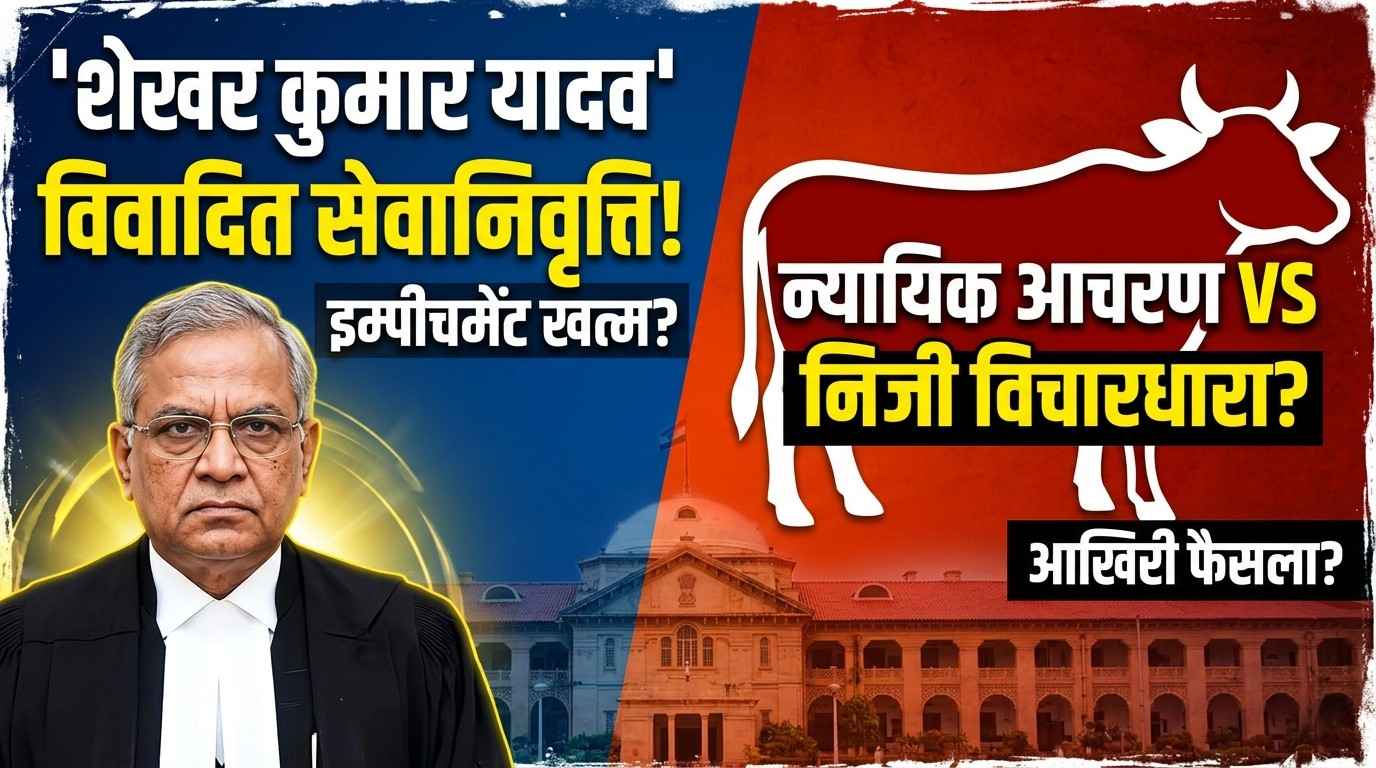
Justice Shekhar Kumar Yadav of the Allahabad High Court is set to retire from judicial service on April 15, 2026, marking the end of a career that became a lightning rod for debates on judicial conduct and secularism. His departure comes at a time when the legal and political spheres were closely watching a nascent impeachment movement against him, which had been gaining momentum in the Rajya Sabha. With his superannuation, the constitutional process of removal becomes infructuous, as Indian law provides no mechanism to continue impeachment proceedings against a retired judge.
Justice Yadav first drew widespread national attention for his unconventional and often polarizing observations in judicial orders. In a 2021 ruling, he famously suggested that the cow should be declared the national animal and afforded fundamental rights, asserting that "scientists believe the cow is the only animal that inhales and exhales oxygen." While these remarks were cheered by cultural nationalists, they were met with skepticism by the scientific community and legal scholars who argued that such personal beliefs have no place in a formal court decree.
The controversy deepened following subsequent remarks concerning the Muslim community and historical narratives. During various hearings, Justice Yadav made oral and written observations suggesting that certain minority practices were at odds with the "original culture" of India. These comments led to a formal complaint by a group of over 60 Members of Parliament, who initiated a motion for his removal on grounds of "misbehavior" and "prejudice." They argued that his pronouncements created a sense of insecurity among litigants and compromised the neutral image of the Allahabad High Court.
The impeachment process, governed by the Judges (Inquiry) Act, 1968, is notoriously difficult to conclude in India, requiring a two-thirds majority in both houses of Parliament. In Justice Yadav's case, while the motion had been admitted for consideration, the establishment of an Inquiry Committee faced bureaucratic hurdles. The delay in the legislative process ensured that the judge would reach the age of 62—the retirement age for High Court judges—before the committee could submit a definitive report or the Parliament could hold a vote.
Legal experts note that this "exit by retirement" is a recurring theme in the history of the Indian judiciary when it comes to controversial figures. Because the impeachment process is so cumbersome, it often serves as a symbolic gesture rather than a practical tool for accountability. Critics argue that the stalling of Justice Yadav's impeachment underscores the need for a more efficient Judicial Standards and Accountability Bill, which could offer disciplinary measures short of removal, such as a formal reprimand or a temporary suspension of judicial work.
Throughout his tenure, Justice Yadav remained unapologetic about his views, often framing them as an attempt to reconnect the law with "civilizational values." However, the Supreme Court has repeatedly emphasized that judges must exercise "extreme restraint" and "judicial soberness." The apex court has noted in several unrelated cases that extraneous remarks in judgments can be struck down if they are irrelevant to the legal dispute at hand, a principle that was frequently cited by those opposing Justice Yadav’s rhetoric.
As he prepares to demit office, the Allahabad High Court—the largest in India—faces the dual challenge of filling his vacancy and managing the public perception of its neutrality. Justice Yadav's legacy will likely be a divided one: seen by some as a judge who was unafraid to speak his mind on national identity, and by others as a cautionary tale of how personal ideology can overshadow the objective application of the law. His retirement ensures he will receive all post-retiral benefits, including pension and perks, which would have been forfeited had an impeachment succeeded.
In the final analysis, Justice Shekhar Kumar Yadav's career highlights the inherent tension between a judge’s individual right to expression and their institutional duty to appear impartial. His departure effectively closes the chapter on one of the most contentious judicial tenures in recent years, but the questions he raised—and the controversies he sparked—will likely fuel debates on judicial reform and the "code of conduct" for the Indian bench for years to come.