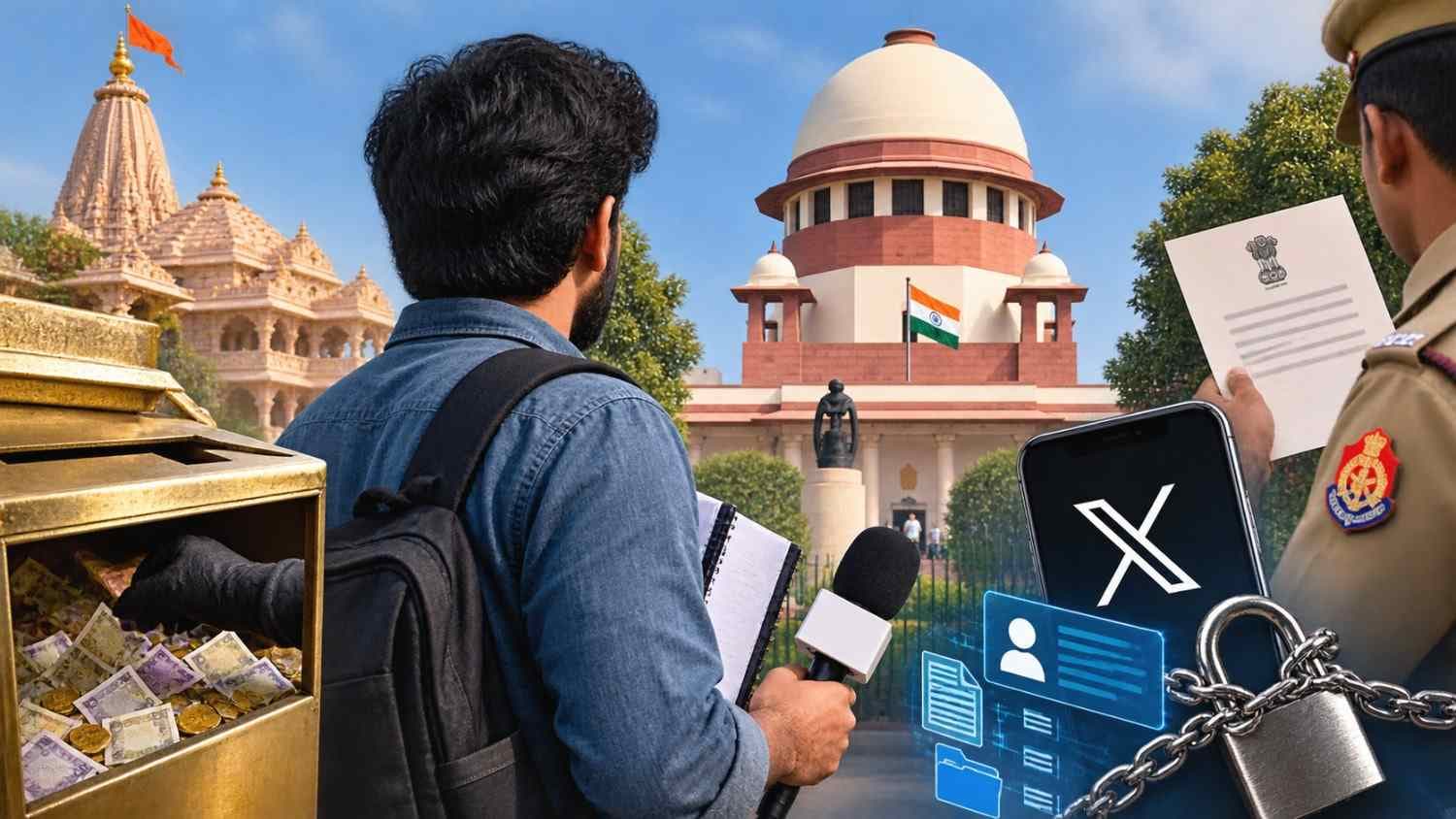
Journalist Abhishek Upadhyaya, who first reported on the Ayodhya Ram temple donation theft scam, has approached the Supreme Court seeking an immediate stay and quashing of a notice issued by the Ghaziabad Crime Branch asking social-media platform X to provide extensive digital information relating to his X account. The application, filed in his writ petition challenging the UP Police FIR over a road rage incident, challenges a notice dated August 22 issued under Section 94 of the Bharatiya Nagarik Suraksha Sanhita (BNSS) by the Crime Branch Investigation Unit, Ghaziabad.
According to the application, X's legal department informed Upadhyaya by email on August 26 that it had received a request from the Ghaziabad Crime Branch for information concerning his account, @upadhyayabhii. X said it was notifying him to enable him to take appropriate legal action to protect his interests.
Last week, the Supreme Court had stayed coercive action against Upadhyay on the FIR. Upadhyay's counsel mentioned the application today before the Chief Justice of India seeking urgent listing. He submitted that though the FIR is regarding an incident of August 18, the police was seeking data from June 1. This was an attempt to know his journalistic sources, he contended. 'My lord was pleased to protect me. IO has sought all digital details since 1 June 2026 up till date, though the road rage incident was of 18.08.2026. That is the week when I collected data to expose Ram Mandir theft. If that is disclosed, entire source would be at mercy of state,' the counsel submitted.
The Chief Justice, pointing out that the petitioner has already been granted interim protection, asked what is the problem in the police investigating the matter. 'We will see. What is the problem? We already protected. Let them investigate,' the CJI asked. The counsel said that he was seeking an urgent listing of the application. 'Just file it,' Justice V Mohana said. 'We will see,' CJI added.
Police sought extensive digital records. The impugned notice seeks, among other things, login and logout IP addresses, an alternate email ID, mobile number, location information including latitude and longitude, mobile and device details, IMEI number, name, address, phone number and IP access and registration logs. Upadhyaya argued that the police demand is disproportionately broad because it seeks digital information covering a period substantially preceding the alleged incident. The plea further contends that the requested data could expose people who communicated with the journalist during his reporting and potentially reveal confidential sources. According to the application, the demand could enable investigators to reconstruct the journalist's digital associations, contacts and movements over several months. The petitioner argued that the issue extends beyond individual privacy and implicates freedom of the press and confidentiality of journalistic sources under Article 19(1)(a) of the Constitution. He contended that unrestricted access to a journalist's digital records could have a chilling effect on potential sources of information on matters of public interest. The application also stated that, during the period covered by the data request, Upadhyaya was engaged in investigative reporting concerning alleged irregularities and theft relating to donations associated with the Ram Temple. The petitioner apprehended that disclosure of his digital records could identify people who assisted that investigation. He has therefore asked the Supreme Court to stay, on an interim and ex-parte basis, the operation of the August 22 notice and restrain the authorities from seeking, obtaining, accessing, processing or disclosing information pursuant to it. He has also sought quashing of the notice.