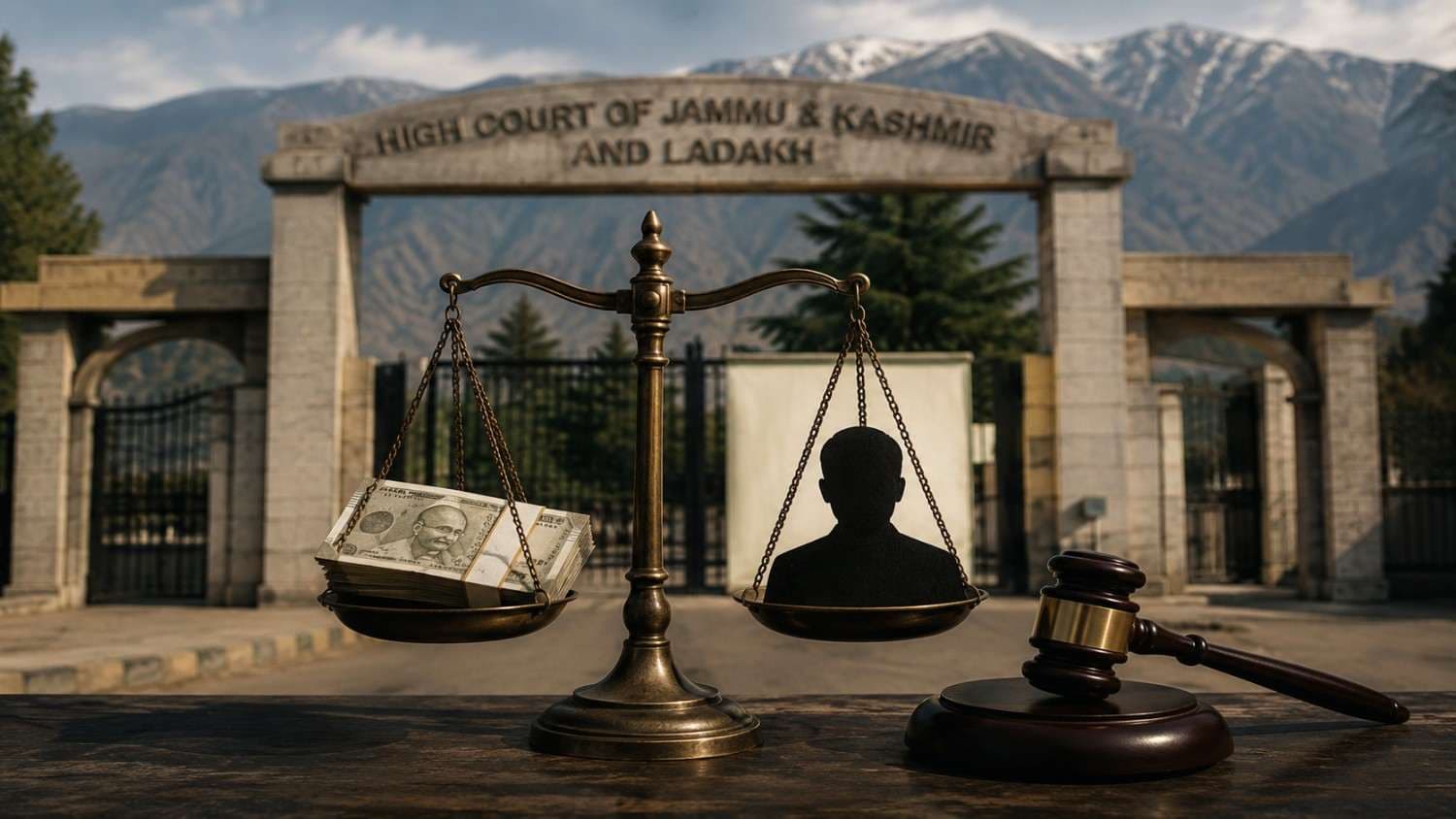
The High Court of Jammu & Kashmir and Ladakh has allowed an appeal and acquitted the accused in a corruption case, holding that a trap witness or bribe giver may be treated as an interested witness, being a person interested in the success of the trap.
The Court was hearing an appeal filed by the petitioner against his conviction under Section 5(1)(d) read with Section 5(2) of the J&K Prevention of Corruption Act. The trial court had convicted the accused primarily on the basis of the testimony of the complainant, who claimed to have paid the alleged bribe during the trap proceedings, and the recovery of the tainted money from the accused.
A Bench of Justice Sanjay Dhar, while allowing the appeal and acquitting the accused, observed that a trap witness may perhaps be considered as a person interested in the success of the trap and that may entitle a court to view his evidence as that of an interested witness.
The Court further observed that a Court may refuse to act upon the uncorroborated testimony of a trap witness where circumstances justify such a course, while it may rely upon such testimony where it is satisfied from the facts and circumstances that the witness is a witness of truth.
Adjudicating the appeal, Justice Dhar noted that in a corruption case involving demand and acceptance of illegal gratification, the prosecution is required to establish the initial demand of illegal gratification, demand and voluntary acceptance of the tainted money during the trap, and recovery of the tainted money from the accused.
The Court first examined the prosecution evidence concerning the initial demand. It noted that the five employees on whose behalf the complainant claimed to have collected the alleged bribe had categorically stated that they had neither contributed towards the bribe money nor had the accused demanded any money from them.
The Court further noted that the complainant himself had contradicted his complaint by stating during cross-examination that he had not collected Rs.300 each from his associates, although his complaint specifically recorded that he had done so. The Court held that this constituted a major contradiction concerning the alleged initial demand.
The Court also found significance in the fact that there was evidence of prior discord between the complainant and the accused. The complainant had been pressing for the engagement of his brother as a daily wager, while one of the witnesses had stated that the complainant had been dissatisfied with his work and had been seeking removal from service.
The prosecution case was that the complainant, Bashir Ahmad Dar, lodged a complaint before the Vigilance Organization alleging that the accused, who was working as Incharge Establishment in the office of the Block Development Officer had demanded Rs.300 from each of six Helpers for preparation of their arrears bills. According to the prosecution, the complainant collected Rs.300 each from five of his associates, making a total of Rs.1800, and approached the Vigilance Organization. A trap team was thereafter constituted and an independent witness, Nazir Ahmad Lone, was associated with the trap proceedings.
After the pre-trap proceedings, the complainant entered the office room of the accused while the shadow witness remained outside near a window. The prosecution alleged that after a brief conversation, the accused demanded and accepted Rs.1800 from the complainant and kept the money in the back pocket of his trouser. The complainant thereafter gave the pre-fixed signal, following which the trap team apprehended the accused. The tainted money was recovered from his trouser pocket and his hands and pocket were washed in sodium carbonate solution, which allegedly turned pink.
The trial court subsequently convicted the accused under Section 5(1)(d) read with Section 5(2) of the J&K Prevention of Corruption Act and sentenced him to two years' simple imprisonment and a fine of Rs.21,000.
During the appeal, the accused contended that the prosecution had failed to establish the demand and acceptance of illegal gratification beyond reasonable doubt and that the shadow witness had not actually witnessed the transaction. It was argued that the conviction could not be sustained on the sole uncorroborated testimony of the complainant.
The High Court, in setting aside the conviction, emphasised that while there is no absolute rule against relying upon the uncorroborated testimony of a trap witness, such evidence can be acted upon only where, having regard to the facts and circumstances of the case, the Court is satisfied that the witness is a witness of truth. In the present case, the Court found that the prosecution had failed to satisfactorily establish the initial demand, a key element of the offence, due to the contradictions in the complainant’s testimony and the denial by the alleged contributors.
The appeal was accordingly allowed, and the accused was acquitted of the charges. The fine imposed by the trial court was also set aside.